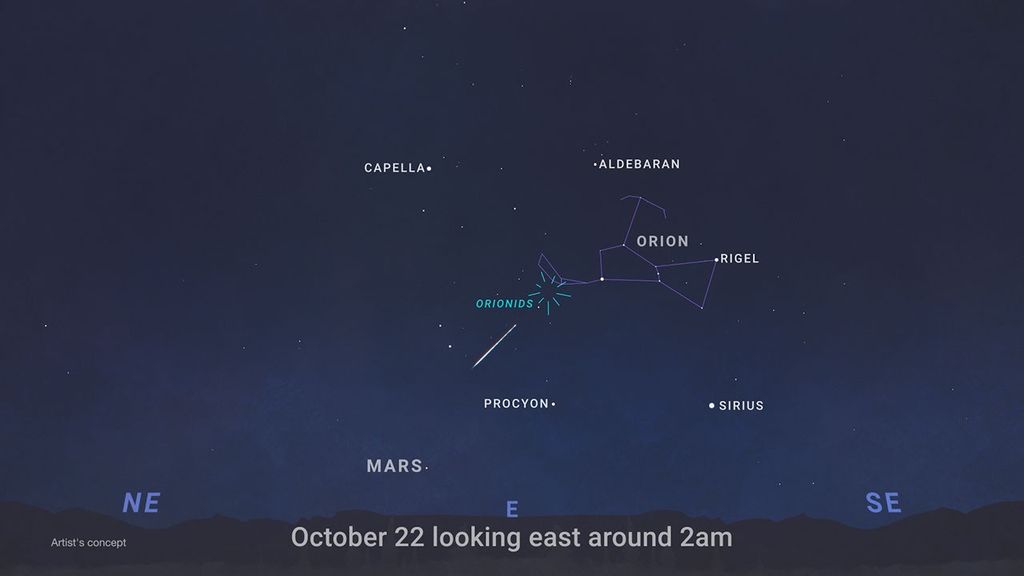
NASA’s October 2026 Orionid sky chart. The shower’s apparent radiant is near Orion, but meteors can appear across the sky. Chart: NASA/JPL-Caltech. Image source.
You do not have to wait for Halley’s Comet to return to see something it left behind. This October, Earth crosses one of its trails of debris, bringing the annual Orionid meteor shower. The best viewing requires a little planning this year: the Moon will brighten the sky through much of the night.
NASA’s October skywatching guide places the peak on the night of October 21 into the morning of October 22, 2026. It recommends looking in the hours before dawn, after the Moon has set. Check moonset for your own location before setting an alarm; a single clock time will not work for every reader.
The dates and the realistic expectations
- Peak night: October 21–22, 2026.
- Active period: October 2 to November 7.
- Where: Both the Northern and Southern hemispheres.
- What you need: A clear, dark sky and a comfortable place to watch.
NASA’s Orionid reference page gives a typical dark-sky rate of about 10 to 20 meteors an hour. Treat that as a guide to the shower’s potential. Moonlight, clouds, nearby lighting and your view of the sky can all reduce the number you actually notice. A quiet ten minutes does not mean the shower is over.
Why Halley’s Comet produces two showers
As Halley travels around the Sun, it sheds dust and other small material. Earth encounters that debris on its own yearly journey. The particles enter our atmosphere at roughly 66 kilometres per second, producing the brief streaks we call meteors. Some Orionids leave a luminous trail that lingers after the initial flash.
Halley’s debris also produces the Eta Aquarid shower in May. The comet itself last visited the inner solar system in 1986 and is expected back in 2061. The annual showers let us watch pieces of its history long before then.
Give yourself a wide view
The name Orionid comes from the shower’s radiant, the direction near Orion from which its paths appear to spread. You can see meteors across the sky, so there is no need to stare at that one point. Looking away from the radiant can reveal longer-looking streaks.
NASA’s general observing advice makes meteor watching an easy activity to start without equipment. Your eyes cover far more sky than a telescope. A reclining chair or blanket helps you stay comfortable while looking upward; an open area lets you watch more of the sky at once.
Choose a place you can safely and legally access, keep bright lights out of your view and give your eyes around half an hour to adjust. Bring another layer even if the evening feels mild. Checking the cloud forecast and local moonset beforehand is more useful than buying equipment for a single night.
The Orionids remain active on either side of the peak. If October 21–22 is cloudy, another clear predawn session can still be worth trying. For this year’s main event, the simplest plan is a dark location, a patient watch and the Moon below the horizon.
Leave a Reply