Dark Fires / Topics
Space & Astronomy
Explore space missions, planets, stars, galaxies, and the science behind new discoveries, with reporting grounded in observatories, mission teams, and published research.
-
Why One White Dwarf Would Look Green to Human Eyes
Astronomers calculated the perceived colors of white dwarfs from their spectra, finding a green example and a wider palette than the familiar name suggests.
-
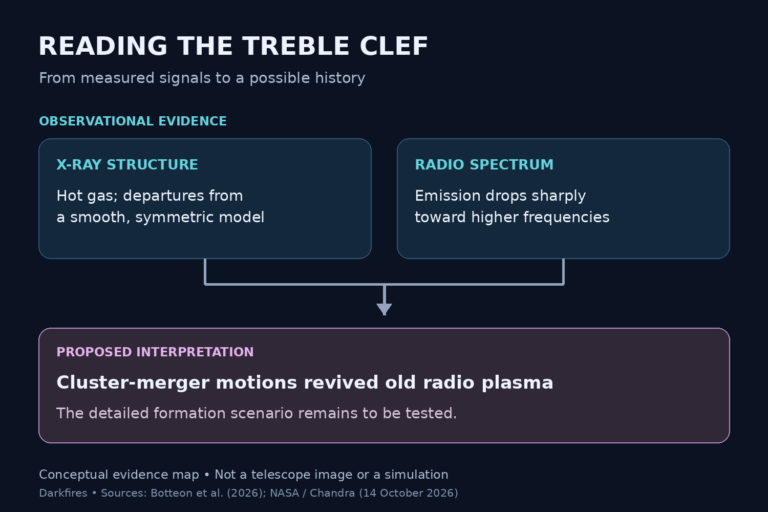
How a Galaxy-Cluster Collision May Have Revived the Treble Clef
New Chandra research links a striking radio source to a cluster merger. The observations support a revived-plasma interpretation, while its detailed history remains a model to test.
-
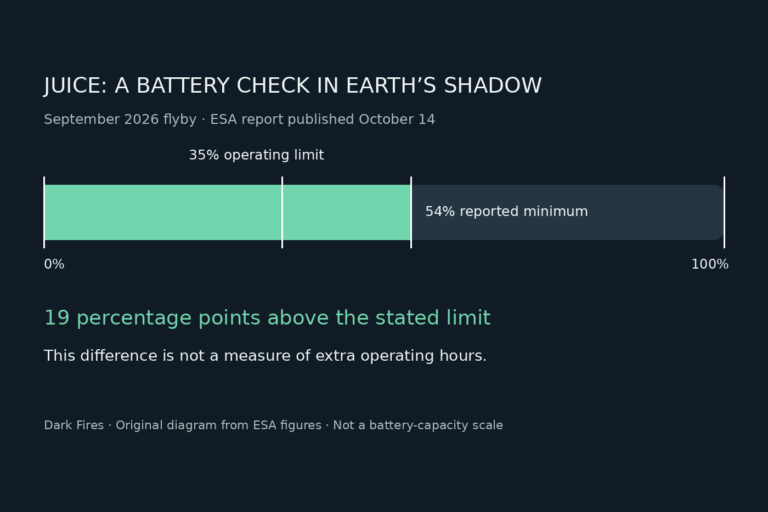
Juice’s Eclipse Test: What the 54% Battery Reading Means
ESA’s Earth-flyby report offers a real battery test for Juice’s journey to Jupiter. Here is what its 19-percentage-point margin establishes, and what remains to be tested.
-
Griffin-1 Clears JPL Tests Before Its Planned Lunar Journey
Voyager’s lunar lander has completed environmental testing at JPL and returned for final assembly ahead of its planned Moon mission.
-
Why Waves Grow Unevenly Along Earth’s Magnetic Boundary
New simulations connect uneven wave activity around Earth’s magnetosphere to the way the solar wind’s magnetic field wraps around the planet’s magnetic environment.
-
Webb Finds a Possible Young Supernova in the Early Universe
The NEXUS survey found a rapidly brightening source at redshift 5.017. Researchers favor a young stellar explosion, while its exact classification remains uncertain.
-
A New Solar Model Filters Out “Ghost” Activity on the Sun’s Far Side
Researchers have developed a way to weigh uncertain far-side solar signals before adding them to magnetic maps, improving the information available to space-weather models.
-
Artemis III’s Boosters Are Stacked as NASA Prepares a Propellant Test
NASA has finished stacking Artemis III’s solid rocket boosters and installed its four main engines, moving the Earth-orbit demonstration mission toward a launch-pad propellant test.
-
Student CubeSats Launch Toward the ISS for Radio and Radiation Tests
PROVES-Maia and PROVES-Taygeta launched on 13 October, taking student engineering and amateur-radio experiments toward the space station.
-
ESA and Astronomers Team Up to Reduce Satellite Interference
ESA and the IAU’s dark-sky centre will work on satellite design and operations to reduce optical and radio interference.