Artemis III has reached another assembly milestone at Kennedy Space Center. In an October 13 progress update, NASA reported that its teams have finished stacking the Space Launch System rocket’s solid boosters and installed all four RS-25 engines on the core stage.
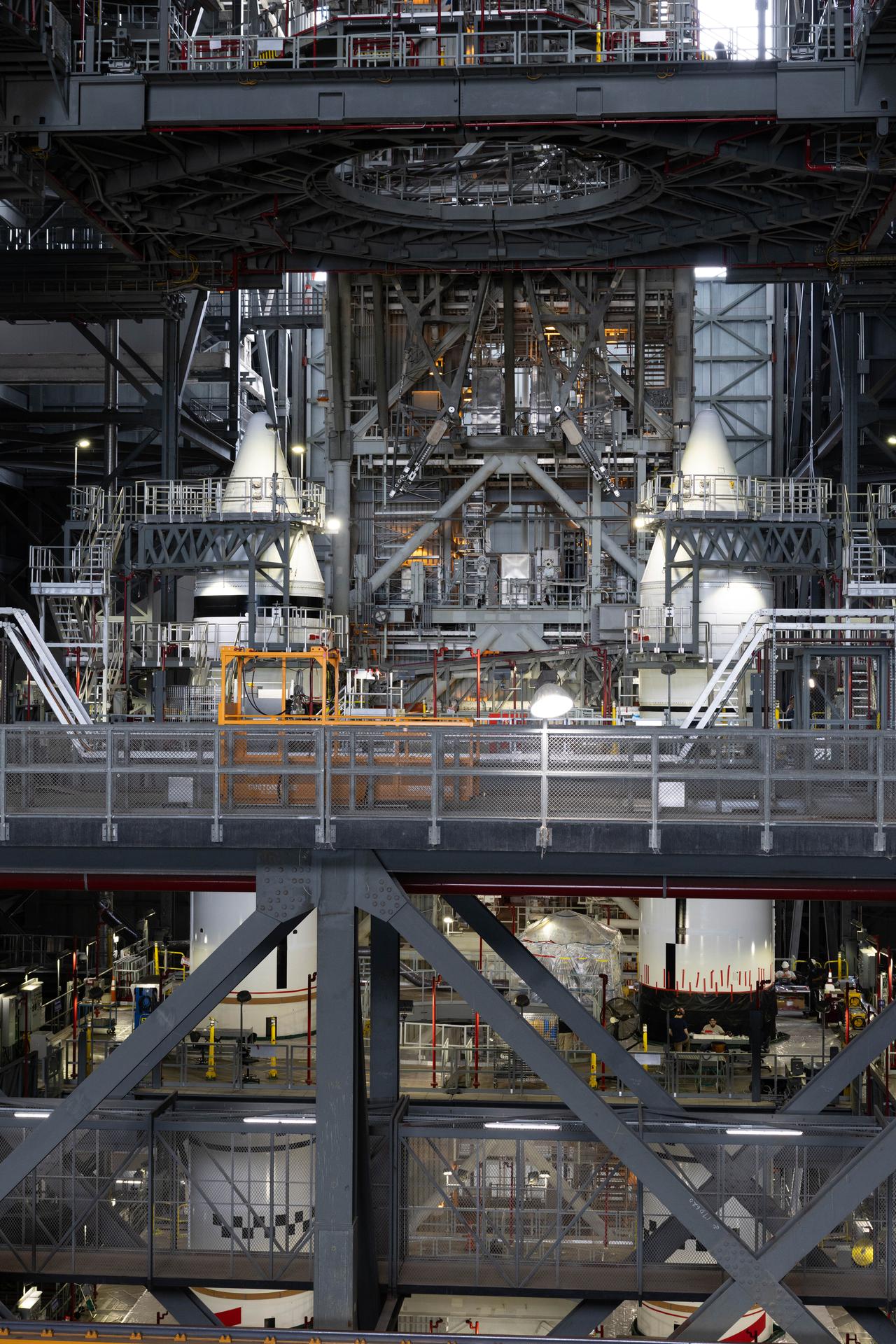
The next major assembly step is to connect the core stage to the boosters, producing a shortened configuration for a propellant-loading test. Before that, workers will install a tunnel along the core stage that carries pyrotechnic wiring. NASA expects the combined hardware to travel to Launch Pad 39B in the coming months.
The test will let the launch team practice loading propellant and following the associated procedures and timelines. The four-person crew will also rehearse parts of launch day, including suiting up, traveling to the pad and walking the emergency exit route. These are preparation activities; the update does not announce a launch date.
An Earth-orbit rehearsal for future lunar landings
The destination is important. NASA’s current Artemis III mission description places this flight in low Earth orbit, with launch planned for 2027. Its purpose is to demonstrate systems needed for later lunar landings, beginning with Artemis IV.
SLS will launch the astronauts aboard Orion. The planned work includes rendezvous and docking demonstrations with one or both commercially developed human landing systems. Those landers are being developed to carry astronauts between lunar orbit and the Moon’s surface on subsequent missions. Artemis III gives the program an opportunity to evaluate critical operations close to Earth before attempting them farther away.
That context explains why a ground milestone matters. Rocket assembly, propellant handling and crew procedures must become a coordinated sequence before the mission can test spacecraft working together in orbit. The completed boosters are a tangible step in that sequence, while the upcoming tanking rehearsal remains a separate test still to be carried out.
Leave a Reply