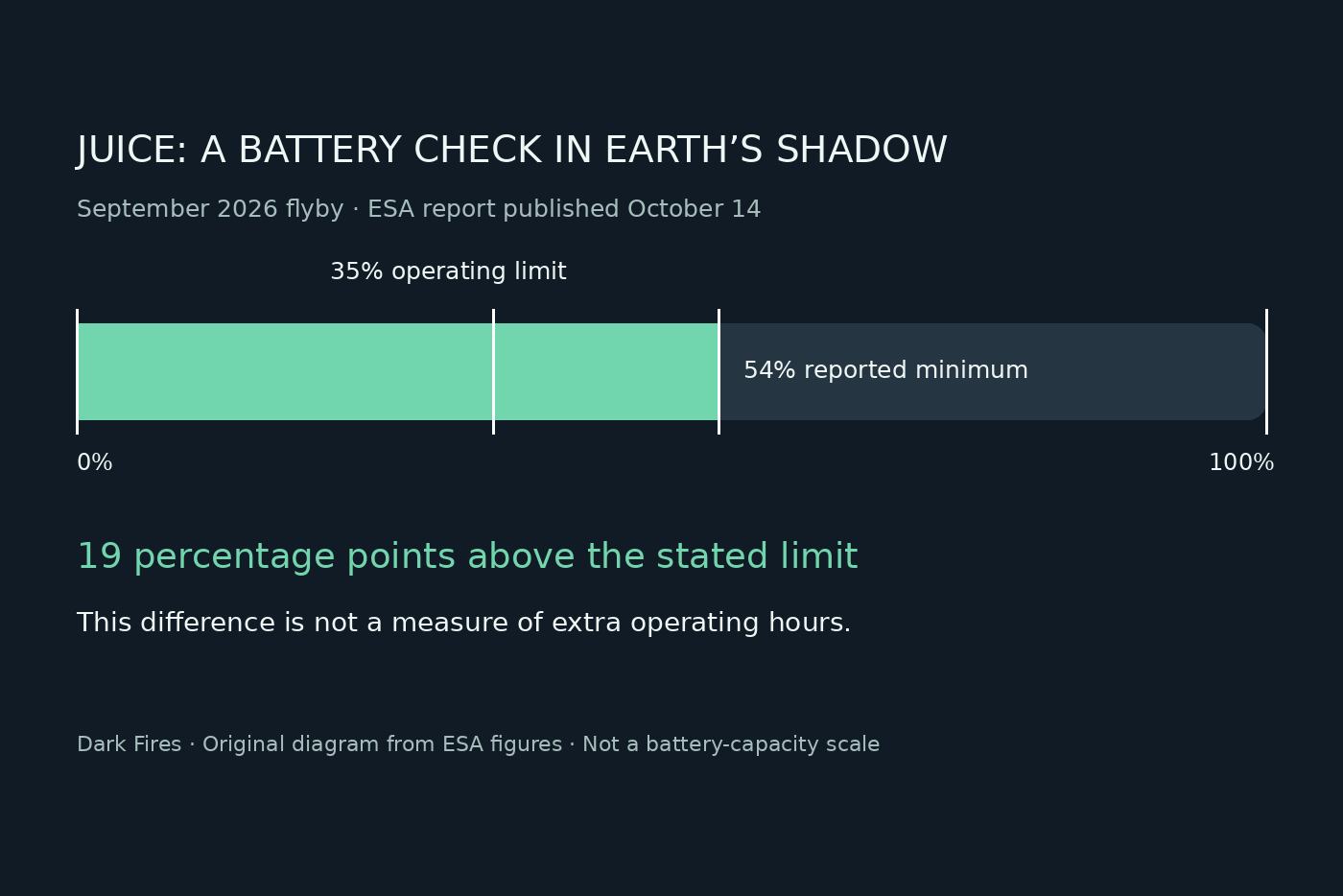
ESA’s October 14 account of Juice’s September 28 Earth flyby contains a more useful result than another beautiful view of our planet: a real test of how the spacecraft can keep working when sunlight disappears. The agency reports that Juice’s battery reached 54%, against an operational limit of 35%, during an eclipse that included three hours in full shadow. Several instruments kept operating. That is encouraging evidence for mission planning, with important limits on what can be inferred from it.
A margin measured in percentage points
The reported minimum was 19 percentage points above the stated operational limit. This is a subtraction of ESA’s two published figures, not an estimate of extra observing time. A battery reading alone cannot tell us how many more hours a spacecraft could safely run: that calculation would need the power demand, usable battery capacity, temperature and operating rules.
That distinction matters when reading an engineering success story. A spacecraft can finish a test with charge to spare while still facing a tightly constrained science schedule. The useful question is which instruments ran, for how long, under which conditions, and how closely the measured power use matched the team’s prediction.
Why so much solar panel produces so little power
ESA’s spacecraft specifications describe two wings totalling 85 square metres, with 23,560 solar cells and a span of 27 metres. Their size is a response to the weak sunlight at Jupiter. The specification gives approximately 850 watts for the spacecraft’s systems and instruments there. During an eclipse, even a large array cannot collect sunlight that is blocked.
The mission’s technical payload overview identifies a lithium-ion battery alongside the solar array, and gives approximately 820 watts for the array at Jupiter under end-of-life conditions. These figures have different stated contexts; they should not be treated as contradictory measurements from the September encounter. Neither is a direct measurement of the spacecraft’s total power consumption throughout that eclipse.
A rehearsal with a clear boundary
In its October 14 operations report, ESA says all ten science instruments contributed to the wider flyby campaign, not that all ten operated together in darkness. The encounter also exercised EAGLE navigation software, which uses camera images of a moon’s illuminated edge. Analysis of that navigation test remains pending. At Jupiter, eclipses can last up to five hours.
Our assessment: the battery result validates a particular flight experience, not every future observing sequence. Five hours is longer than three, but simply scaling the reported battery drop would be misleading. Different instrument combinations and thermal conditions could change demand. The next useful evidence would be a comparison between the flight measurements and updated power simulations, followed by a defined observing plan for longer eclipses.
The flyby had a second job
The encounter was also part of Juice’s route to Jupiter. ESA’s September 21 preview explained the trade: planetary gravity assists reduce the fuel needed to reach the destination and preserve propellant for later orbital manoeuvres. It scheduled instrument observations of Earth and the Moon between September 23 and October 3, giving teams known targets against which to calibrate their instruments and analysis methods.
The mission overview lists a final Earth flyby in January 2029 and arrival at Jupiter in July 2031. Juice is intended to examine Jupiter, Ganymede, Callisto and Europa, including the moons’ potential as habitats. This week’s engineering account does not report a discovery of life or a new ocean detection. It describes part of the practical work needed to obtain reliable measurements when the spacecraft arrives.
What to watch next
- Power: whether updated models reproduce the measured battery behaviour and cover longer eclipses.
- Navigation: the eventual EAGLE test analysis, rather than assuming that running the software established its accuracy.
- Science planning: which instruments can operate together within the available electrical and thermal limits.
Those are concrete milestones. A successful rehearsal is valuable because it replaces some assumptions with flight data, while making the remaining assumptions easier to identify.
Reporting checked October 14, 2026. Diagram: Dark Fires, based on the two battery percentages in ESA’s October 14 operations report. The graphic does not show battery capacity or endurance.
Leave a Reply