A striking radio image nicknamed the “Treble Clef” may preserve the aftermath of two events: an old eruption from a supermassive black hole and a later collision between galaxy clusters. But the interesting question is not why the structure resembles musical notation. It is how astronomers distinguish a plausible reconstruction from a directly observed event.
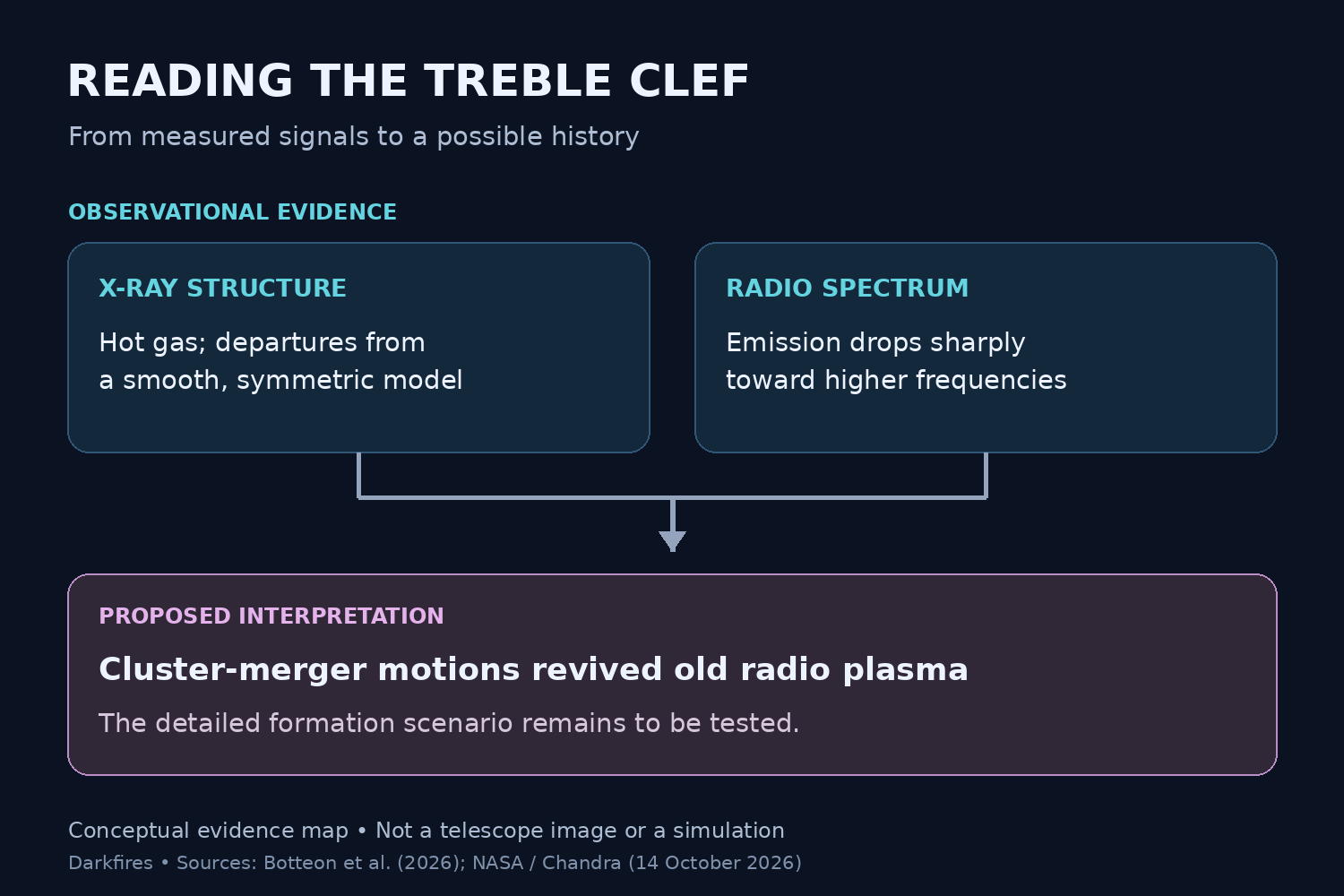
NASA’s October 14 release presents a composite of radio, infrared and X-ray observations. The target lies behind the Milky Way’s crowded plane. Chandra and eROSITA reveal hot gas associated with its host cluster; LOFAR supplies the conspicuous radio structure. Removing a smooth, approximately oval model of the X-ray emission exposes excess brightness on opposite sides of the center. The researchers interpret that pattern as evidence of a cluster merger.
That subtraction is important: the picture combines observations with processing designed to expose otherwise subtle structure. It is evidence from which a history can be reconstructed, rather than a recording of the collision itself.
What the new research establishes
The underlying study is “The Treble Clef radio phoenix and its old nonthermal filaments,” by Andrea Botteon and colleagues. Its first preprint appeared July 7, with a revision dated October 5. Today’s announcement therefore brings wider attention to research that was already publicly available.
The team classifies the source, catalogued as VLSS J0318.9+5755, as a radio phoenix: aged material from earlier black-hole activity that has become radio-bright again. Its radio spectrum falls exceptionally rapidly at higher frequencies, with spectral indices exceeding four in some regions between 400 and 650 megahertz.
The proposed history is more qualified than the nickname. The authors suggest that merger-driven gas motions compressed, stretched and redistributed old plasma. They explicitly describe this as one possible scenario and say that reproducing the detailed shape would require dedicated simulations. In their interpretation, mixing motions primarily shape the structure; it is not simply a tracing of shock surfaces. A possible surrounding radio halo also remains a candidate rather than an established detection.
Why faded plasma can brighten again
The physical idea predates this object’s new analysis. In work published in 2001, Torsten Enßlin and Gopal-Krishna modeled how fossil radio plasma could be revived by compression. Their calculations followed electrons through expansion, energy losses and later contraction after a radio galaxy’s central engine had stopped supplying the material.
Under suitable conditions, compression associated with the growth of cosmic structure could make even very old plasma visible again. The model predicted diffuse sources with exceptionally steep radio spectra, particularly accessible at low observing frequencies. This is a theoretical explanation for a population of objects, not a measurement of the Treble Clef’s individual past. Its value here is to explain why an old outflow need not simply disappear forever.
One image does not settle the mechanism
A useful comparison comes from a 2017 study of gently reenergized electrons in Abell 1033. That research examined a radio tail whose electrons appeared to receive enough additional energy to counter their losses. It also emphasized that identifying radio phoenixes by shape alone is uncertain: spectral and polarization information can help distinguish misleading lookalikes.
The comparison does not mean Abell 1033 and the Treble Clef share an identical mechanism. It shows why the broader scientific problem remains active. Astronomers must determine not only where radio-emitting material lies, but how its particles acquire, lose and regain energy in a moving environment.
The useful takeaway is therefore an evidential hierarchy. A memorable outline draws attention. Measurements across wavelengths establish the environment and particle behavior. Models then connect those measurements into a possible history. Keeping those steps separate makes the Treble Clef more interesting: it becomes a test of how cosmic collisions recycle old material, with important parts of the reconstruction still open to scrutiny.
Reporting checked October 14, 2026. Original explanatory graphic: Dark Fires, based on Botteon and colleagues and NASA/Chandra. It is a conceptual summary, not a telescope image or simulation.
Leave a Reply