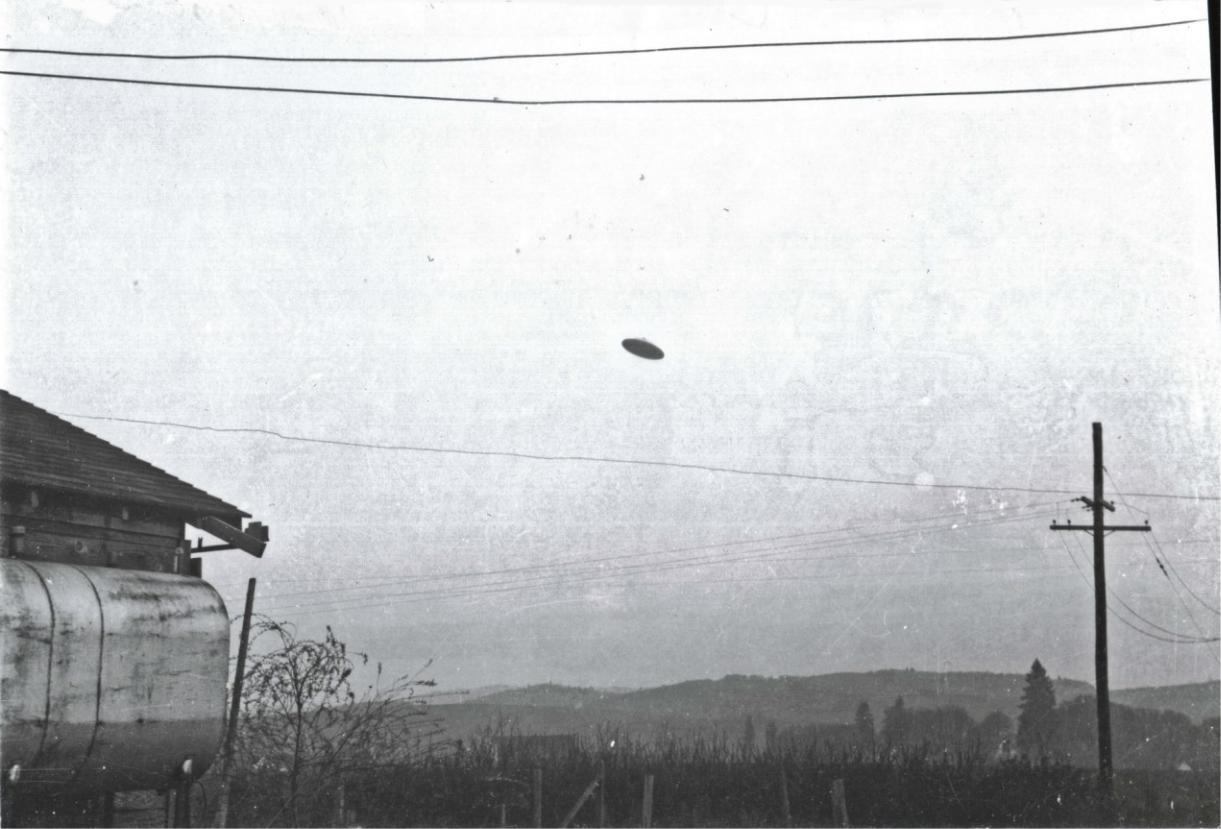
Two photographs associated with McMinnville, Oregon, have survived a debate far longer than the encounter they purportedly show. Paul and Evelyn Trent reported the sighting on May 11, 1950; the local Telephone-Register published the pictures on June 8. The useful question is not simply whether the photographs are “real.” A photograph can faithfully record either a distant object or a nearby model.
What Hartmann actually concluded
William K. Hartmann investigated the photographs for the University of Colorado UFO study. His Case 46 analysis, preserved in an NCAS transcription, describes examining the original negatives and interviewing the witnesses years after the event. He considered the evidence compatible with a large, distant object, but expressly did not claim to have excluded fabrication.
His strongest argument involved brightness. Atmospheric scattering can make a distant dark surface look paler. The object’s relatively bright underside therefore appeared significant. But estimating distance that way required assumptions about its surface reflectance and illumination. Hartmann also acknowledged that its position beneath the overhead wires in both exposures supported a suspended-model possibility.
This is why quoting only his favorable concluding sentence misrepresents the investigation. His analysis was conditional, and the alternative explanation was inside the report, not an objection discovered decades afterward.
Maccabee revisited the optical assumptions
Physicist Bruce Maccabee later argued that the brightness evidence still favored distance after additional corrections. In an archived version of his own analysis, he describes incorporating laboratory estimates of veiling glare, a film-exposure curve and field measurements of surface-brightness ratios. Veiling glare is light scattered within a camera that can brighten darker parts of an image.
Maccabee concluded that the underside remained too bright for an ordinary nearby white-paper surface under his model. His paper originated in the proceedings of a 1976 Center for UFO Studies conference; the linked version says it was modified in April 2000. The 2013 print timestamp visible in the PDF is not the date of a new investigation.
The important distinction is between improving a model and directly measuring an unknown object’s range. Maccabee’s work offers a competing optical interpretation, not a second camera position with an independently known baseline.
A later study argued for a suspended model
Antoine Cousyn, François Louange and Geoff Quick reached the opposite assessment in their 2013–2014 IPACO study. They examined geometry involving the object and wires, then used an image-processing method to search for a faint suspension thread. Their introductory chronology distinguishes an April 2013 study, a June supplement and a May 2014 update that included corrections to the software’s calculations.
The authors regarded the resulting evidence as decisive for a model. That remains their analytical conclusion: this article has not independently reproduced their processing. Readers should examine the input scans, reconstruction assumptions and detection procedure rather than treat a computer-assisted result as automatically assumption-free.
McMinnville is therefore more instructive as a disagreement about inference than as a slogan about authenticity. The surviving images permit serious analysis, yet distance, surface properties and photographic processing remain central to the competing explanations. Preserving those distinctions neither proves a spacecraft nor excuses a weak hoax argument. It makes clear what each analysis actually has to demonstrate.
Featured image: Paul Trent’s first McMinnville photograph, reported taken May 11, 1950. Paul Trent; public domain in the United States (published without a copyright notice). Scan reproduced in the IPACO analysis. The object’s identity and distance are disputed. Photograph reproduced in the IPACO report (PDF page 2). Public-domain provenance.

Leave a Reply