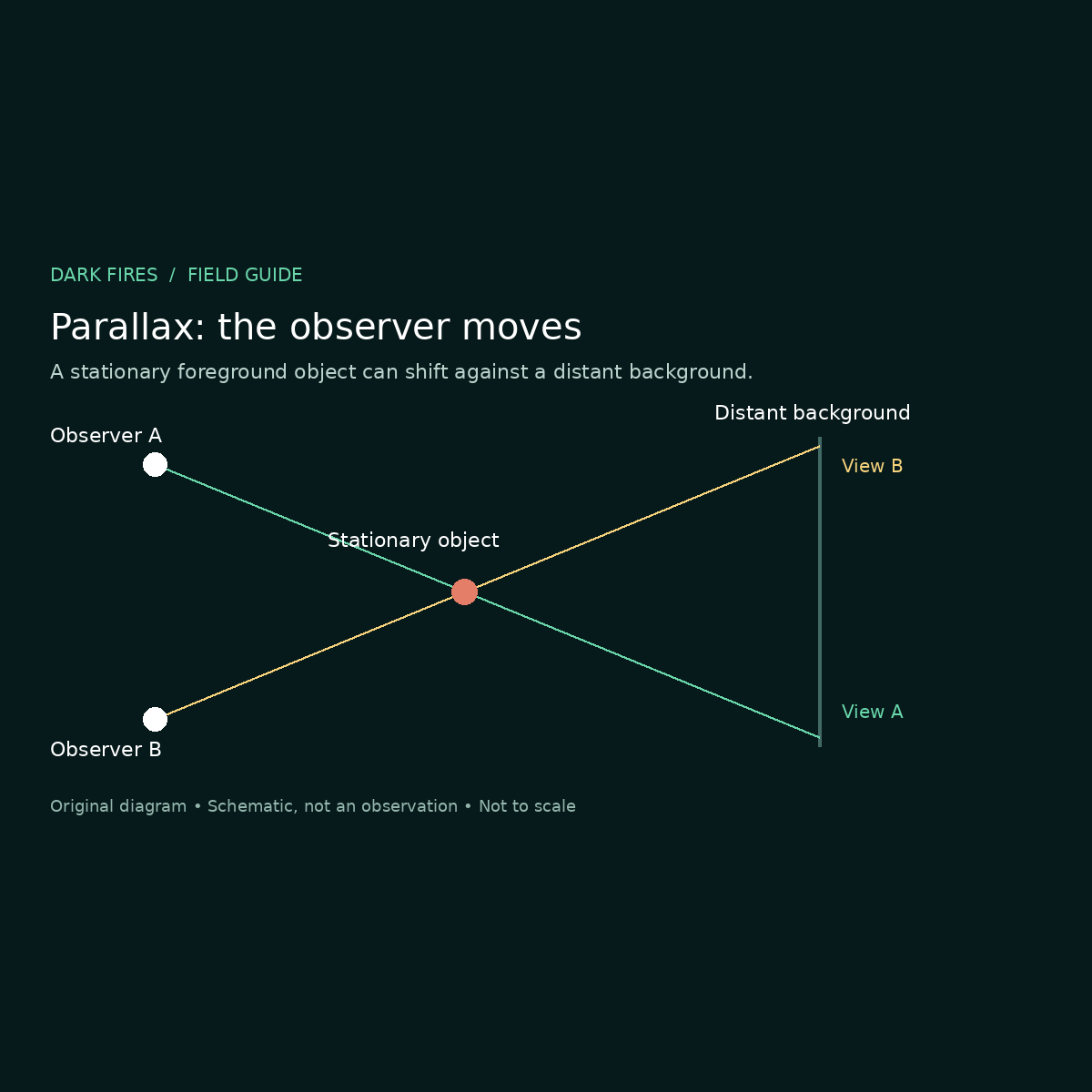
A UAP crossing a landscape in a moving aircraft’s video may be moving in the world, moving only in the image, or doing both. Before turning that crossing into a speed estimate, an investigator has to reconstruct the observer’s motion. Parallax is the geometric reason.
A change of viewpoint changes the view
ESA’s explanation of parallax uses an accessible demonstration: hold a finger still and alternate which eye is open. The finger shifts relative to the background even though it has not changed position. A nearer finger produces a larger displacement. Astronomers exploit the same underlying geometry, using known observing baselines to measure distances.
The lesson for a moving camera is not that a suspicious object must be stationary. It is that apparent motion combines the geometry of the scene with changes in the observing position. A background is a reference in the picture, not automatically a complete reference frame for physical speed.
A roadside experiment
Imagine riding as a passenger past a stationary fence post with a distant hill behind it. The post sweeps across the hill in your view. If a camera tracks the post, keeping it near the centre, the hill instead appears to slide behind it. Neither description requires the post to travel across the countryside.
Now replace the post with an airborne object whose range is unknown. Motion relative to the background remains measurable, but the reconstruction has more unknowns. The object could also be drifting or flying. To distinguish those possibilities, the analysis needs more than the speed at which scenery passes through the frame.
A real warning from aviation records
NASA’s Aviation Safety Reporting System discussed observer-dependent visual confusion in CALLBACK issue 246, published in December 1999. One report described observers initially interpreting lights from two separate aircraft as one rapidly approaching aircraft; the distinction became apparent when more lighting detail was visible. The bulletin emphasized the difficulty of night scenes with few surface references.
These are safety reports and teaching examples, not controlled experiments establishing what happened in an unrelated UAP encounter. Their value is narrower: experienced observers can share a compelling interpretation before enough scene information is available to test it.
What a reconstruction must keep separate
Record the camera platform’s position and motion, its viewing direction, and the object’s measured position within the image. Changing camera aim is not the same thing as moving the camera’s location. A reconstruction should account for both, rather than attributing every shift to the target.
Then test plausible ranges and trajectories. Does a slow or stationary object fit the observed sequence once observer motion is included? If several solutions fit, state that ambiguity. If none fits, identify the residual mismatch instead of declaring that parallax has been “ruled out” without showing the geometry.
Parallax is neither a universal explanation nor a dismissal of witnesses. It is a necessary bookkeeping step: separate movement of the viewpoint from movement of the thing being viewed before deciding how extraordinary the latter really is.
Image: Original diagram by Dark Fires. The two sightlines illustrate changed alignment; this is not an observed UAP track and is not to scale.
Leave a Reply