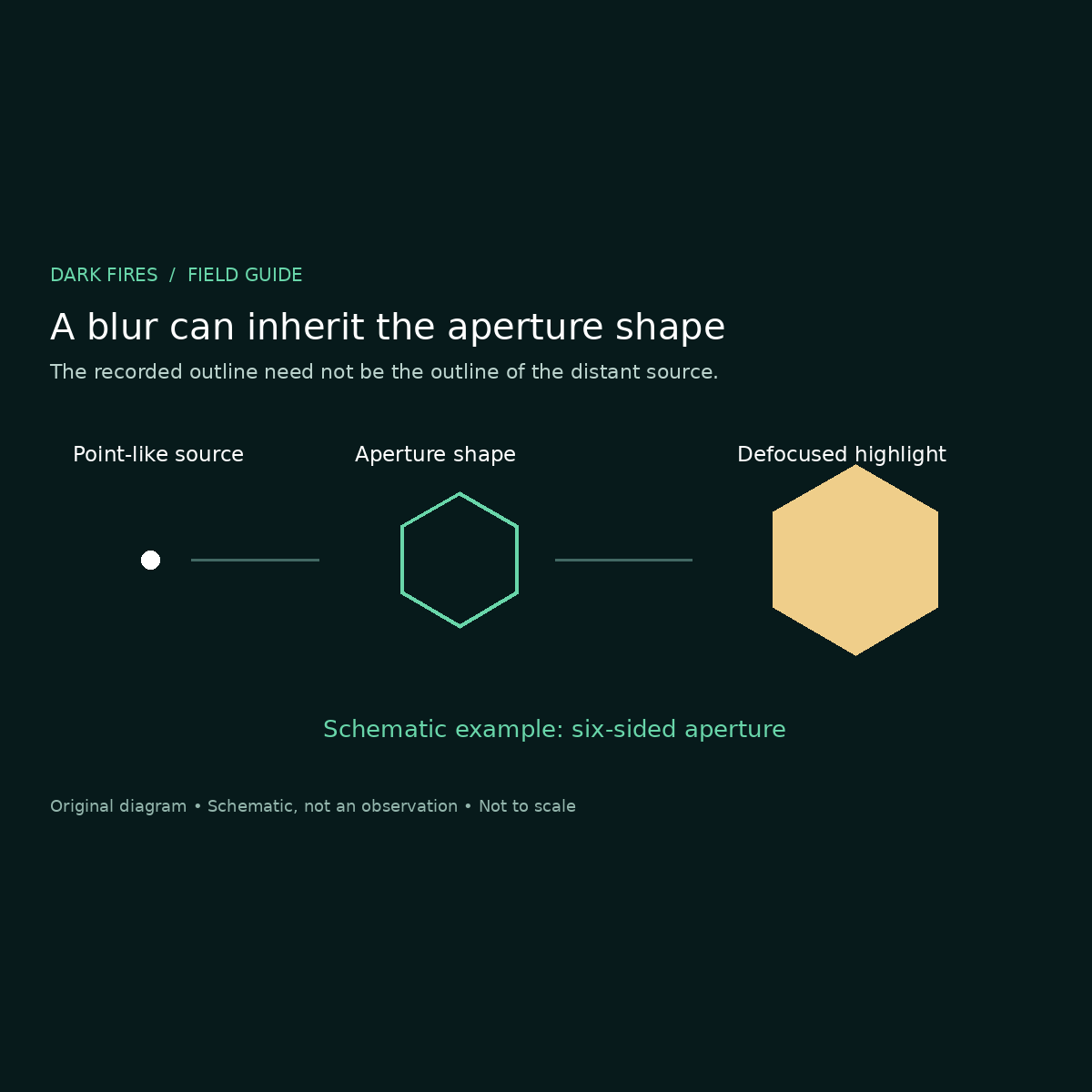
A glowing polygon in a night-sky photograph is not automatically a polygonal object. Before interpreting its edges as the shape of a UAP, ask a more basic question: was the light in focus? An optical system can impose a recognizable outline on a source too small to reveal its own shape.
Where the polygon comes from
Nikon’s explanation of bokeh describes how the lens diaphragm affects out-of-focus highlights. A more circular opening produces rounder highlights; a more hexagonal opening can produce six-sided ones. This is a property of image formation, not evidence that the light source itself has six sides.
The term bokeh normally refers to the character or quality of out-of-focus rendering, rather than a special class of object. Canon’s 2025 beginner guide also describes the influence of aperture, lens choice and the separation of subject and background. Familiar decorative-light photographs deliberately exploit this effect.
Those manufacturer explanations establish an optical mechanism. They do not establish that a particular unexplained image was produced by it. Moving from “this can happen” to “this happened here” requires information about the actual recording.
A practical comparison
Suppose a video contains several unrelated distant lights. If all acquire similar polygonal outlines when focus changes, a shared camera effect becomes a strong candidate explanation for the common shape. If one light alone has a stable, sharply resolved structure while other objects are demonstrably in focus, the same inference is less straightforward.
That comparison is an analytical proposal, not a universal diagnostic. Sources at different distances may not share focus, and brightness differences can make them appear unlike each other. A test should preserve those complications rather than selecting only the frames that resemble the desired answer.
Test the equipment, not just the silhouette
A useful reconstruction uses the same camera and lens, with the original focal length, aperture and focus behaviour documented as closely as possible. Photograph a known distant light under comparable conditions, then vary focus while retaining the original recordings. The question is whether the system can reproduce the observed shape under relevant settings—not whether some camera somewhere can make a similar blob.
Do not treat every camera as having an adjustable, multi-bladed aperture. Determine what the actual device uses. Nor should a demonstration with one setting silently stand in for an event recorded with another. A convincing optical explanation is specific enough to make a testable prediction.
Where the original device or settings are unavailable, the appropriately limited conclusion may be that defocus is plausible but unconfirmed. An enlarged crop alone cannot provide the missing camera history.
What remains unexplained
Explaining the outline is not necessarily identifying the source. A defocused light could still require separate investigation of its location, motion and timing. Conversely, not reproducing one outline immediately does not demonstrate an exotic craft. Keep two questions separate: what emitted or reflected the light, and what did the camera do to that light?
Image: Original diagram by Dark Fires. The six-sided example illustrates an optical possibility; it is not a reconstruction of a reported UAP.
Leave a Reply