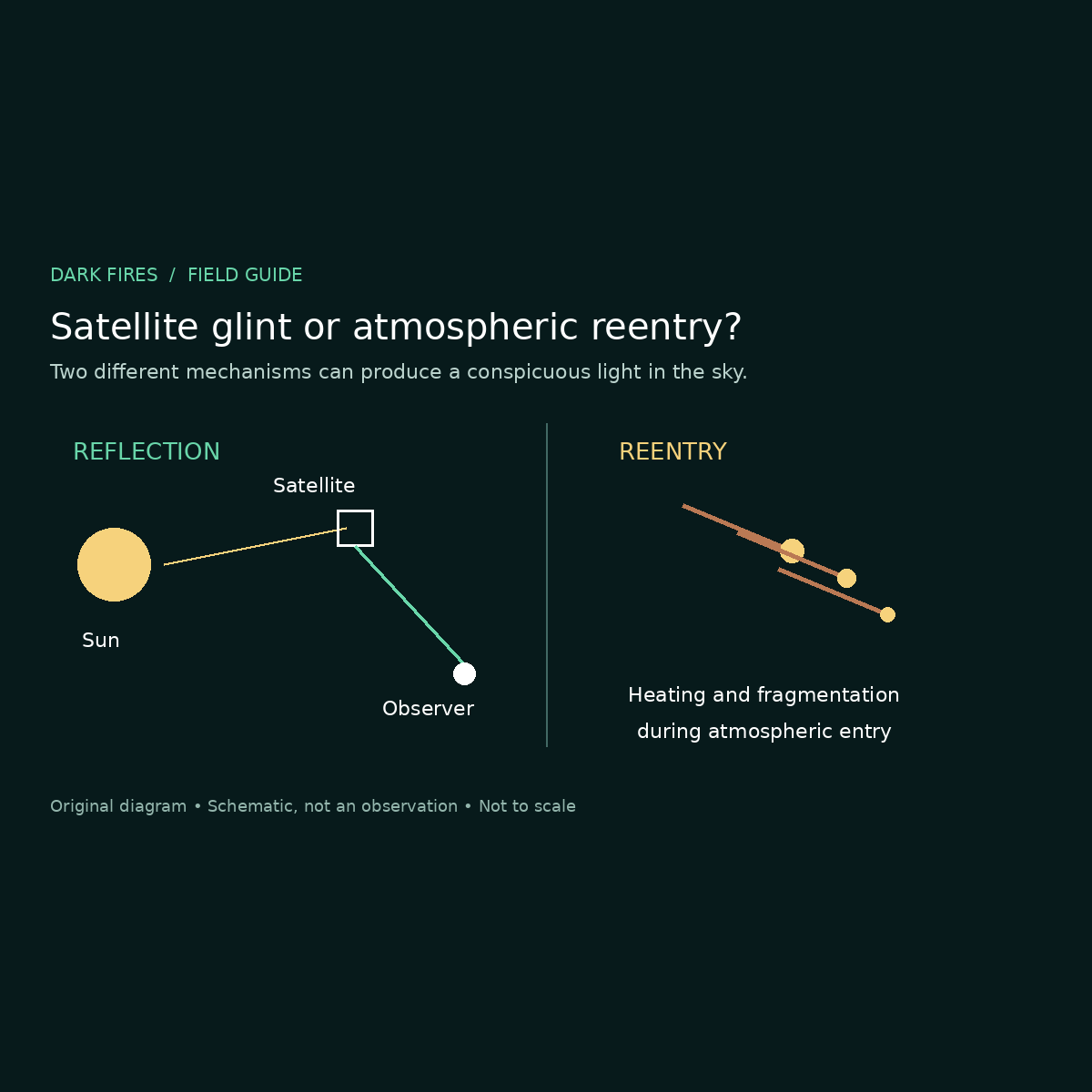
A satellite brightening dramatically and a spacecraft breaking apart during reentry are not the same phenomenon. One can be a change in reflected sunlight; the other involves passage through the atmosphere. Distinguishing those mechanisms gives a UAP investigation better questions than simply asking whether a light “looked like a satellite.”
A flash does not require an explosion
In a paper submitted to arXiv on May 21, 2024, Anthony Mallama and Richard E. Cole investigated extreme Starlink flares. They found that strong specular reflections—sunlight preferentially directed toward an observer—could account for the brightness they examined. They also applied their analysis to a flare reported as a UAP by pilots of two commercial aircraft.
This is a specific research analysis, not evidence that every cluster of unusual lights is Starlink. Its useful general lesson is that apparent brightness can change sharply because illumination and viewing geometry change, without a corresponding explosive event or burst of propulsion.
There is also a less dramatic way for an orbiting object to disappear. NASA’s Spot the Station FAQ explains that the International Space Station is visible by reflected sunlight and can leave view when it enters Earth’s shadow. The observer’s darkness and the spacecraft’s illumination are different questions.
Reentry is a different physical process
NASA’s Orbital Debris Program Office describes spacecraft entering the atmosphere after natural orbital decay or a controlled manoeuvre. Aerodynamic forces can exceed structural limits, breaking a vehicle apart; fragments then continue descending and experiencing heating. Some materials and components survive longer than others, and some can reach the ground.
A group of luminous fragments can therefore be consistent with a reentry. But “consistent with” is not a confirmed identification. The visual description alone does not name the spacecraft, establish its orbit, or exclude other luminous events.
Build two hypotheses, not one label
For a reflection hypothesis, ask whether a candidate satellite’s predicted position and direction fit the observation at the recorded location and time. Then ask whether its illumination and viewing geometry make the brightness behaviour plausible. A brightening by itself answers neither question.
For a reentry hypothesis, compare the observation with the relevant object’s trajectory and reentry information. Note whether the recording shows distinguishable fragments, how their relative positions change, and how that evidence fits the proposed event. Do not assign a universal duration threshold: an observer may capture only part of an event.
These are proposed lines of investigation, not a claim that a casual observer can derive a secure identification from appearance. A match should account for the sequence, not merely one impressive frame. A missing catalogue match is also not positive evidence for an extraordinary alternative.
Keep the mechanism and the identification separate
“Possible reflection,” “possible reentry” and “identified satellite” represent different evidentiary stages. Preserve that distinction in the headline and conclusion. Ordinary space activity supplies testable explanations for some striking lights, but selecting the right explanation still requires event-specific records.
Image: Original diagram by Dark Fires comparing reflection and atmospheric entry. It is conceptual, not an observation or a reconstruction of the 2024 paper’s case.
Leave a Reply