On October 1, 1948, North Dakota Air National Guard pilot George F. Gorman reported pursuing an unexplained light near Fargo. The familiar label “UFO dogfight” compresses a complicated record into a dramatic conclusion. A better starting point is what the early Air Force documents actually describe—and which parts were observations rather than measurements.
A pursuit described through a single light
An Air Force intelligence report bearing a cover date of April 28, 1949, summarized Gorman’s account: while flying an F-51 near Fargo at approximately 8:30 p.m., he noticed an intermittent white light below him and attempted to intercept it. The summary described a 27-minute encounter and attributed apparent evasive movements and superior performance to the light. These are the report’s descriptions of the episode, not independently instrumented flight data. The document is available as a Project 1947 transcription of Air Intelligence Report 100-203-79, especially Appendix C, paragraphs s and its continuation.
The same summary contains a crucial limitation: the witnesses described a small white light without a visible structure attached. That is a very different evidentiary situation from observing a clearly outlined aircraft at a known distance. A light’s apparent movement across a cockpit is real as an observation, but converting that movement into an object’s speed requires its distance and the observer’s own motion.
What the additional witnesses add
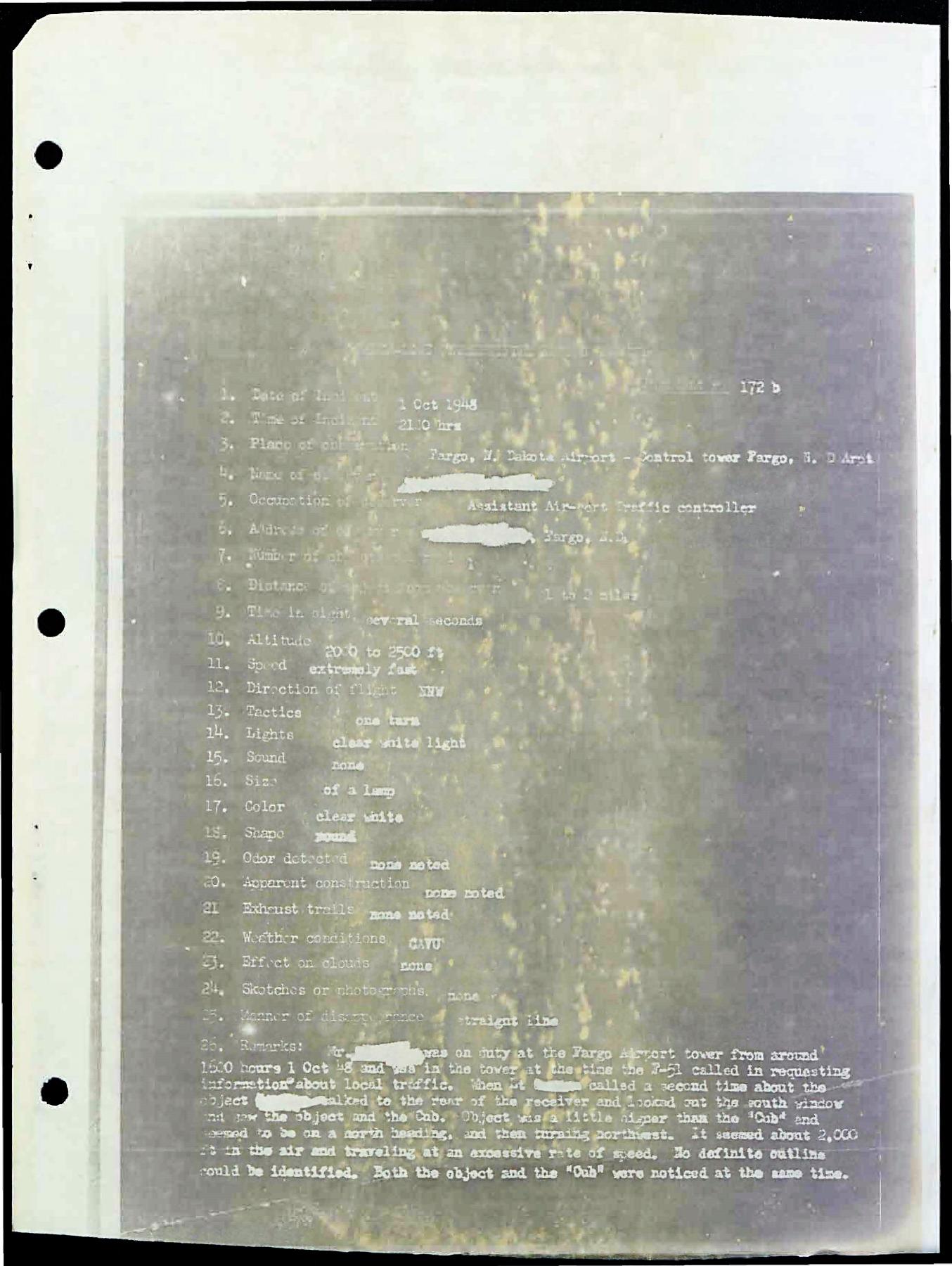
The University of Wyoming’s collection guide links copies of the Project Sign records preserved in the Richard F. Haines papers. In the digitized file, PDF page 11 records an assistant airport traffic controller’s observation. His form describes a white light, no identifiable outline and a brief view. It also records seeing the light and a Cub aircraft at the same time.
That matters: the case cannot fairly be reduced to one pilot reporting something nobody else noticed. But corroboration has a scope. A controller’s brief sighting of a light is not automatically confirmation of every turn, estimated speed or apparent response described during a longer airborne pursuit. The individual forms deserve to be read before their observations are merged into one narrative.
A provisional report, not a measured performance test
The 1949 intelligence summary stated that investigation had eliminated another aircraft or a meteorological balloon. That statement establishes the assessment expressed in this particular document. It does not, by itself, supply the underlying tests or make the conclusion immune to revision. The report’s broader introduction explicitly framed its analysis as provisional and said firm conclusions about the existence and origin of the reported objects were not substantiated.
Those two layers should stay together: investigators took the reports seriously, while the same document acknowledged limits in what could be established. Its speculation about possible origins is historical evidence of intelligence thinking, not proof that any proposed origin was correct.
Gorman remains useful as a record-review case because it separates three questions often collapsed into one: was a light reported by multiple people, did the pilot experience an apparent pursuit, and was extraordinary flight performance demonstrated? The early documents support taking the first two seriously. They do not provide a calibrated range-and-position record that independently settles the third.
Featured image: U.S. Air Force Project Sign witness-report page, October 1948. Public-domain federal record; archival copy courtesy of the American Heritage Center, University of Wyoming, Richard F. Haines papers, Collection 12722, Box 1. Archived Project Sign record (PDF page 11).
Leave a Reply