In the early hours of July 24, 1948, Eastern Air Lines pilots Clarence Chiles and John Whitted reported an unusual object passing their DC-3 near Montgomery, Alabama. Their account became one of the early UFO era’s best-known aviation cases. Reading the surviving documents reveals a distinction that dramatic retellings can lose: a government case file can contain several kinds of evidence, including estimates and material copied from newspapers.
A pilot explicitly called the speed an estimate
NICAP preserves a five-page reproduction of the witness statements, sketches and Air Force checklist. Whitted’s statement describes an object passing on the right, with a cigar-like appearance and what he interpreted as two rows of illuminated windows. He estimated a speed around 700 mph, but expressly qualified it as an estimate.
He placed the viewing duration between five and ten seconds and said he heard no noise and felt no turbulence from the object. These are significant features of his account. They should not be replaced with a claim that a measured shock wave or aircraft wake independently verified a close encounter.
Even an experienced aviator’s estimate does not supply a known distance to an unfamiliar light or shape. Without that distance, apparent angular motion cannot uniquely determine physical speed. Recognizing this limitation does not accuse the witness of dishonesty; it distinguishes an observation from a reconstructed trajectory.
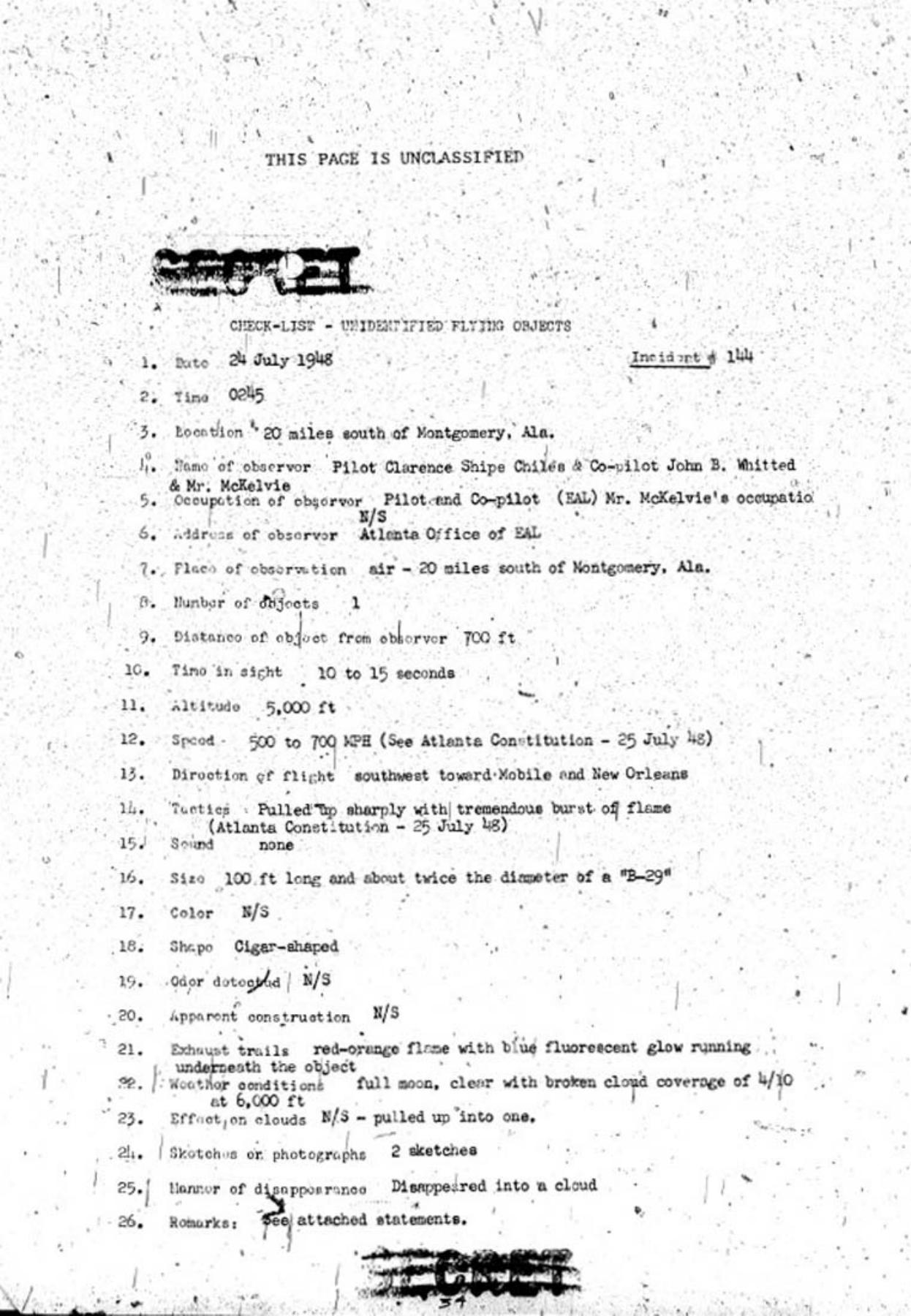
The checklist names its newspaper source
The last page of the same PDF is particularly revealing. Its speed entry cites the Atlanta Constitution of July 25, 1948. The entry describing an abrupt climb and a burst of flame cites that newspaper too. The checklist is an authentic part of the investigative record, but those particular entries are not an additional independent observation merely because they appear on an Air Force form.
There are also differences in numerical descriptions: the checklist gives ten to fifteen seconds in sight, whereas Whitted’s statement gives five to ten. These discrepancies do not automatically solve the case. They show why combining every dramatic detail into one seamless account overstates the precision of the surviving evidence.
How the fireball explanation fits the debate
Researcher Martin Shough’s later technical review argues that a fragmenting fireball remains viable. His proposed mechanism is that separated bright fragments can be interpreted as illuminated windows within a single vehicle, while changing viewing geometry can suggest a maneuver. He compares early statements with later accounts rather than treating all descriptions as equally contemporaneous.
That is a retrospective explanatory model, not a recovered instrument track of this event. It is useful because it identifies specific features an ordinary explanation would need to reproduce; it should not be upgraded into a measured reconstruction simply because it is plausible.
Even the chronology needs care. A later Air Force intelligence report, transcribed by Project 1947, assigns July 25 to its summary of the incident, while the case checklist records July 24. The newspaper citation is also July 25. The distinction between event date, newspaper date and later compilation is precisely what archival reading must preserve.
The Chiles–Whitted record documents a striking report by two pilots. Its strongest historical lesson is not that every reported detail was independently verified, but that source provenance matters inside an official file as much as outside it.
Featured image: U.S. Air Force checklist for Incident 144, July 24, 1948. Public-domain federal record, reproduced in NICAP’s archive. Its entries include explicitly attributed newspaper material. Archived Air Force checklist (PDF page 5).
Leave a Reply