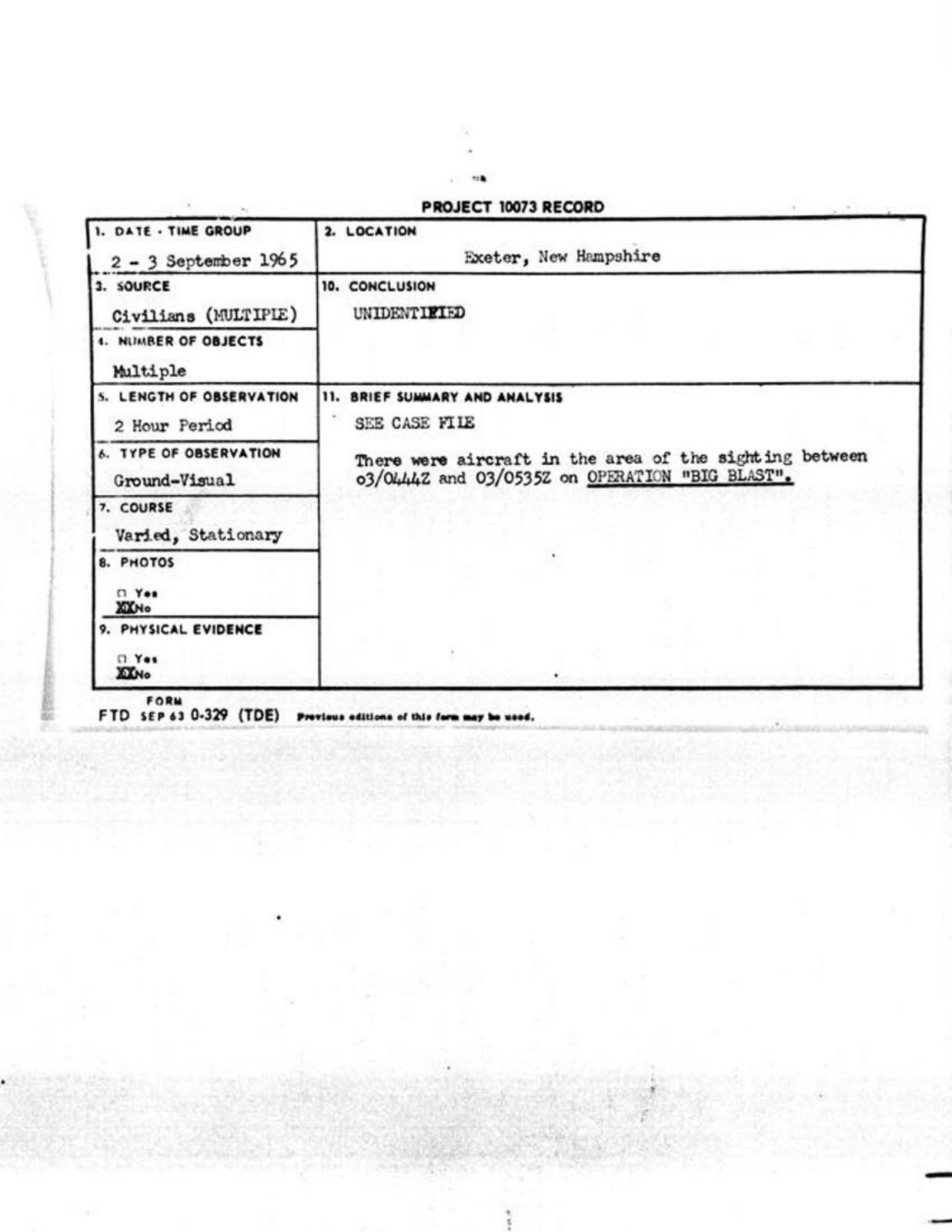
The Exeter, New Hampshire, UFO case is often presented as a contest between three witnesses and an aircraft explanation. The surviving Air Force file shows something more useful: investigators checking competing timelines, witnesses challenging an explanation, and a case summary that retained an unidentified conclusion. None of those facts establishes an extraterrestrial visitor.
The sighting and the first military assessment
The central encounter was reported in the early hours of September 3, 1965. The people named in the initial military report were Norman Muscarello and Exeter police patrolmen Eugene Bertrand and David Hunt. The Blue Book records reproduced by NICAP contain a September 15 report from Pease Air Force Base describing five bright red lights that appeared to move together. The report labels the observation ground-visual, not radar tracking, and preserves estimated positions and motion supplied by witnesses.
On PDF page 36, Major David H. Griffin reported that he had not identified a probable cause. He considered the observers reliable and said he had inspected the area. He also noted B-47 aircraft activity, but did not believe it explained the sighting. That is an investigator’s contemporary judgment. Reliability is relevant to whether an account deserves investigation; it does not turn an estimated altitude into a measured one.
Aircraft activity was a real lead, not a completed identification
The file documents an effort to check military operations rather than merely invoke them. An Eighth Air Force reply on PDF page 23 says the operational portion of the Big Blast “Coco” training mission was complete by 04:30 UTC on September 3. Ten participating B-47s from Pease were estimated to reach their initial approach fix between 04:44 and 05:35 UTC. The reply explains that Exeter lay within the recovery traffic pattern and lists the lights approaching aircraft might display.
These details support investigating aircraft as a possible explanation. They do not independently place a particular bomber at the witnesses’ reported location and time. An estimated arrival at an approach fix is also not a recorded landing time. Substituting one for the other makes a reconstruction look more precise than its source.
Time zones matter here. New Hampshire was on Eastern Daylight Time, four hours behind UTC: that stated approach interval corresponds to 12:44–1:35 a.m. locally. Those are conversions of the document’s operational estimates, not newly recovered observations.
The witnesses disputed the timing
In their December 2, 1965, letter, reproduced on PDF pages 20–21, Bertrand and Hunt objected to the public explanation and its effect on their professional credibility. They distinguished Muscarello’s earlier report from their subsequent visit to the site and placed their own observation nearly an hour after 2 a.m. They also described seeing what they thought was a high-altitude B-47 after the unusual lights disappeared.
The letter is important testimony about the witnesses’ position, not independent confirmation that their identification judgments were infallible. Conversely, documented aircraft activity elsewhere in the timeline does not automatically invalidate their account.
The file’s front summary marks the case unidentified and records no photographs or physical evidence. Read together, the pages establish a serious investigation with unresolved identification—not a measured demonstration of extraordinary flight. Exeter’s enduring value is the unusually visible paper trail: readers can compare the report, the operational information and the witnesses’ objections instead of choosing a verdict first and fitting the records around it.
Featured image: U.S. Air Force Project Blue Book case summary for Exeter, September 1965. Public-domain federal record, reproduced in NICAP’s document archive. Archived Blue Book record (PDF page 1).
Leave a Reply