Slow freezing followed by slow thawing can gather diluted molecular ingredients into cell-sized compartments and activate protein production, researchers report in an October 16, 2026 bioRxiv preprint. The study, highlighted by Astrobiology.com on October 23, has not been peer reviewed.
Tatsuya Shinoda and colleagues observed membrane material and chemically different dissolved molecules concentrating together in liquid regions confined by ice. As the samples slowly thawed, giant vesicles formed and enclosed the concentrated contents. The team also assembled a multicomponent protein-making mixture inside these compartments, obtaining activity from dilute preparations that showed little or none in bulk solution.
The result connects concentration, enclosure and biochemical function in one environmental sequence. The proposed advantage is physical concentration, bringing dispersed ingredients into a shared compartment rather than merely cooling a reaction mixture. It does not demonstrate a self-reproducing organism or show that the first cells followed this particular route.
A longer history of ice-assisted compartments
Research first published online in November 2016 had already shown that freeze–thaw treatment could trap DNA inside giant lipid vesicles. In that experiment, ice formation damaged existing membranes, allowing DNA to enter; thawing helped the membranes reseal. Heating alone did not achieve the encapsulation. The study followed membrane shape, ice formation and DNA uptake to test that proposed mechanism.
Those earlier experiments provide an important benchmark: enclosing genetic material was already achievable through temperature cycling. Any claim of a completely new connection between ice and protocells would overlook that record.
The protein-making machinery also deserves context. A 2005 methods paper by developers of the PURE system describes a cell-free setup reconstructed from essential elements of the Escherichia coli translation system. Its controlled composition lets researchers adjust the mixture and investigate protein production without an intact cell. Using such prepared machinery is a powerful laboratory test of organization, but it does not explain how that machinery originally evolved from prebiotic ingredients.
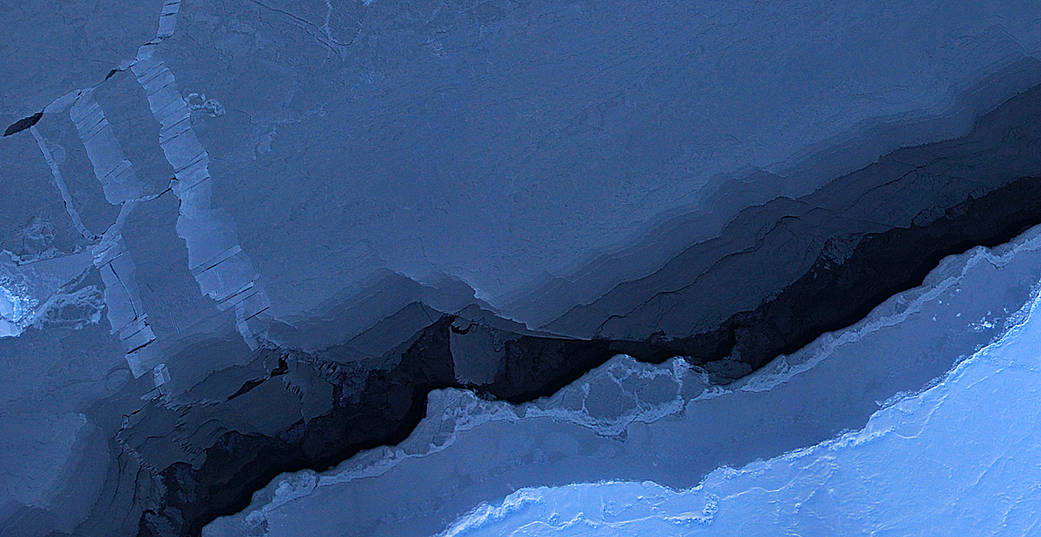
Featured image: Sea ice and open water in the Beaufort Sea in a NASA aerial-photo mosaic published in 2013. Context image only, not the laboratory experiment. Credit: NASA / DMS. Image source. Usage terms.
Leave a Reply