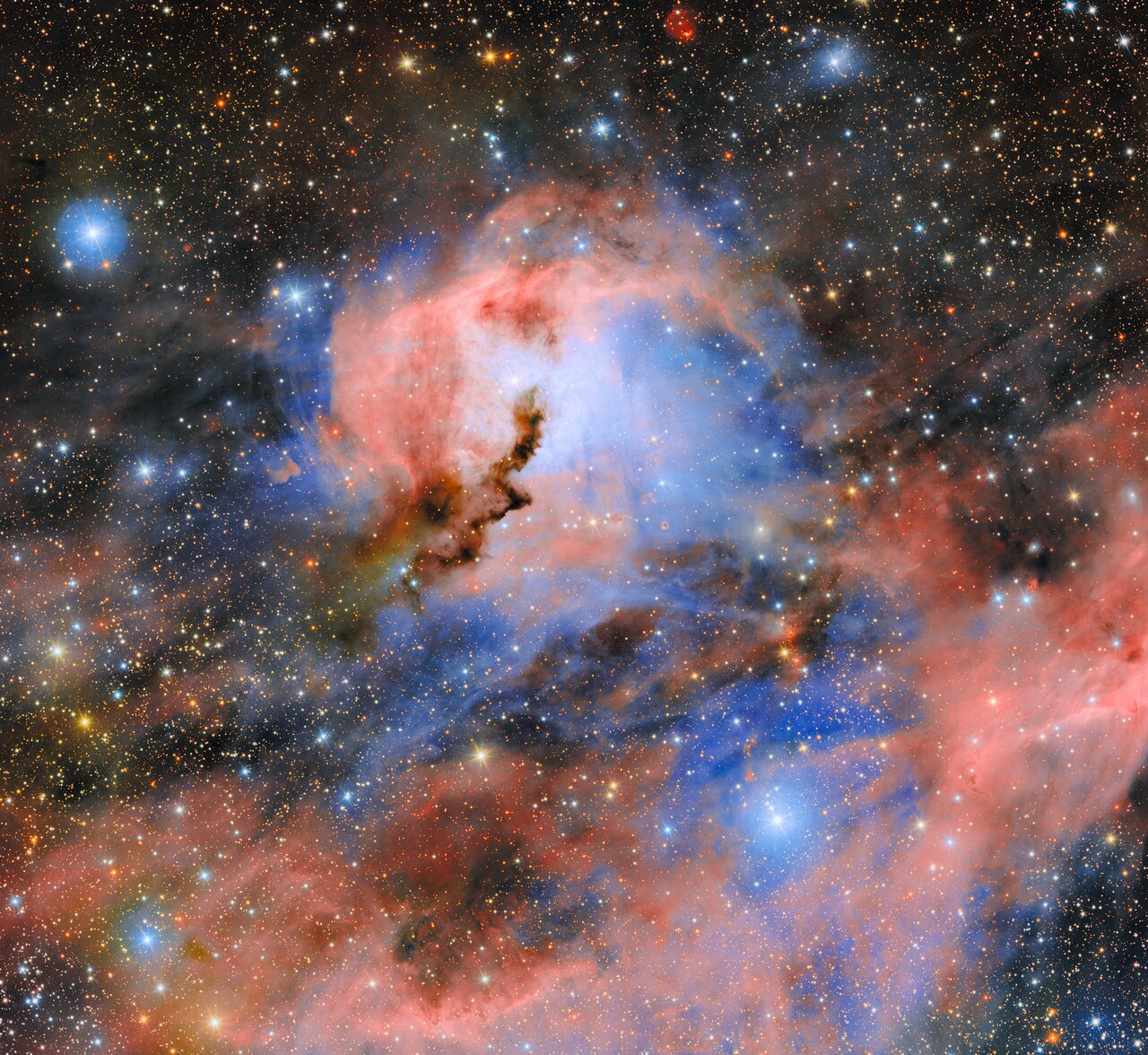
Pink clouds, blue haze and a dark ridge fill a newly released view of the Seagull Nebula. Rubin Observatory released the image on October 22, 2026, using observations made by its Commissioning Camera, or ComCam, in late 2024.
The scene shows the nebula’s head, about 3,700 light-years away. Ultraviolet light from young stars energizes hydrogen that appears pink; dust scattering starlight produces the blue glow. The image’s intricate structure also supplied a demanding test for the observatory’s image-processing software.
ComCam has since left the telescope and now supports testing in a summit clean room. The release therefore celebrates an earlier engineering contribution, rather than announcing a fresh observation by Rubin’s main survey camera.
Rubin’s account of its completed commissioning tests explains why that rehearsal mattered. Engineers checked how the telescope’s active optics maintained the shapes and positions of three large mirrors while pointing around the sky. They tested image quality through six filters and moved observations from Chile to the U.S. data facility at SLAC. The processing pipelines had to work as part of the same chain. Together, these steps tested much more than a camera: they exercised an observing system whose optical, mechanical, networking and computing components must cooperate reliably during repeated observations.
That repetition is central to the Legacy Survey of Space and Time, which Rubin says began in June 2026. Its ten-year program targets four broad areas: dark matter and dark energy, the Solar System’s population, the structure of the Milky Way, and objects that change in the sky. The observatory expects roughly ten terabytes of data per night. Researchers will work with the growing record through the Rubin Science Platform, connecting individual images to a much larger archive of positions, brightnesses and changes over time. The Seagull image offers a vivid glimpse of the preparation behind that effort.
The Seagull Nebula in late-2024 ComCam observations, released in October 2026. Credit: NSF–DOE Vera C. Rubin Observatory/NOIRLab/SLAC/AURA. Image Processing: T.A. Rector (University of Alaska Anchorage/NSF NOIRLab), D. de Martin & M. Zamani (NSF NOIRLab). CC BY 4.0. Image source · CC BY 4.0 license.
Leave a Reply