Amino acids can enter the dense forms of ice expected deep inside some ocean worlds, according to a study published in Science Advances on October 23, 2026. The result offers a possible way for organic ingredients to move through ice that would otherwise separate an ocean from the rocky interior beneath it.
Jihua Hao and colleagues used a diamond-anvil cell to test glycine and alanine at elevated pressures and temperatures. Both entered ice VI and ice VII, with greater incorporation into ice VII. Their calculations suggest that amino acids can become part of the crystal structure as the ice grows, rather than being excluded completely into the surrounding liquid.
The experiment establishes chemical compatibility, not transport across an actual moon. Whether moving ice supplies an ocean with useful ingredients remains a planetary-scale question. The work reports neither extraterrestrial organisms nor evidence that these amino acids were made by life.
Why an ocean needs connections
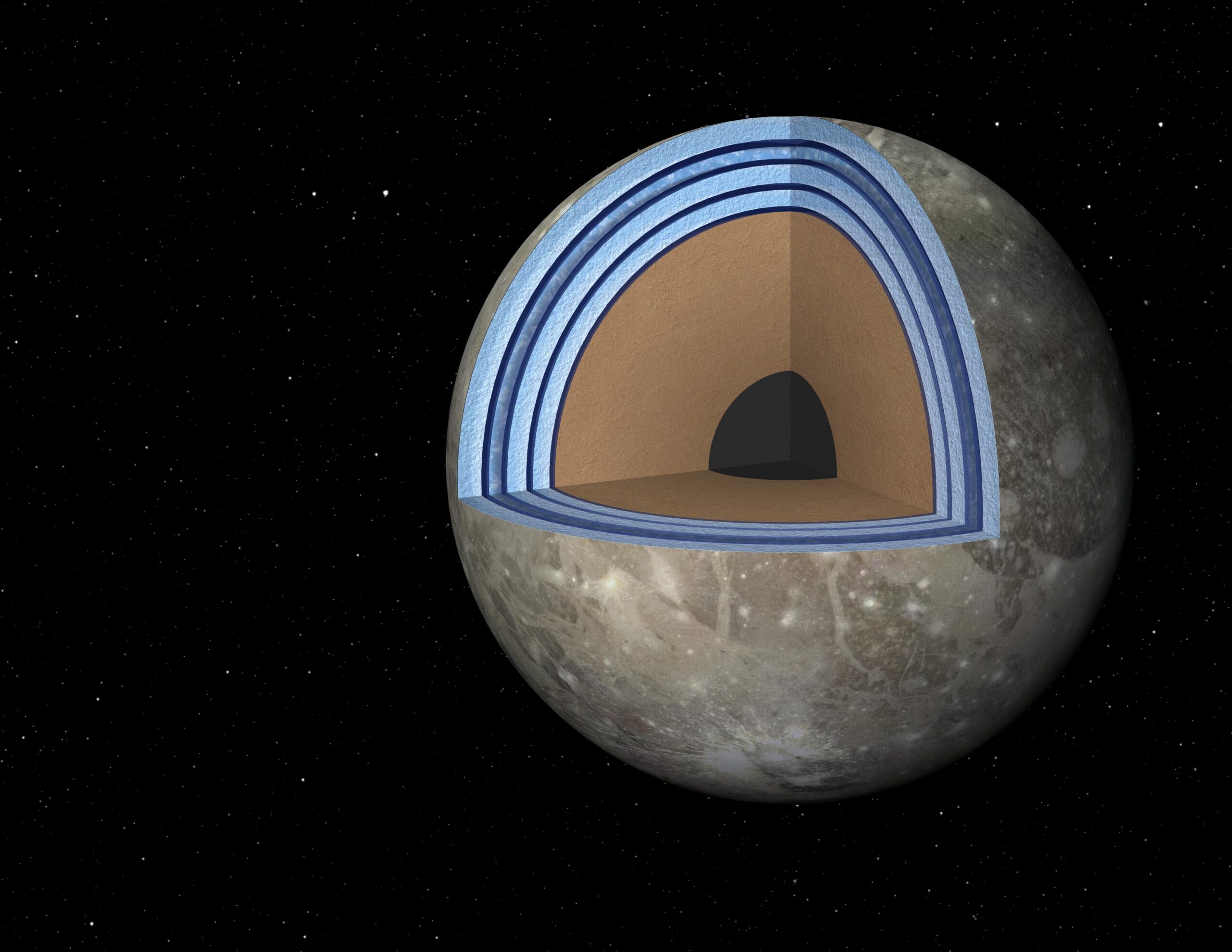
An ocean’s internal structure has long mattered to habitability studies. NASA-funded modeling reported in May 2014 examined Ganymede, Jupiter’s largest moon. Instead of a single ocean trapped between two ice layers, that work proposed a stack of liquid and solid layers. Ordinary surface ice is relatively light, while deeper, high-pressure forms can be denser than water.
Adding dissolved salts changed the model substantially. Sufficiently salty liquid could sink below the deepest ice and contact the rocky seafloor. Water-rock interaction matters because it creates opportunities for chemistry that isolated water would lack. The researchers described ice forming in an upper ocean layer and floating upward, while salts sank. Their modeled interior was therefore a dynamic arrangement, rather than a uniformly frozen barrier.
That earlier study also warned that a moon might never reach the modeled stable configuration. Ganymede’s proposed layers remain a theoretical framework for interpreting its interior, not a directly photographed cross-section.
Featured image: Artist’s concept of a layered Ganymede interior, published in 2014. This older model illustrates context, not the new experiment. Courtesy NASA/JPL-Caltech. Image source. Usage terms.
Leave a Reply