A study published October 7, 2026, in Astrobiology maps chemical differences inside solid organic films produced by electrical-discharge experiments. Christian Jenewein and colleagues examine how these films develop hollow, cell-like structures, offering a closer look at the physical settings in which prebiotic chemistry could become compartmentalized.
Electron microscopy and spectroscopy revealed that the material was chemically uneven. Different regions contained different mixtures of carbon-rich structures and products associated with hydrogen-cyanide chemistry. Hollow shapes appeared preferentially where the films met water. The authors connect this organization to local interactions among gas, liquid and solid material, rather than a uniform reaction throughout the apparatus. The authors also suggest that near-ultraviolet absorption could help shield fragile compounds.
Astrobiology.com highlighted the paper on October 22. That is the date of the renewed coverage, not the original publication.
From chemical ingredients to compartments
The work follows a PNAS study published online in December 2024 and in a January 2025 issue. That research used glass reactors and electrical sparks to explore a plausible early-Earth gas mixture. With water present, silica helped produce organic films built from hydrogen-cyanide-derived material. Hollow microscopic structures grew from the films into the water. The researchers proposed that such enclosed spaces could act as tiny reaction chambers, bringing compartment formation into the same experimental setting as the production of prebiotic compounds.
The wider experimental tradition has also shown why apparatus details matter. In a 2008 reanalysis of Stanley Miller’s preserved samples, a version that injected hot water mist into the spark chamber yielded a broader assortment of amino acids than the classic arrangement. That result concerned possible volcanic environments and chemical building blocks, rather than the creation of organisms.
The new film study likewise reports non-biological structures, not living cells. Its value is in testing where chemistry becomes organized. Whether comparable compartments supported the further steps required for life on early Earth remains a separate question.
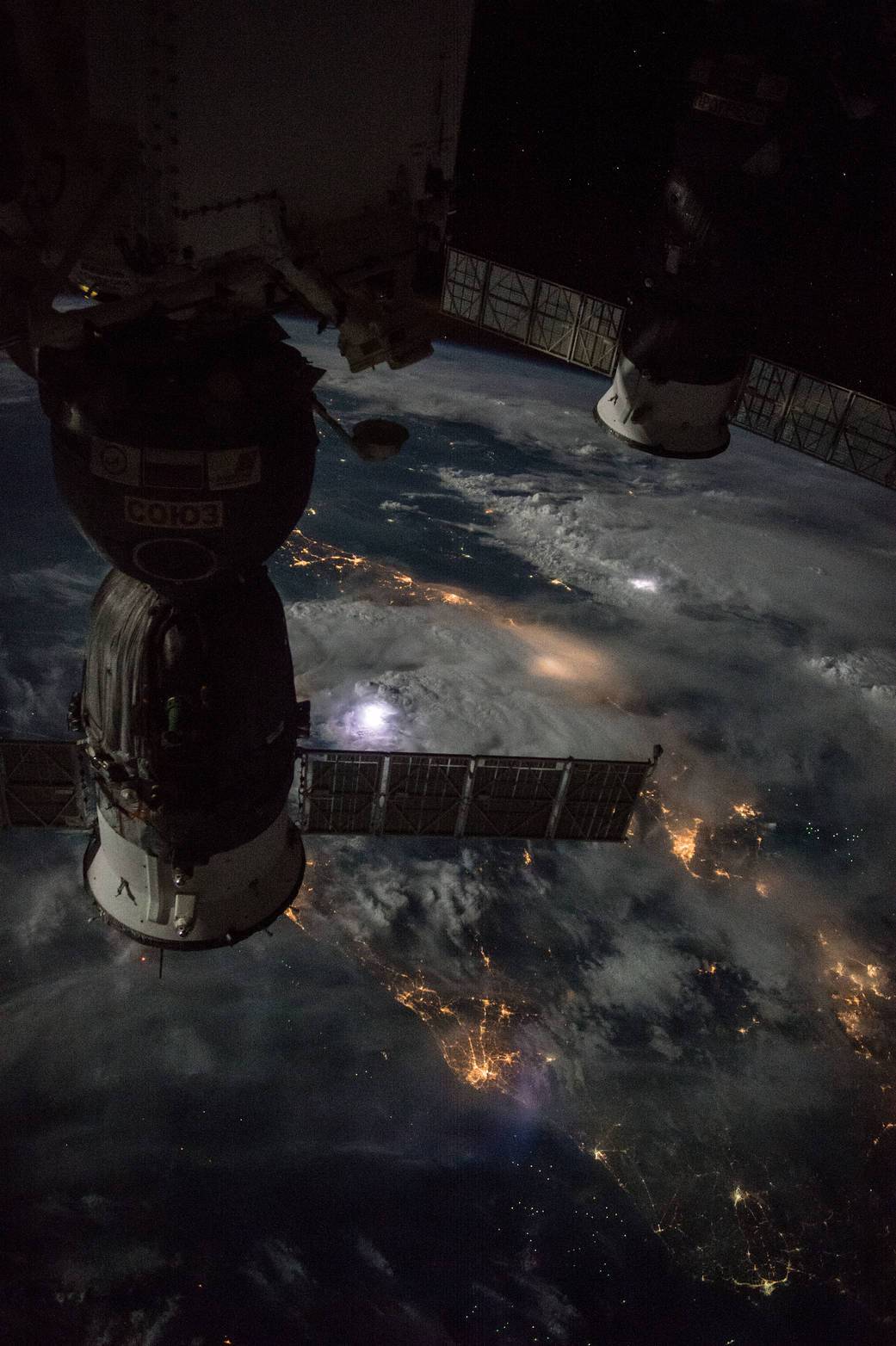
Featured image: Lightning illuminates clouds beneath the International Space Station on September 18, 2016. This archival photograph illustrates natural electrical activity; it does not show the laboratory experiment. Credit: NASA. Image source. Usage terms.
Leave a Reply