NASA’s Psyche spacecraft has shifted into sustained propulsion on its journey to a metal-rich asteroid. JPL’s October 22, 2026 update says this phase began on September 28, keeping the mission aimed at a summer 2029 rendezvous.
Its thrusters are expected to operate about 90 percent of the remaining cruise. Only one of its four thrusters operates at a time. Weekly communications and engineering work interrupt the thrusting. Power will gradually decrease as the spacecraft travels farther from the Sun.
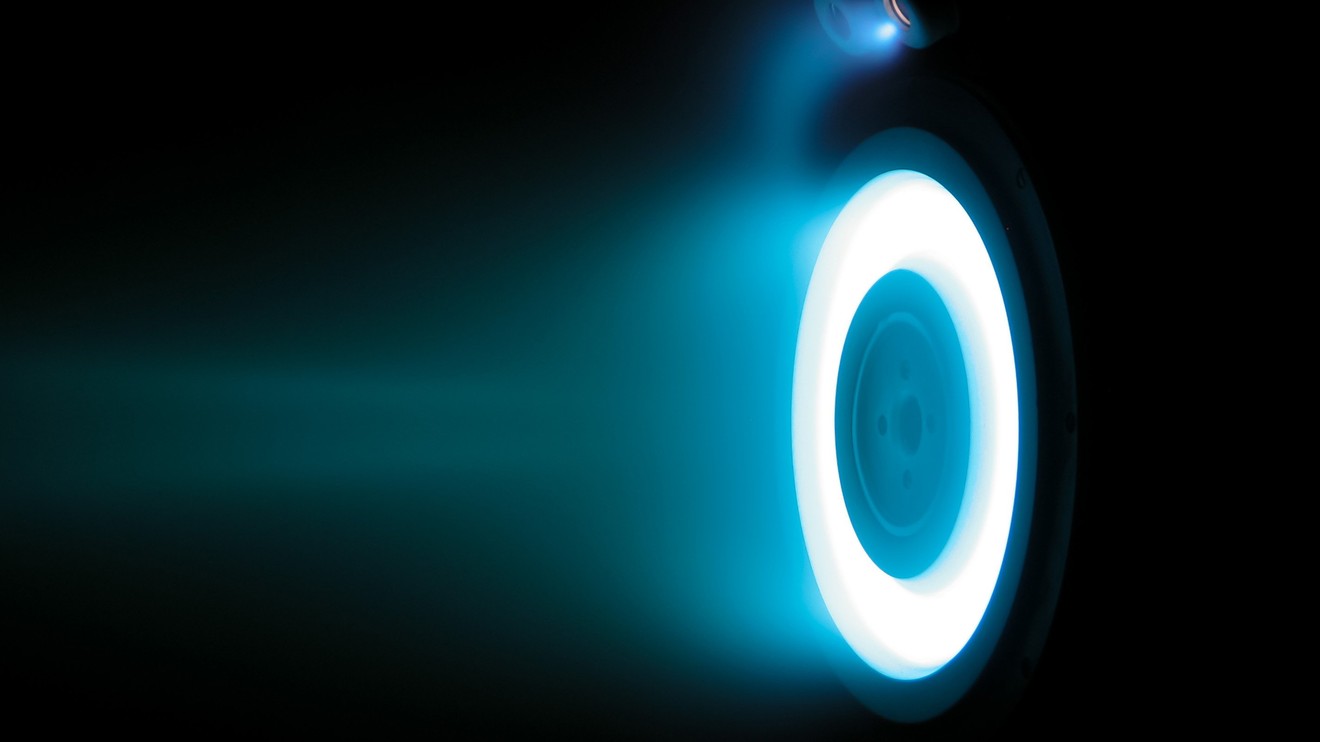
The propulsion system turns sunlight into a gentle, persistent push. Solar arrays supply electricity, while electromagnetic fields accelerate charged xenon atoms out of Hall thrusters. Expelling those ions changes the spacecraft’s motion without requiring the high, brief thrust associated with a chemical engine.
JPL’s technical explanation describes why this approach suits a long interplanetary journey: efficient use of propellant allows thrusting to continue for years. The launch rocket provided the force needed to escape Earth; electric propulsion handles the slower process of reshaping the spacecraft’s route through deep space. Small accelerations accumulate over time.
The new cruise phase follows a May 15, 2026 Mars gravity assist. In results released on July 17, NASA described how the encounter changed Psyche’s trajectory and provided an instrument rehearsal. The imager, magnetometer and gamma-ray and neutron spectrometer all gathered useful measurements.
Mars offered a well-studied target against which scientists could check performance. The neutron instrument detected the expected increase near closest approach, although the spacecraft was too distant to measure Martian gamma rays. Its cameras also recorded the Martian moons, practicing the search for small companions around the eventual asteroid target. Those tests provide practical experience for the encounter ahead.
At the asteroid, a planned two-year science campaign will investigate its composition and history. A possible exposed planetary building-block core remains a hypothesis to test, rather than an established identity.
A Psyche-type Hall thruster operates during prelaunch testing at JPL. Credit: NASA/JPL-Caltech. Image source; image usage terms.
Leave a Reply