Dragonfly has completed a real-time rehearsal of its first flight above Titan, using flight-like computers at Johns Hopkins Applied Physics Laboratory. NASA announced the milestone on October 23, 2026. The rotorcraft has not flown on Titan; the achievement is an integrated ground simulation.
Flight software worked with simulated navigation-camera, inertial-sensor and lidar inputs to search for a safe landing area, turn back and descend. A camera emulator rendered scenes in real time, matching exposures of roughly 20 to 70 milliseconds. Engineers next plan tests on the actual flight system, additional flight profiles and deliberate faults to assess autonomous responses.
That autonomy supports an unusual landing sequence. Dragonfly will enter Titan’s atmosphere inside a protective capsule, slow beneath parachutes, and then emerge from its backshell. Rather than remain attached all the way to touchdown, the rotorcraft will begin powered flight and use lidar to guide its approach to the surface.
Titan’s dense atmosphere and weak gravity favor aerial exploration. A radioisotope power system will support operations far from the Sun, where solar illumination is limited. Flying between sites would let the mission cross terrain that could obstruct a wheeled rover.
The mission overview lists launch no earlier than July 2028 and arrival in late 2034. Plans call for about 3.3 years of exploration, including dunes and Selk Crater. Those are future objectives; the current testing campaign is part of preparing the hardware and software to carry them out.
The science program combines measurements taken on the ground and in flight. Instruments will examine surface chemistry, measure elemental composition, monitor weather and investigate seismic activity. Aerial photographs and atmospheric profiles will help place local samples in their wider geological setting and identify promising future landing areas.
Selk Crater is particularly interesting because an ancient impact may have mixed liquid water with organic material. Studying the frozen remains could help researchers investigate chemical steps relevant to life’s origins. Successfully navigating between distinct locations is therefore central to the mission’s scientific value.
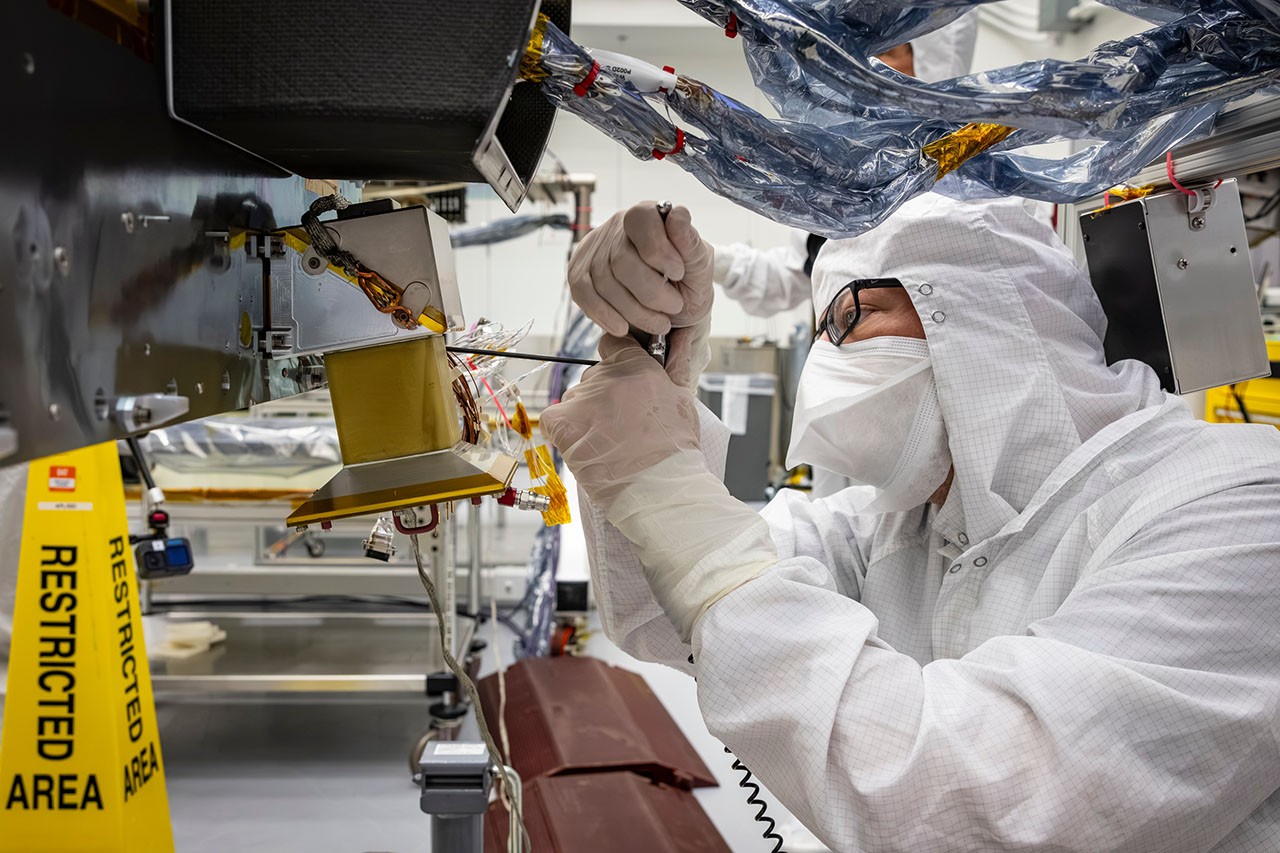
A technician installs a Dragonfly navigation camera on August 19, 2026. Credit: NASA/Johns Hopkins APL/Ed Whitman. Image source; image usage terms.
Leave a Reply