A black-hole system has offered an unexpected clue about how feeding disks change shape. A study published in Nature Astronomy on October 22, 2026 examines MAXI J0637-430 during the decline of its 2019 outburst.
Near peak brightness, its optical and near-infrared spectrum showed relatively cool gas with strong hydrogen and helium emission lines. As the source faded, the spectrum instead became hotter-looking and nearly featureless. The authors interpret this reversal as evidence that a vertically extended inner disk initially blocked radiation from reaching the outer disk.
The inferred shielding occurred at roughly one fifth of the Eddington luminosity, below the regime usually associated with such thickening. X-ray spectra support the interpretation, which could affect estimates of black-hole spin and interpretations of polarization. The geometry is inferred from light, rather than directly photographed.
NASA’s explanation of black-hole anatomy helps separate the object from its luminous surroundings. Gas pulled from a companion star can collect in a rapidly rotating accretion disk, gradually moving inward. That material remains observable before crossing the event horizon. The horizon itself marks a boundary from which even light cannot escape. Consequently, a changing spectrum describes conditions outside the black hole, not radiation emerging from its interior. An isolated black hole that has exhausted nearby material may lack a bright disk altogether.
The observations include spectroscopy from the Very Large Telescope’s X-shooter instrument. Its three separate arms divide incoming light into spectra covering ultraviolet, visible and near-infrared wavelengths. Each spectrum is arranged into shorter segments so a long wavelength range can fit on a detector. This approach records how brightness varies across many colors, rather than reducing a source to a single brightness measurement. The broad coverage also reduces the need to combine observations taken under different conditions. Comparing those detailed patterns is especially useful when several parts of a system contribute different kinds of light.
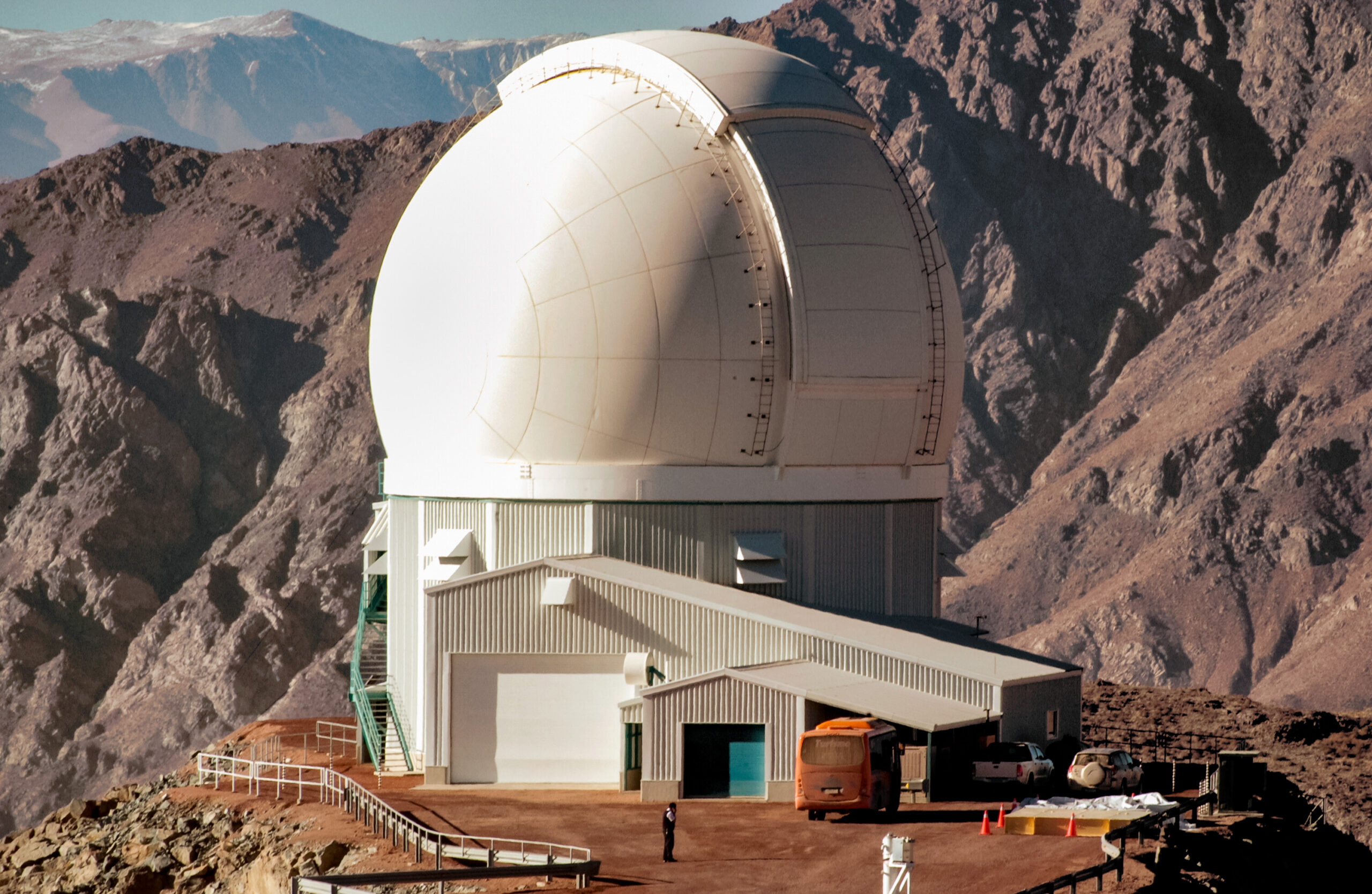
The SOAR Telescope in Chile contributed optical spectroscopy to the study. Credit: CTIO/SOAR/NOIRLab/NSF/AURA/M. Paredes. Licensed under CC BY 4.0. Image source · CC BY 4.0 license.
Leave a Reply