A gravitational-wave alert can tell astronomers that something happened without showing them exactly where the flash will appear. At the same time, an optical kilonova can fade within days. NASA’s November 24 profile of Kilonova Catcher explains how volunteers with telescope cameras help fill that gap.
The volunteers join a rapid-response network. When an alert comes from a gravitational-wave detector or a space telescope, observers can cover fields and return to targets on successive nights. This extends follow-up across time zones and weather windows. The same network can also help follow other transients such as gamma-ray bursts.
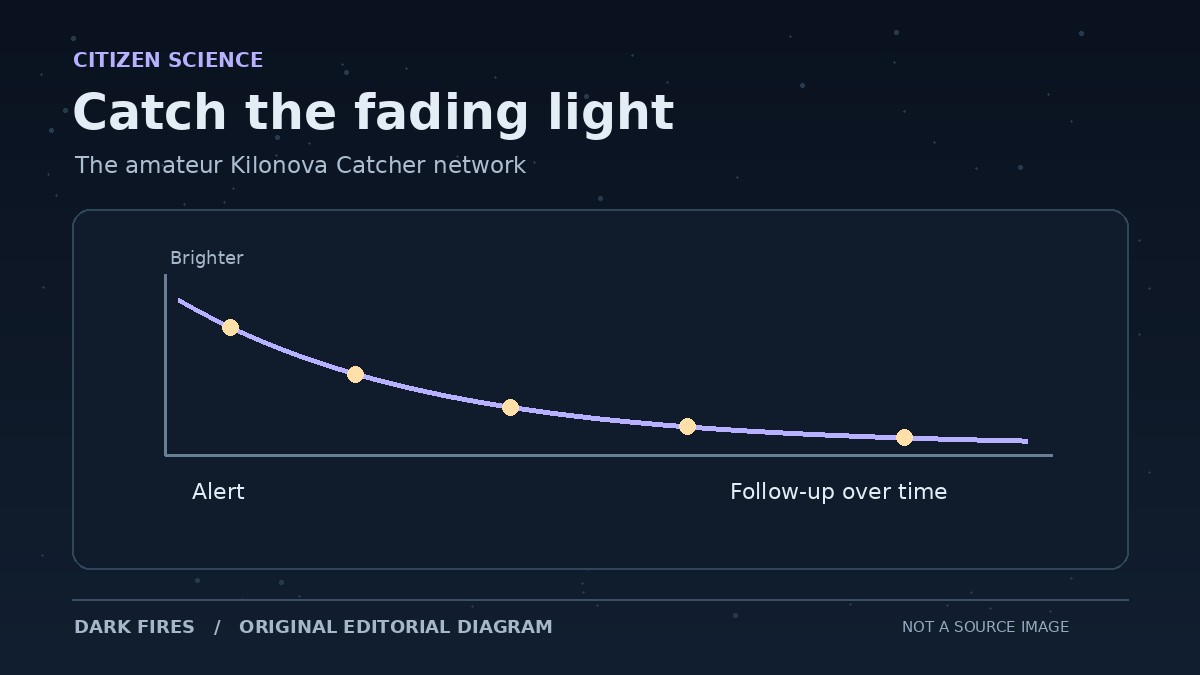
Latency matters, but so does repeat coverage. A candidate seen on one frame may need additional images to confirm it and measure how it changes. Observations on later nights help build a light curve, and the team can put results from several observers into context. An isolated point of light is not enough to establish a kilonova.
NASA lists an observing telescope and a camera, or access to one, as the basic starting point. The project page has the participation details. This is best suited to readers who want to supply their own observations; the separate galaxy-classification projects use images that are already available.
Sources: NASA’s November 24 project profile · Kilonova Catcher participation page
Leave a Reply