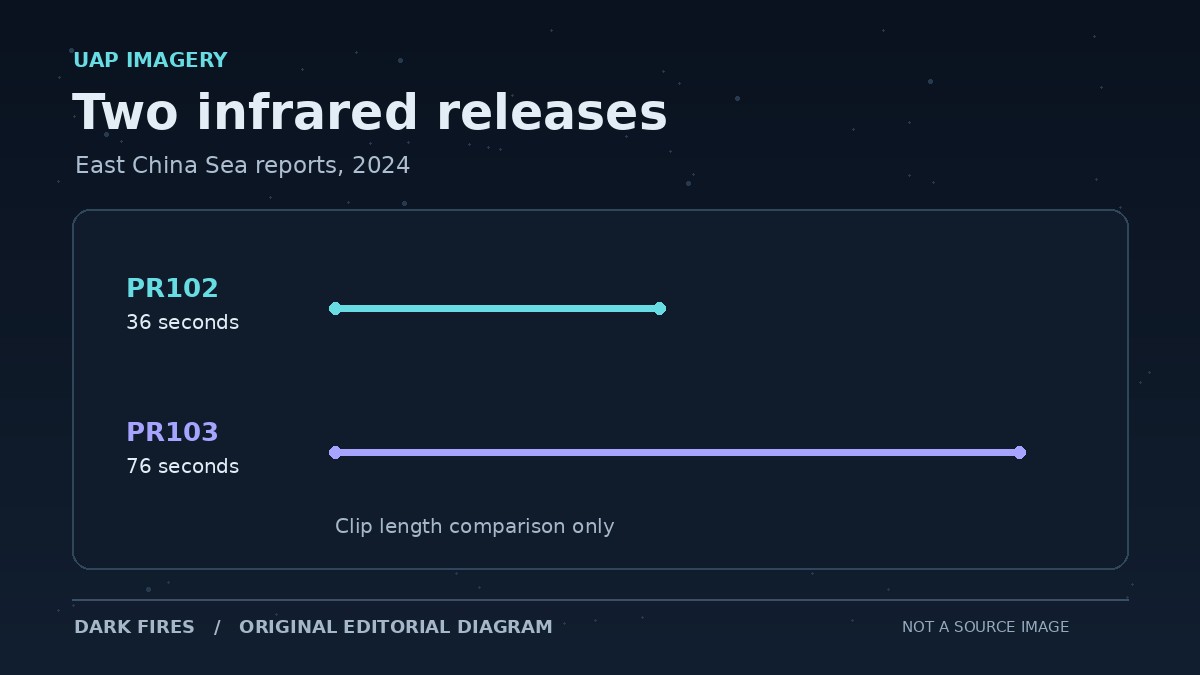
Two infrared clips from the East China Sea both show an area of contrast, according to the All-domain Anomaly Resolution Office’s descriptions. The public copies, PR102 and PR103, were filmed in 2024 and posted July 10, 2026. Their descriptions offer a useful way to separate what a tracking camera does from what can be said about the thing it is tracking.
In the 36-second PR102 clip, the camera initially keeps the contrast near the center. It leaves the top of the frame during the middle section, and the description notes zoom changes near the end. In the 76-second PR103 clip, the camera pans to keep contrast near the center; an auto-tracking reticle appears about 12 seconds in and remains for the rest of the clip.
A marker in the middle of the screen can make an object look steady because the camera is doing the work of keeping it there. Conversely, a feature leaving the frame gives its position relative to the camera at that moment, not its speed through the air. A useful next step would be to compare timed frames with sensor pointing and field-of-view information and independent range data, if available.
The descriptions do not establish a link between the two clips or identify the source of the contrast. The comparison is about how the two public records present tracking, not a reconstruction of a shared encounter.
Sources: AARO description and footage for PR102 · AARO description and footage for PR103
Leave a Reply