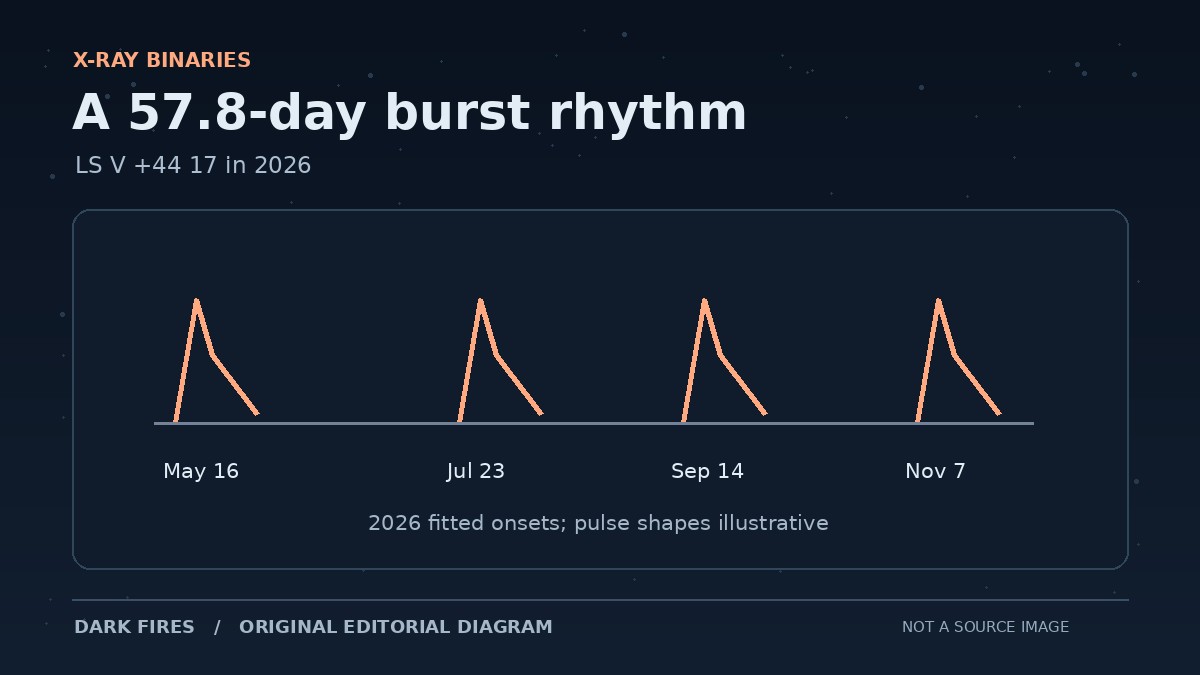
Four well-observed brightenings from the X-ray binary LS V +44 17 gave a monitoring team a much shorter recurrence interval than older reports suggested. Using data from MAXI and NASA’s Swift, the team fitted the outburst start dates and reported 57.8 days between cycles in its November 22 notice.
Five outbursts were recorded in 2026, but coverage of the earliest one did not pin down its start or peak. The fit used the later four, with estimated onsets in May, July, September and November. Fitting those dates lets the astronomers use events with different shapes and different intervals between their onsets and peaks.
The same team reexamined data from 2010–2011 and found a separate recurrence estimate of 51.0 days, roughly one-third of the older 150-day figure. The authors suggest that the shorter historical value could be closer to the true orbital period if this binary behaves like another studied system. That is an interpretation, not a direct measurement of the orbit.
The next useful comparison is between future monitored outbursts and an independent orbital measurement. A repeating brightening records how the system’s flow of matter changes; matching it to the orbital clock requires additional evidence.
Sources: MAXI team’s timing analysis in Astronomer’s Telegram 18164 · MAXI source light curve
Leave a Reply