A pale, comet-like object over western Pennsylvania on October 13 prompted UFO reports, but the emerging explanation points to a documented space launch. Researcher Stan Gordon attributed the sightings he received to SpaceX’s CRS-35 mission. A NASA image article published October 14 independently confirms that the mission produced sunlit exhaust plumes visible across the eastern United States.
The distinction matters: NASA has documented the launch and its widespread sky display. Gordon made the identification of the Pennsylvania reports. The agency’s account does not say it investigated those particular witnesses.
Two reports, one short window
In his October 13 account, Gordon describes a driver in Westmoreland County who saw a white-blue, gaseous-looking object over the Arona area at approximately 6:40 a.m. The observation lasted several seconds. Another report involved two witnesses between Luxor and Crabtree, also in Westmoreland County, who described a comet-like appearance and took two photographs.
Gordon says the pictures led him to recognize a launch-related event, resembling earlier reports he had encountered. That is an investigator’s assessment of witness descriptions and photographs, rather than a published trajectory reconstruction.
The independent launch record
NASA’s launch report puts liftoff at 6:33 a.m. EDT on October 13 from Space Launch Complex 40 at Cape Canaveral Space Force Station. A Falcon 9 carried Dragon and more than 6,300 pounds of science and cargo toward the International Space Station. Dragon separated from the second stage about nine minutes after launch.
The reported Pennsylvania observation therefore falls roughly seven minutes after liftoff. That timing is consistent with an ascent-related sighting, although timing alone cannot establish precisely what an observer saw.
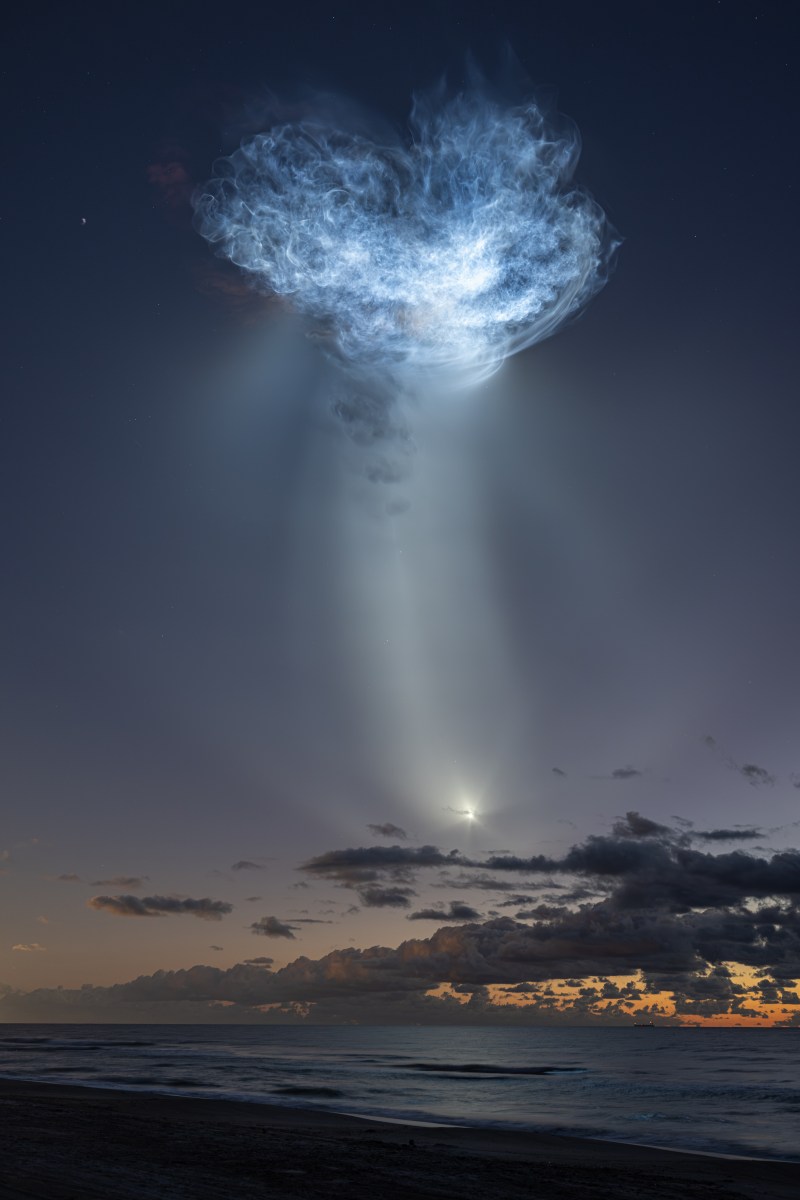
More importantly, NASA’s October 14 image article identifies a bright “jellyfish” display from this specific launch and says its exhaust plumes were visible across the eastern United States. This supplies independent regional context for the proposed explanation, beyond the fact that a rocket happened to launch that morning.
Why an ordinary launch can look extraordinary
The lighting geometry explains much of the unfamiliar appearance. In a NASA explanation of a separate March launch, the high-altitude exhaust caught sunlight while the photographer remained in darkness. The illuminated exhaust appeared as a glowing cloud. Such conditions can occur around dawn or dusk.
That earlier example explains the mechanism; it is not additional evidence about the Pennsylvania witnesses. The October mission’s own NASA photograph documents the relevant kind of display on the relevant date.
What would make the identification more rigorous?
A useful next step would be a time-and-direction comparison using original photographs and the witnesses’ locations. The All-domain Anomaly Resolution Office’s information checklist emphasizes precise observer times, positions and travel paths, the phenomenon’s location and movement, other observers, and available sensor records.
For anyone documenting a similar sighting, a practical checklist is:
- Record the clock and time zone. Note whether the time is exact or estimated, and when the observation began and ended.
- Keep location and direction together. Where were you standing or traveling, and which way were you looking? Nearby landmarks can help reconstruct the view.
- Preserve the original files. Keep photographs or video with their timestamps and other metadata, rather than relying only on a reposted clip.
- Separate observation from interpretation. Record color, shape, duration and apparent movement before assigning a cause.
AARO’s public guidance also explains why uncompressed imagery, camera specifications and geolocation matter: they allow comparisons with known traffic and tracking databases, while compression can introduce artifacts.
The best-supported reading of this case is a plausible, independently corroborated launch explanation. It neither turns every unusual light into a rocket nor requires these reports to remain mysterious simply because the original view was startling. The useful work is connecting a particular observation to a particular event, while keeping the remaining limits visible.
Image: NASA/John Kraus. Sunlit exhaust from the October 13, 2026 CRS-35 launch. This NASA mission photograph is not an image supplied by the Pennsylvania witnesses. Reporting checked October 14, 2026.
Leave a Reply