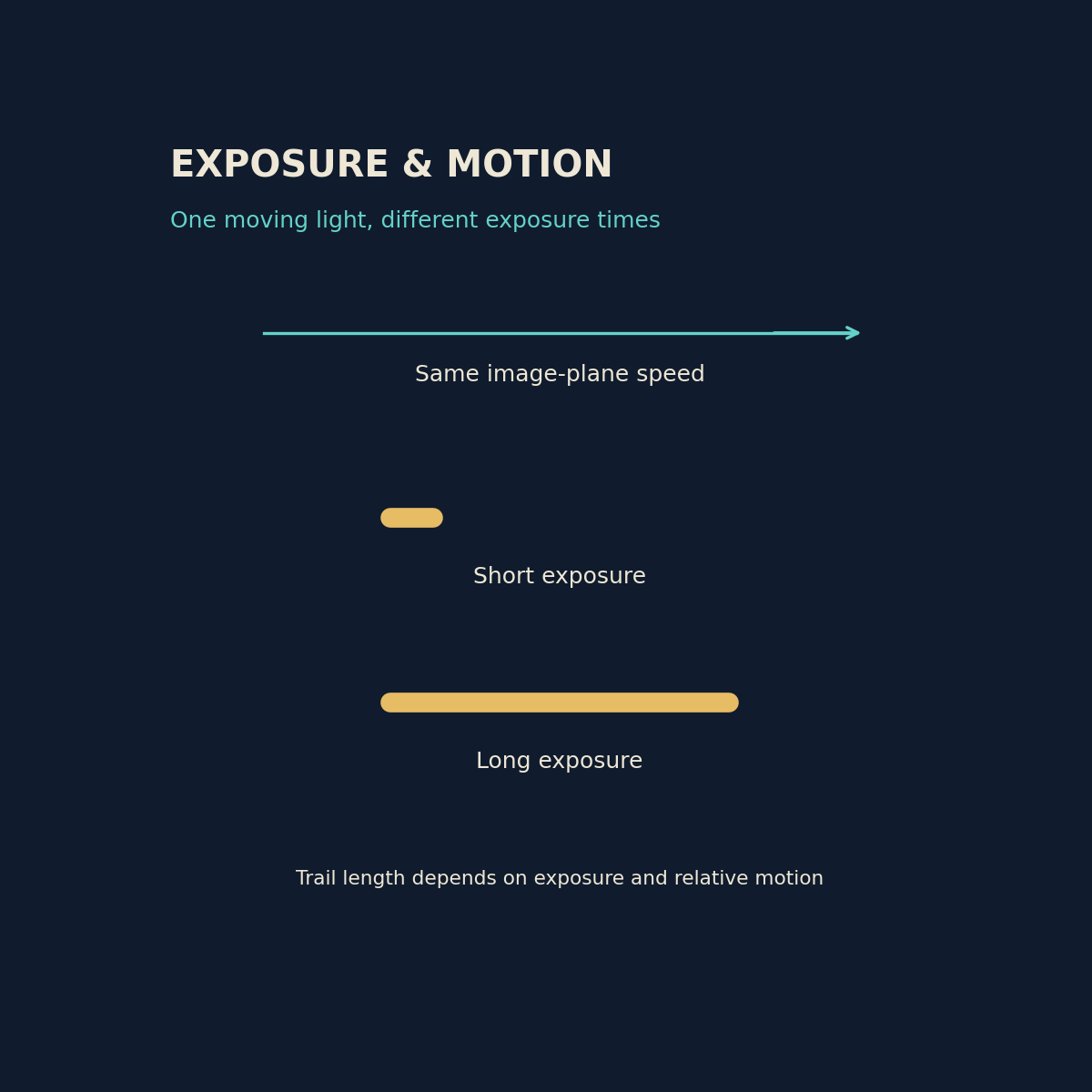
Original diagram by Dark Fires. Schematic, not an observation; not to scale.
A luminous streak in a photograph records light collected over an interval. Its length can reflect movement during that interval rather than the length of a solid object. Before interpreting a bright bar, hook or ribbon as an aircraft structure, establish how long the camera was collecting light and whether the camera itself moved.
What the camera measures
Nikon’s shutter-speed guide explains that longer exposures admit light for longer and make motion blur more likely. The relevant movement is movement across the sensor. A stationary distant light can trace a path when a handheld camera shakes; a moving source can leave a trail even on a tripod.
Exposure time and frame rate are different quantities. A video marked 30 frames per second describes how often frames are delivered, not necessarily the exposure duration of each frame. Obtain the actual setting or camera metadata instead of assuming that every frame was exposed for exactly one thirtieth of a second.
A small calculation with strict limits
Consider a hypothetical point whose image moves at 120 pixels per second across a fixed camera sensor. During a one-tenth-second exposure, its ideal motion trail spans about 12 pixels. During a one-hundredth-second exposure, it spans about 1.2 pixels. This simple calculation assumes steady motion, constant image scale and uninterrupted exposure. It does not convert pixels into metres or establish the object’s speed through space.
The same limitation applies in reverse. Dividing trail length by exposure time estimates image-plane motion only when the trail really comes from motion and the timing is known. Focus, optical spreading, clipping and processing can widen or reshape a trail. A clipped social-media video may not preserve enough information to separate those contributions.
A practical comparison
Keep the original file and inspect nearby stars, distant lamps or other references. Similar hooks on several unrelated lights support camera movement as a shared cause. A sharp background with one elongated source supports relative source motion, though it still does not identify the source. These are comparisons to test, not automatic verdicts.
If an observation continues, record a stable wide view and then, where practical, a shorter exposure without changing the viewpoint. Note every settings change. Basler’s imaging guidance recommends short enough exposure that a moving image does not travel more than roughly one pixel when blur must be minimized. In a dark sky this may make the source faint, so preserve both versions.
How to report the result
Write that a source produced a measured trail during a stated exposure, and list camera-motion uncertainty. Reserve claims about physical shape or acceleration for evidence that survives those checks. An exposure explanation can account for a strange image without identifying the light that produced it.
Leave a Reply