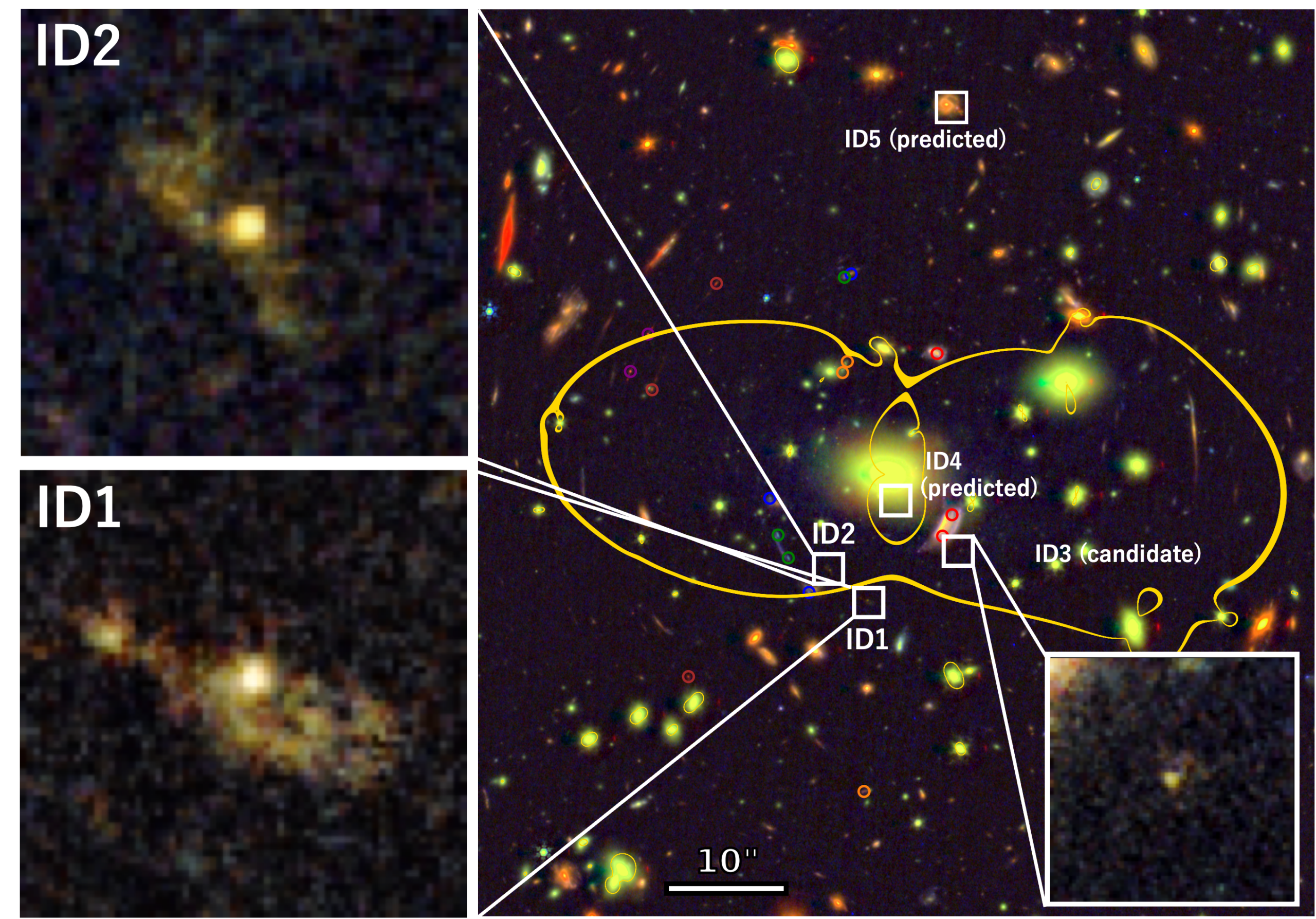
A distant galaxy nicknamed Misty Moons offers a close look at a normally inaccessible question: how much of an early galaxy’s stellar mass was concentrated in small, bright clumps rather than spread smoothly through it?
The study, highlighted in November 6 coverage after publication in The Astrophysical Journal on October 19, uses gravitational lensing to examine a galaxy estimated to lie at redshift 11 to 12. This is not a discovery first announced this weekend: the team’s preprint initially appeared in November 2025 and was revised in July 2026.
Several images of one galaxy
The foreground galaxy cluster MACS J0257.1-2325 bends the light traveling toward Earth. Two bright images of Misty Moons are magnified roughly 20 to 30 times, allowing Webb to reveal internal features that would otherwise blend together.
Two independent lens models predict five images of the same background galaxy. The analysis concentrates on the two brightest, with a third candidate identified and two others below detection. Multiple images are useful because the reconstructed source should have a consistent structure even when the foreground lens stretches each view differently.
The researchers estimate that individual stellar clumps have effective radii of roughly 10 to 70 parsecs and masses around ten million Suns. Together, the clumps account for at least about 80 percent of the inferred stellar mass. That concentration points to a clustered form of early star formation.
Where the uncertainties enter
The redshift is estimated from imaging through different filters, rather than established by a spectroscopic measurement in this analysis. It places the object approximately 370 million to 410 million years after the Big Bang under the study’s cosmological interpretation. The exact physical picture also depends on correcting for lens magnification and fitting models to the observed light.
As the November report explains, the bright central structures may include light from an accreting black hole. Such a contribution would complicate estimates that attribute the light to stars. The possible connection between these clumps and the ancestors of globular clusters is consequently a research question rather than a demonstrated evolutionary history.
The larger value of Misty Moons is that a natural lens opens its internal structure to scrutiny. An ordinary unresolved image can make several star-forming knots look like one compact object. Here, astronomers can begin asking which pieces create the apparent brightness, and test those answers against more than one view of the same galaxy.
Featured image: Minami Nakane et al., VENUS collaboration (2026), Figure 1; JWST/NIRCam and Hubble observations. CC BY 4.0. Image source; license.
Leave a Reply