NASA has confirmed the UltraViolet EXplorer, or UVEX, after a major technical and programmatic review, moving the observatory from planning toward final design and fabrication. The agency’s October 27, 2026, announcement commits to a launch by January 2031 and a total lifecycle cost of $590 million.
The milestone is Key Decision Point C. It is not a launch, a first-light observation, or a new astronomical discovery. It establishes a development commitment for a mission designed to supply a missing part of the modern multiwavelength sky map. NASA’s confirmation notice identifies an all-sky ultraviolet survey and rapid observations of neutron-star-merger aftermaths among its goals.
Why another wavelength matters
Astronomical objects do not tell the same story in every band of light. An infrared survey and an ultraviolet survey can emphasize different components of the same galaxy or different phases of an explosion. Combining them therefore adds physical information, not merely a new color treatment for an existing picture.
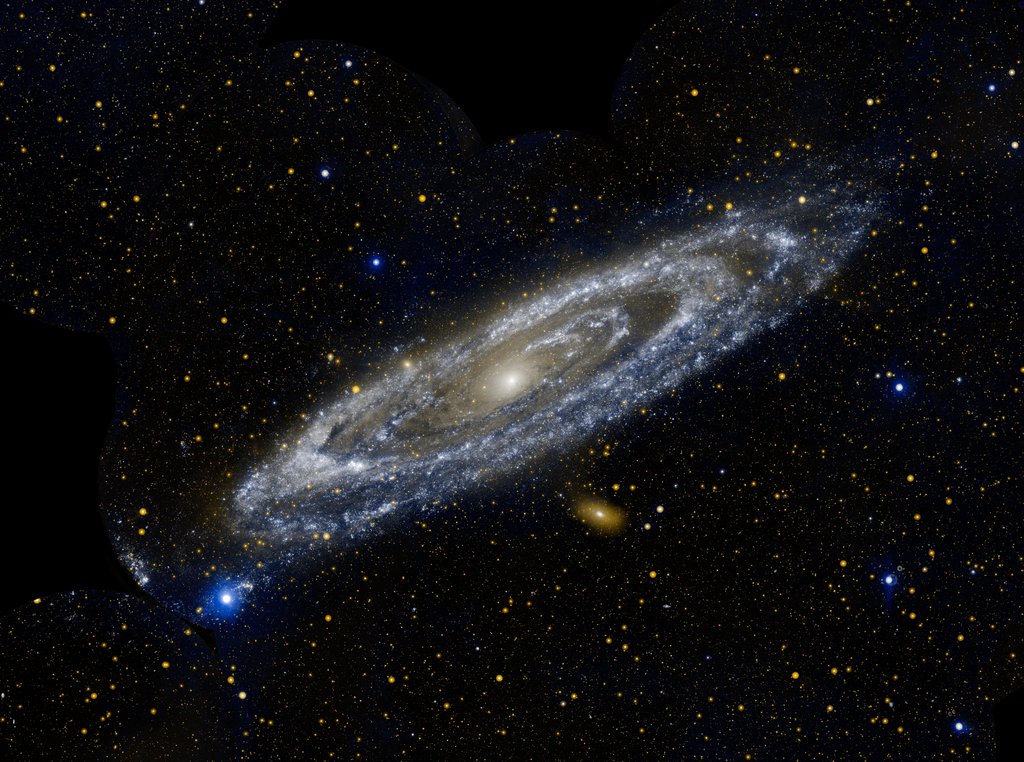
Caltech’s mission announcement describes UVEX as a successor to the Galaxy Evolution Explorer, which mapped ultraviolet skies between 2003 and 2013. UVEX is intended to reach much fainter sources while adding dedicated capabilities for a changing sky. It will obtain spectra as well as images, separating received light by wavelength to investigate the properties of its sources.
The project is led by Caltech principal investigator Fiona Harrison. UC Berkeley’s Space Sciences Laboratory manages the mission, Northrop Grumman will build the spacecraft, and JPL contributes detector technology. Caltech’s IPAC will process and archive the data. These responsibilities underline how much engineering and data infrastructure stands between a confirmed concept and an astronomical survey.
Small galaxies and short-lived flashes
The University of Maryland’s account highlights two complementary observing jobs. One is finding low-mass galaxies with few heavy elements, many of which remain difficult to detect. The other is turning quickly toward transient events, including supernovae and the luminous aftermaths of neutron-star collisions.
Early ultraviolet emission can fade on timescales of hours to days. A telescope that arrives late may still observe an interesting object, but miss the short-lived information needed to distinguish competing explanations of the initial outburst. Rapid response is consequently part of the measurement strategy, not just operational convenience.
The mission’s dynamic-universe lead, Maryland astronomer Suvi Gezari, describes ultraviolet spectra as a way to examine the physics, chemistry and surroundings of these events. The university also reports that a portion of observing time will be available to outside researchers, allowing the wider community to propose targeted observations.
A capability, not a guaranteed discovery list
The scientific promise should remain separate from results. Predictions that UVEX could uncover millions of additional small galaxies are survey ambitions, not a catalog already produced. Likewise, pointing at an explosion will not automatically resolve every uncertainty about its origin.
What has changed this week is the project’s status. NASA has accepted a defined path toward building an observatory that can connect deep ultraviolet mapping with time-sensitive follow-up. The payoff, if development and operations succeed, will be a new way to compare where the universe’s faint populations reside with how its most energetic events evolve.
Featured image: The Andromeda galaxy in ultraviolet light from GALEX, UVEX’s predecessor. Archival GALEX image, not an observation by the unlaunched UVEX mission. Credit: NASA/JPL-Caltech.
Leave a Reply