Voyager 1 is approaching a distance that turns a familiar measurement of time into a striking measure of space. NASA predicts that on November 18, 2026, the spacecraft will be one light-day from Earth: about 25.9 billion kilometers, or 16.1 billion miles. As of November 1, that milestone remains ahead, not already achieved.
The approach comes after two very different engineering developments. In an October 29 mission update, NASA’s Jet Propulsion Laboratory reported a successful power-saving change in September and a brief, unexplained loss of communications in October.
A signal returns before commands arrive
The Deep Space Network did not detect Voyager 1 during scheduled contacts on October 18 and 19. The signal returned on October 20, before engineers sent troubleshooting commands. The team found that one set of thrusters had gone offline and a backup set had activated, but the cause of the interruption was still being investigated.
That is an important distinction: restored communications establish that contact resumed, not that the underlying fault has been fully explained. The spacecraft has automatic protective responses, allowing it to enter a stable condition without waiting for instructions from Earth.
Separately, September’s coordinated substitution of three lower-power devices reduced electrical demand while preserving the spacecraft’s thermal balance. The maneuver buys operating margin for science instruments; it does not give the aging probe an unlimited supply of power.
Distance measured by light
NASA’s Voyager tracking page gives the predicted crossing as November 18 at 2:16:07 a.m. Pacific Standard Time, equivalent to 10:16:07 UTC. The reference point is Earth. A distance from the Sun is not interchangeable with a distance from our moving planet, particularly when a headline attaches an exact date to the crossing.
A light-day means the distance light travels in 24 hours, not a special speed that Voyager has reached. Radio signals are electromagnetic radiation too, so the same scale helps explain why deep-space operations demand patience. At roughly this separation, a command and its eventual reply involve about two days of signal travel, before allowing for processing and ground-station scheduling.
Not a new border of interstellar space
Voyager 1 crossed the heliopause in August 2012; Voyager 2 followed in November 2018. That boundary marks the transition from the Sun’s solar-wind environment to interstellar space. The one-light-day marker is instead a distance milestone, not another physical wall waiting in the spacecraft’s path. NASA’s November Night Sky Notes places the coming anniversary in that longer journey.
The difference makes the event more meaningful, not less. There is no sudden change in the laws of physics on November 18. What changes is the scale of a human undertaking: a machine launched in 1977 will soon be far enough away that even light needs a day to bridge the distance. The October interruption is a reminder that maintaining that connection remains an active engineering challenge.
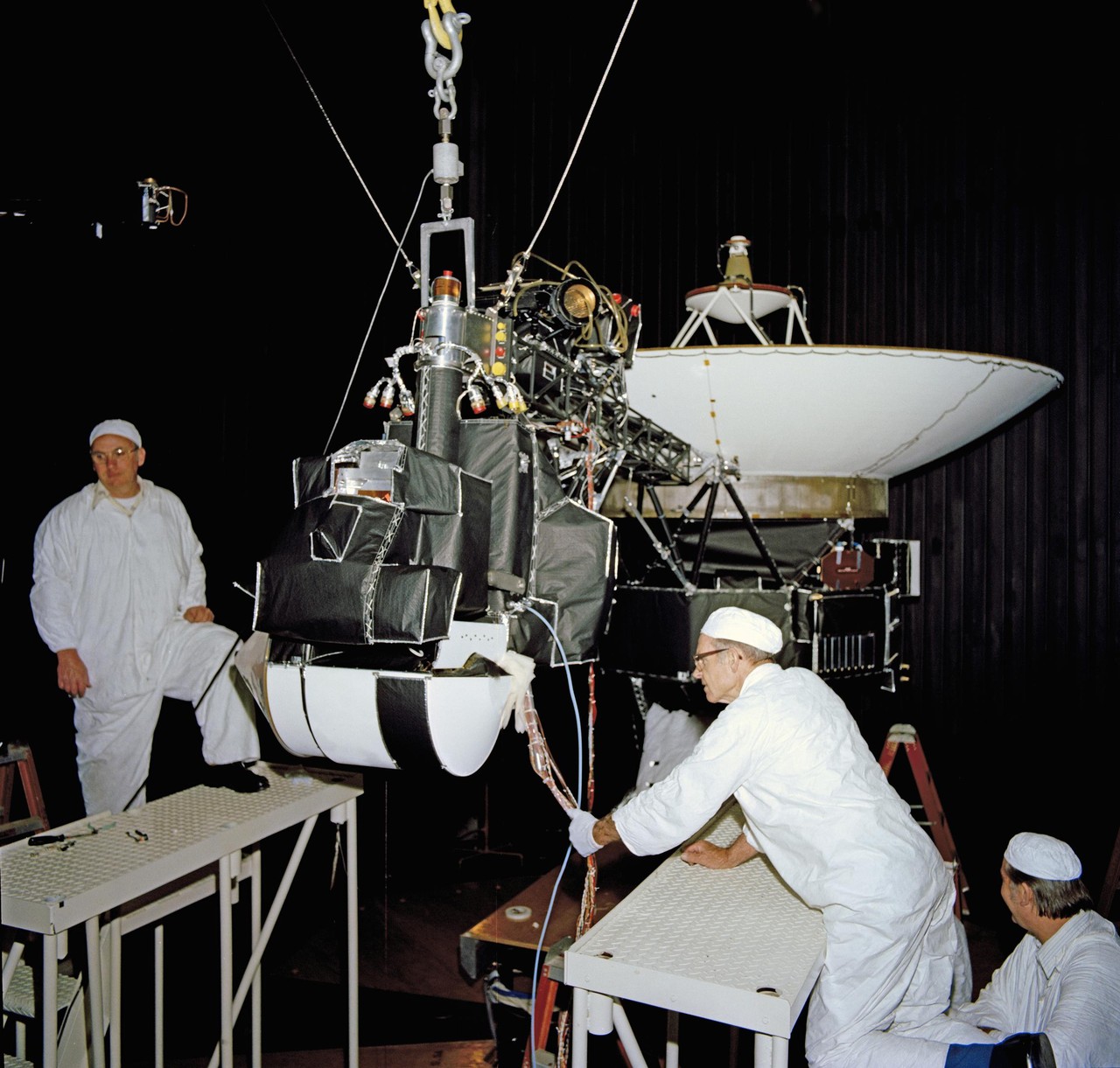
Featured image: A Voyager spacecraft undergoing testing at JPL in 1977; archival photograph, not a current view from interstellar space. Credit: NASA/JPL-Caltech.
Leave a Reply