Perseverance does not need a spacesuit, but small pieces of spacesuit material carried on the rover are helping researchers prepare for people who eventually might. A study highlighted by NASA on October 26, 2026, examines dust accumulated during 1,645 Martian days, including particles far smaller than those previously resolved on the planet.
The practical finding is not simply that Mars is dusty. Different surfaces collect different particle populations, and the smallest grains can remain attached through years of driving and drilling. NASA’s account describes measurements extending down to roughly 100 nanometers on some samples, alongside fine particles measured in micrometers.
A calibration target becomes an exposure experiment
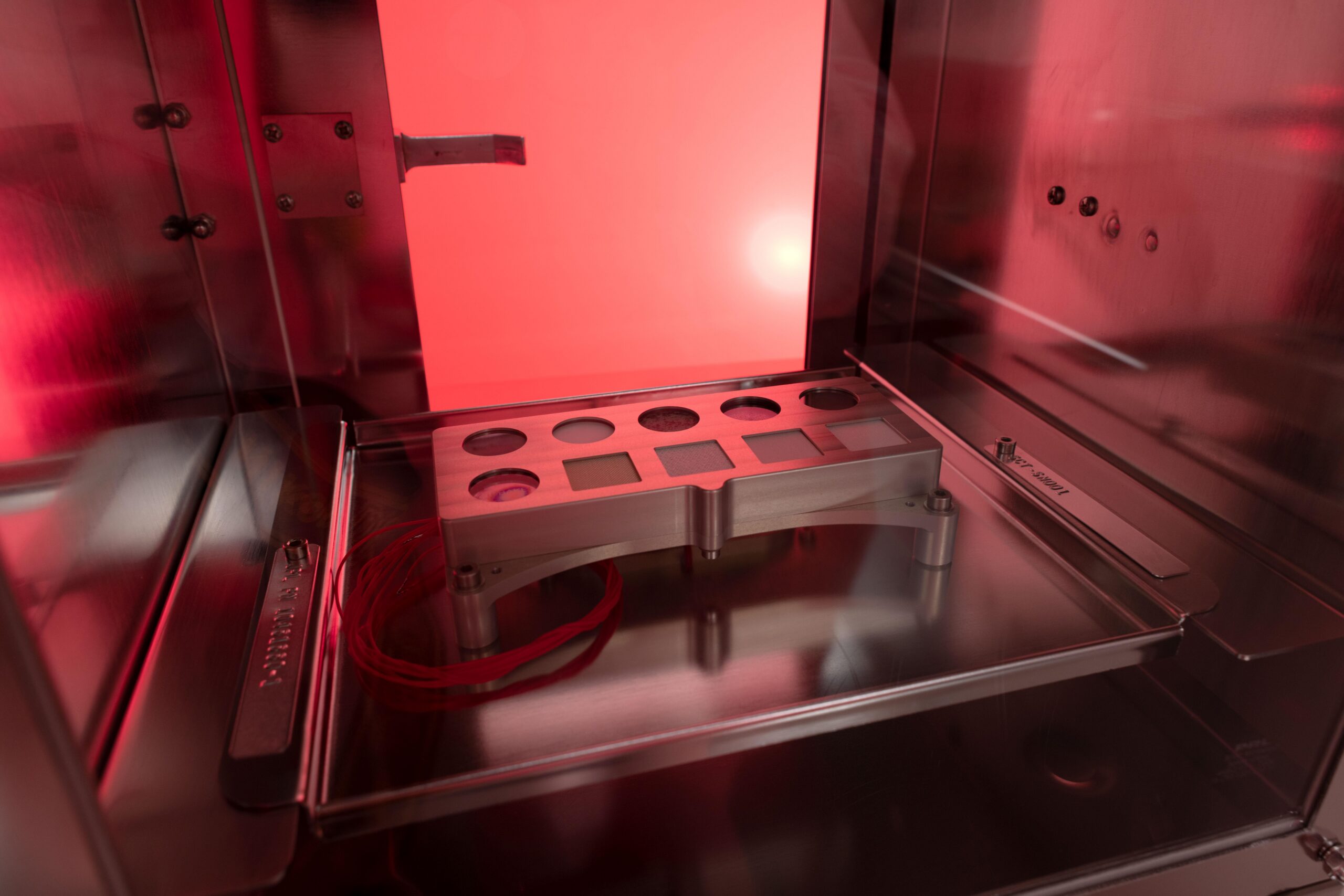
The rover carries material swatches associated with SHERLOC, its instrument for examining rock chemistry, and additional reference materials used by PIXL, its X-ray spectrometer. These targets support instrument calibration, but exposure to the Martian environment gives them another role: they record what happens when dust encounters particular surfaces.
Teflon provides an especially useful reference because PIXL does not directly detect its constituent elements. Detectable elemental signals from that target therefore reveal deposited material rather than the substrate itself. NASA reports that static charging appears to help determine which particle sizes adhere to different materials.
Less abrasion does not mean no concern
An October 29 report from Washington University in St. Louis, where lead researcher Scott VanBommel works, describes little visible wear on the swatches over the study interval. Martian grains tend to be smoother than the sharp lunar particles that caused trouble during Apollo missions.
That is encouraging for material durability, but it answers a different question from whether dust can enter a habitat or affect a person. A fabric may look intact while still carrying a persistent coating of very small particles. Treating those two observations as contradictory would obscure the engineering problem.
The university explains that VanBommel developed a method to estimate the tiny particles’ sizes. The health relevance comes from knowledge of fine and ultrafine particles on Earth; the rover experiment itself did not expose astronauts, measure a human dose, or establish a safe indoor concentration for a Mars habitat.
From measurements to mission design
A 2026 conference contribution from the Mars 2020 team situates these observations within a wider program supporting future human exploration. Dust composition, weather, hardware degradation and the availability of local resources all enter that planning. Several rover instruments contribute different pieces of the environmental picture rather than one instrument supplying a complete safety assessment.
The immediate use of the new dust measurements is to sharpen questions for ground testing. Which materials retain the least troublesome particle population? How much survives repeated cleaning? Can an airlock arrangement keep contaminated surfaces outside living areas? Those are design questions the observations help inform, not solutions already certified by a rover on another planet.
The lesson is a measured one: long-lived hardware on Mars can reveal hazards before crews arrive. It can show what sticks and how surfaces change, while leaving exposure limits and protective-system performance to additional experiments. The swatches are small, but the distinction between visible damage and invisible contamination is central to the much larger task of building a habitable outpost.
Featured image: SHERLOC’s calibration target during prelaunch preparation on Earth. It carries reference materials and spacesuit samples; archival NASA photograph released in July 2020, not a view of the 2026 dust measurements. Credit: NASA/JSC.
Leave a Reply