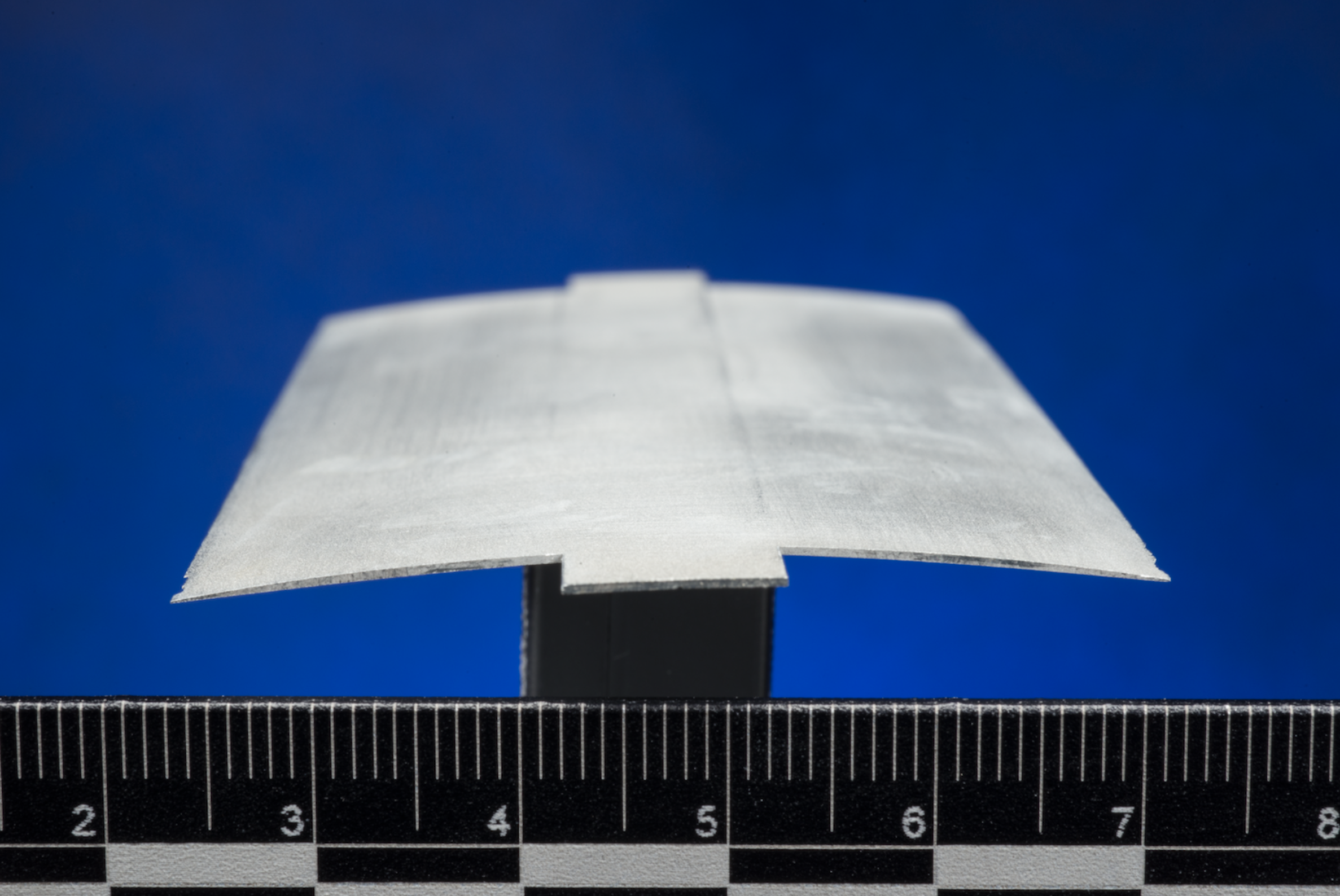
A much thinner rotor-blade profile could help future helicopters travel farther across Mars. NASA highlighted the experimental roamx-0201 design on October 20, 2026. The research is aimed at aircraft beyond the planned SkyFall mission, rather than a confirmed change to its helicopters.
The underlying study compares the new airfoil with CLF5605, the profile used by Ingenuity. Researchers combined two independent computational approaches with measurements in Tohoku University’s Mars Wind Tunnel. That comparison matters because aerodynamic behavior in this regime can respond strongly to small differences in geometry and experimental setup.
At the conditions studied, including a Reynolds number of 20,000 and a Mach number of 0.60, roamx-0201 achieved roughly 19 to 43 percent better lift-to-drag ratios across the different methods. In practical terms, the new shape produced the required lift with less aerodynamic resistance.
NASA describes a sharper, less rounded airfoil, using disturbed airflow near its leading edge to improve lift. The agency also cites a modeled possibility of single flights extending to 18.7 kilometers. That is a projection for future aircraft, not an achieved flight record.
The simulations also indicated more favorable stall behavior and about 20 percent greater maximum lift. These are aerodynamic findings under specified conditions. A successful airfoil comparison does not establish the endurance, payload capacity or operating limits of a complete helicopter carrying out a scientific mission.
The wider ROAMX program also includes equipment to evaluate complete rotors. A separate NASA technical report, released earlier in 2026, describes a vacuum-compatible hover test stand designed to measure performance under Martian aerodynamic conditions. That reusable apparatus supports experimental checks on future rotor designs.
NASA says the technology is not yet ready for Mars. Continued testing will need to reconcile predictions with measured performance before a future mission can rely on the design. The result offers a promising route toward more capable aerial exploration, with development still ahead.
A test model showing the thin roamx-0201 airfoil profile. Credit: NASA. Image source; usage guidelines.
Leave a Reply