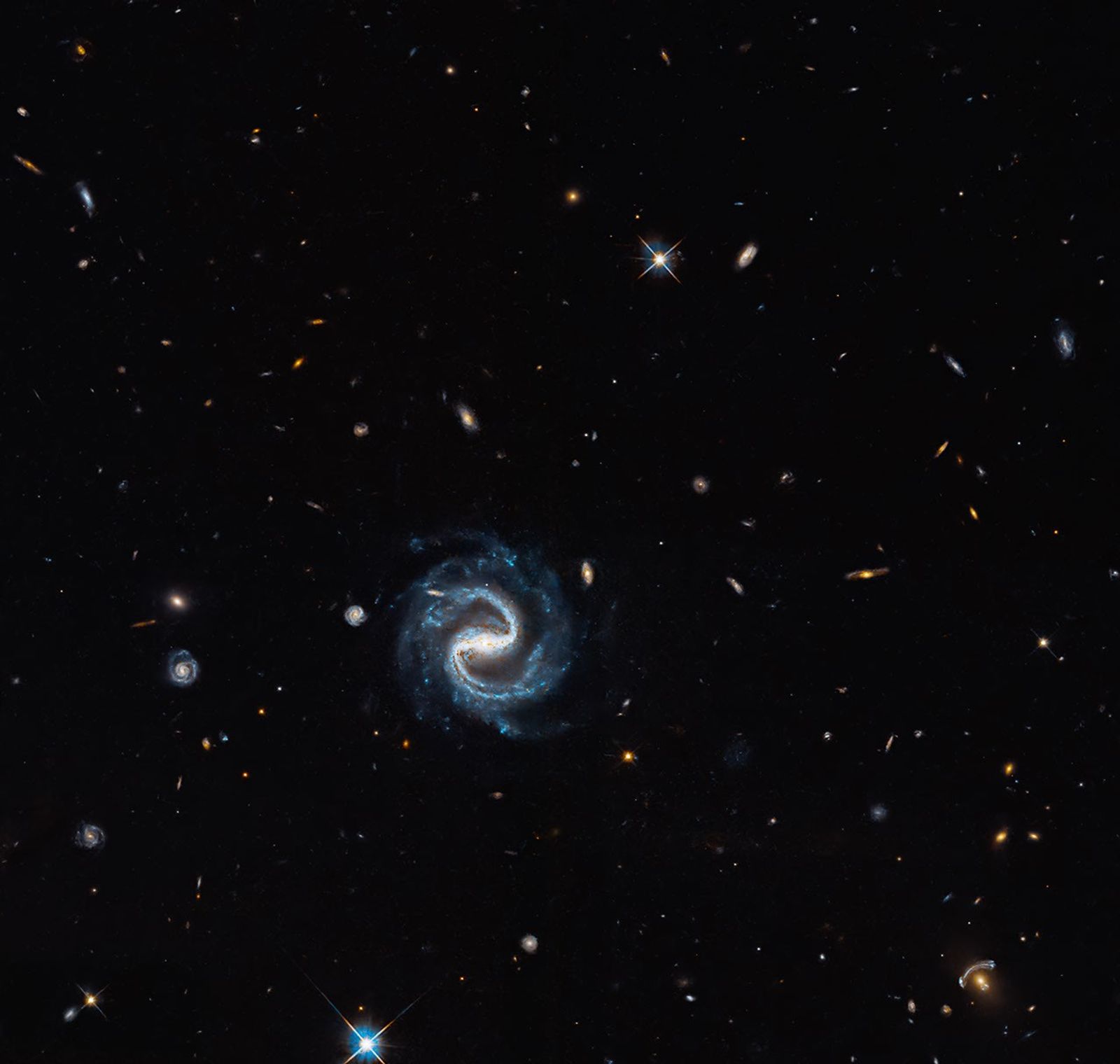
A small arc near a bright spiral galaxy is helping astronomers prepare for much larger cosmic surveys. An October 22, 2026 Hubble release highlights a gravitational lens that will inform analysis of observations from the Nancy Grace Roman Space Telescope.
The lens pairs a foreground elliptical galaxy roughly 4.5 billion light-years away with a background galaxy about eight billion light-years away. The more distant system appears twice: as a prominent curved image and a smaller, reversed counterpart. Researchers are using detailed Hubble examples to develop models for interpreting Roman’s larger fields.
Gravitational lensing turns the geometry of spacetime into an astronomical measuring tool. A massive foreground object redirects light from something behind it. Depending on the alignment, a distant galaxy can appear stretched, amplified or repeated. Mapping these distortions helps reveal the distribution of matter, including material that emits no detectable light. A bright arc is therefore evidence about both the source and the mass lying along its light path.
The complementary telescope designs explain the partnership. Hubble and Roman both use 2.4-meter primary mirrors, but their optical layouts differ. Roman’s shorter focal length supports a much wider field, while Hubble supplies tightly focused observations across ultraviolet, visible and near-infrared wavelengths. Roman’s Wide Field Instrument has a 288-megapixel detector array. Hubble’s Advanced Camera for Surveys has a much smaller field and a 16-megapixel array.
For lensing research, the practical advantage is coverage. A wide survey can supply a broad population of candidate systems; detailed observations can then investigate individual examples. The two approaches address different questions, from how frequently particular arrangements occur to how mass is distributed within a selected lens. Neither a large camera nor a sharp image alone replaces the modeling needed to connect distorted light with an underlying mass distribution.
In the new scene, the conspicuous spiral draws the eye, but the lensing target lies in the lower-right corner.
Hubble’s field includes a gravitational lens at lower right. Credit: NASA, ESA, and X. Huang (University of San Francisco); Processing: Gladys Kober (NASA/Catholic University of America). Image usage terms.
Leave a Reply