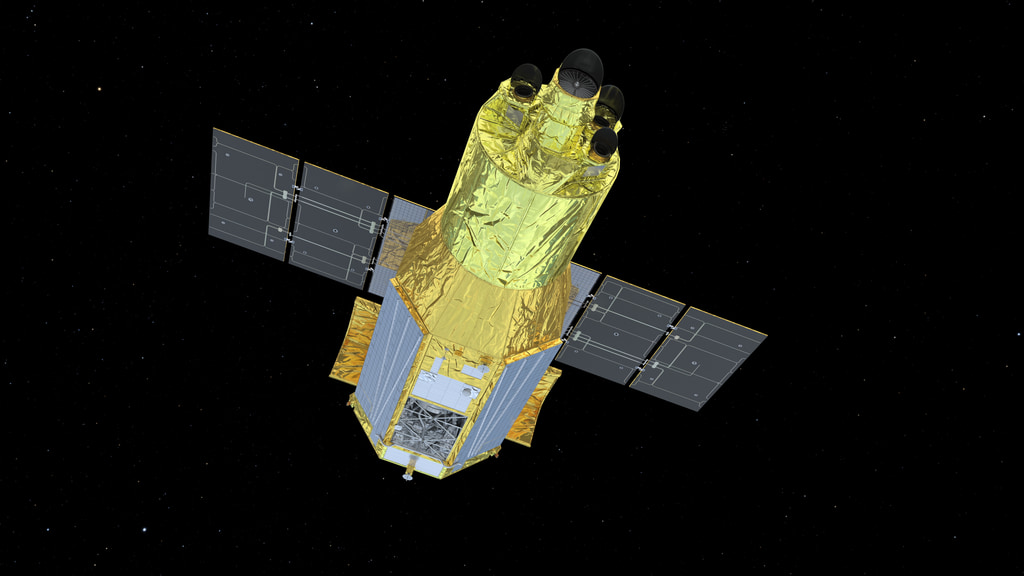
Coordinated X-ray and radio observations are clarifying how the galaxy 3C 120 launches a powerful jet while its central black hole feeds rapidly. Tohoku University’s October 20, 2026 announcement describes research published in The Astrophysical Journal Letters on October 19.
The study combines XRISM spectroscopy with three radio-telescope networks. A broadened iron emission feature indicates that a relatively cool, thin accretion disk ends at about 20 gravitational radii. Inside that boundary, the researchers infer a hotter, thicker flow. Tracing the radio jet backward places its origin on a similarly compact scale.
That geometry offers a plausible environment for magnetic fields to draw energy from the black hole’s rotation. The observations support this proposed connection; they do not directly show the entire magnetic engine or establish that every jet-producing black hole behaves identically.
The measurement depends on reading light much more finely than an ordinary image allows. XRISM’s Resolve detector, developed through Japanese and U.S. collaboration, measures the tiny rise in temperature when an X-ray photon lands on a pixel. Operating extremely close to absolute zero makes those small energy deposits measurable. Each recorded energy contributes to a spectrum, rather than merely marking where a photon arrived. The spacecraft carries a second instrument, Xtend, which takes wider-field X-ray images; separate mirror assemblies focus light onto the two instruments.
The mission’s scientific explanation describes why such spectra are useful near black holes. Different elements leave recognizable patterns at particular X-ray energies, and detailed observations can reveal how surrounding material moves. The black hole itself emits no escaping signal from inside its event horizon, so astronomers study the gas and plasma outside it. This makes the environment the accessible record of processes occurring close to an otherwise invisible object.
Combining that record with radio structure is the advance in 3C 120: the instruments constrain different pieces of one system, allowing the proposed launching region to be tested against independent observations.
Artist’s concept of XRISM, not an image of 3C 120. Credit: NASA’s Goddard Space Flight Center Conceptual Image Lab. Image usage terms.
Leave a Reply