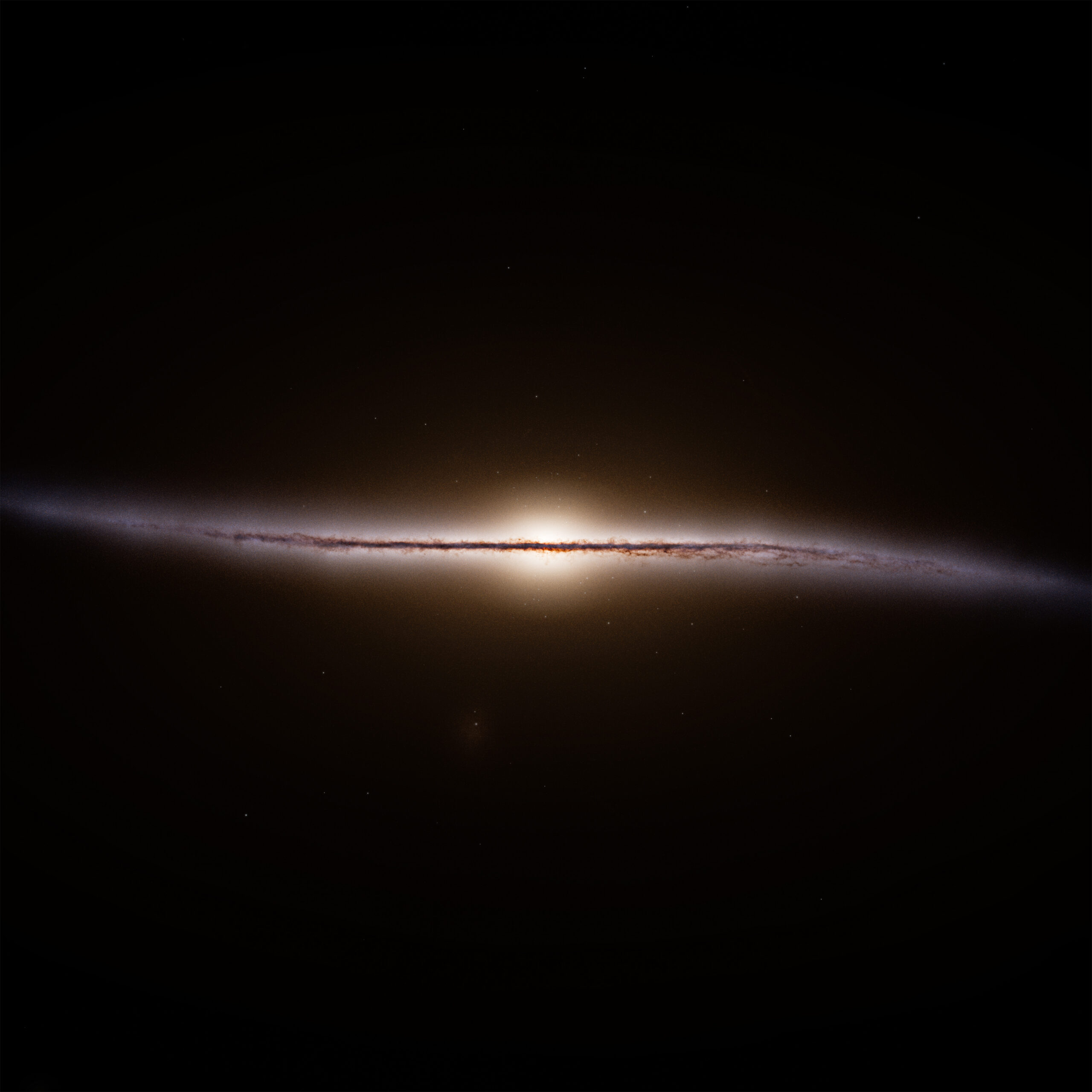
The Milky Way’s flattened disc appears to preserve two different phases of its formation. Research highlighted by the Instituto de Astrofísica de Canarias on October 19, 2026 connects the heights of stellar populations above the galactic plane with increasingly precise estimates of their ages.
The ChronoGal study, published in The Astrophysical Journal Letters, uses Gaia data for stellar samples in the Sun’s neighborhood. Its reconstruction finds a pronounced change around 10.85 billion years ago. Before that transition, the inferred scale height fell from more than 1.26 kiloparsecs to roughly 0.5 kiloparsecs in about two billion years. Younger populations show a much gentler decline, reaching around 0.1 kiloparsecs for the youngest stars. Scale height describes a population’s vertical distribution, rather than the full edge-to-edge thickness of the Galaxy.
The interpretation favors an early gas disc that was initially turbulent and became calmer over time, allowing later stars to form in thinner layers. It does not imply that existing old stars simply sank together into today’s thin disc.
The competing explanation discussed in the institution’s account starts with stars forming in a thin distribution and gradually being stirred away from the plane by gravitational encounters and galactic structures. Precise ages help distinguish this slow heating picture from a changing birth environment. The authors argue that the especially rapid early change favors the latter for the thick disc’s formation.
The result draws on a mission whose observing phase has already ended. ESA announced Gaia’s final science observations in January 2025, after more than three trillion measurements of about two billion stars and other objects. Repeated observations mapped stellar positions, distances, motion and brightness, giving researchers the raw material for reconstructing the Galaxy’s past.
This is a reconstruction, not a movie of the young Galaxy. The surviving local stellar populations let researchers test different histories by comparing where stars are today with when those stars formed.
The best Milky Way map, by Gaia (edge-on): an artist’s impression based on mission data, not an external photograph. Credit: ESA/Gaia/DPAC, Stefan Payne-Wardenaar. CC BY-SA 3.0 IGO; resized for display.
Leave a Reply