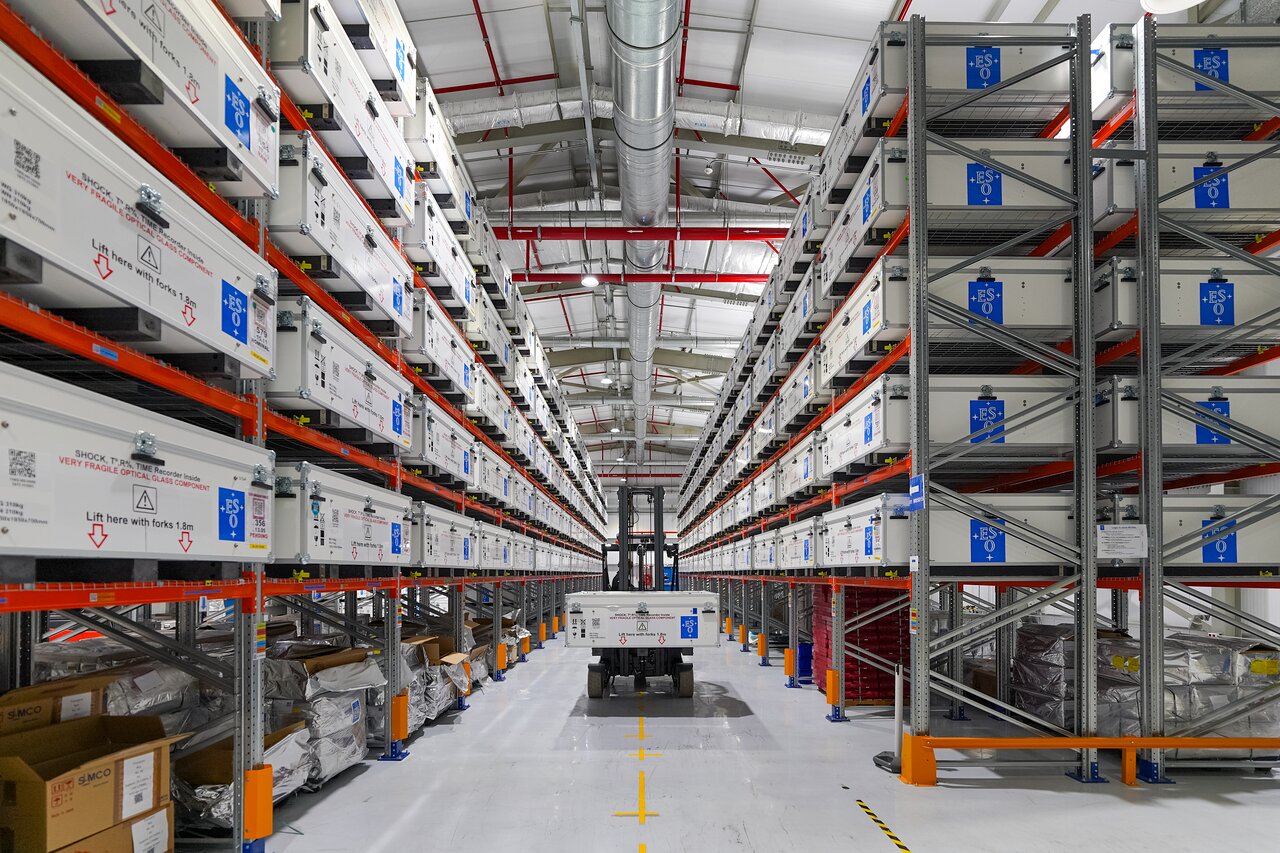
The Extremely Large Telescope’s main mirror is not a single enormous disc awaiting delivery. It is an optical system assembled from hundreds of precisely shaped pieces—and maintaining it will require a continuing exchange of those pieces. An ESO milestone announced October 14, 2026 makes that distinction especially useful: nearly 500 mirror segments had reached Chile.
That shipment count is more than half the complete production run of 931, not a claim that half the telescope was already observing. The working primary mirror will contain 798 segments. Another 133 provide replacements while used segments receive fresh reflective coatings. ESO also reported that the last segment had entered production at Safran Reosc in France.
Why build more mirrors than fit?
According to ESO’s technical description of M1, the 39-metre mirror has six sectors, each containing 133 segment types. A seventh set supplies a corresponding spare for every type. The pieces are not all interchangeable: their optical shapes depend on where they sit in the overall curved surface.
Over time, reflective coatings need renewal. The maintenance plan calls for exchanging two segments a day, keeping the telescope supplied with freshly coated surfaces without routinely leaving an empty position. That makes the spare set part of the operating design, not simply insurance against broken glass.
The mirror also has to behave as one surface while the telescope moves and temperatures and wind conditions change. Sensors measure neighboring segments’ relative positions; actuators correct their alignment. Merely placing hundreds of polished hexagons side by side would not produce the intended image.
A delivery milestone, not first light
The arriving segments go to the ELT Technical Facility at Paranal for inspection and coating. They are not being counted as installed, aligned and commissioned on the telescope at Cerro Armazones. ESO’s October announcement put the overall project above 75 percent complete and scheduled first observations with scientific instruments for late 2030. That remains a plan, not a completed event.
It is worth separating several milestones that are often compressed into “the telescope is ready”: manufacturing a component, delivering it, integrating it into a working system, and demonstrating scientific performance. The October update establishes real progress at the manufacturing and logistics stages. It does not erase the later engineering work.
What the size is intended to buy
ESO’s specifications give the telescope a light-collecting area of 978 square metres and describe an optical and near-infrared observatory with a five-mirror design. Its location is Cerro Armazones in Chile’s Atacama Desert, at an altitude of 3,046 metres.
Collecting area and image quality are different requirements. A larger collecting surface supplies more light for measuring faint targets, while alignment, atmospheric correction and the scientific instruments determine how usefully that light can be analyzed. The mirror shipment matters because it supplies the physical surface on which those later capabilities depend. The less photogenic work of storage, coating and replacement will remain essential long after the construction headlines end.
Featured photograph: mirror-segment containers at the ELT Technical Facility, early October 2026. Credit: ESO, CC BY 4.0.
Leave a Reply