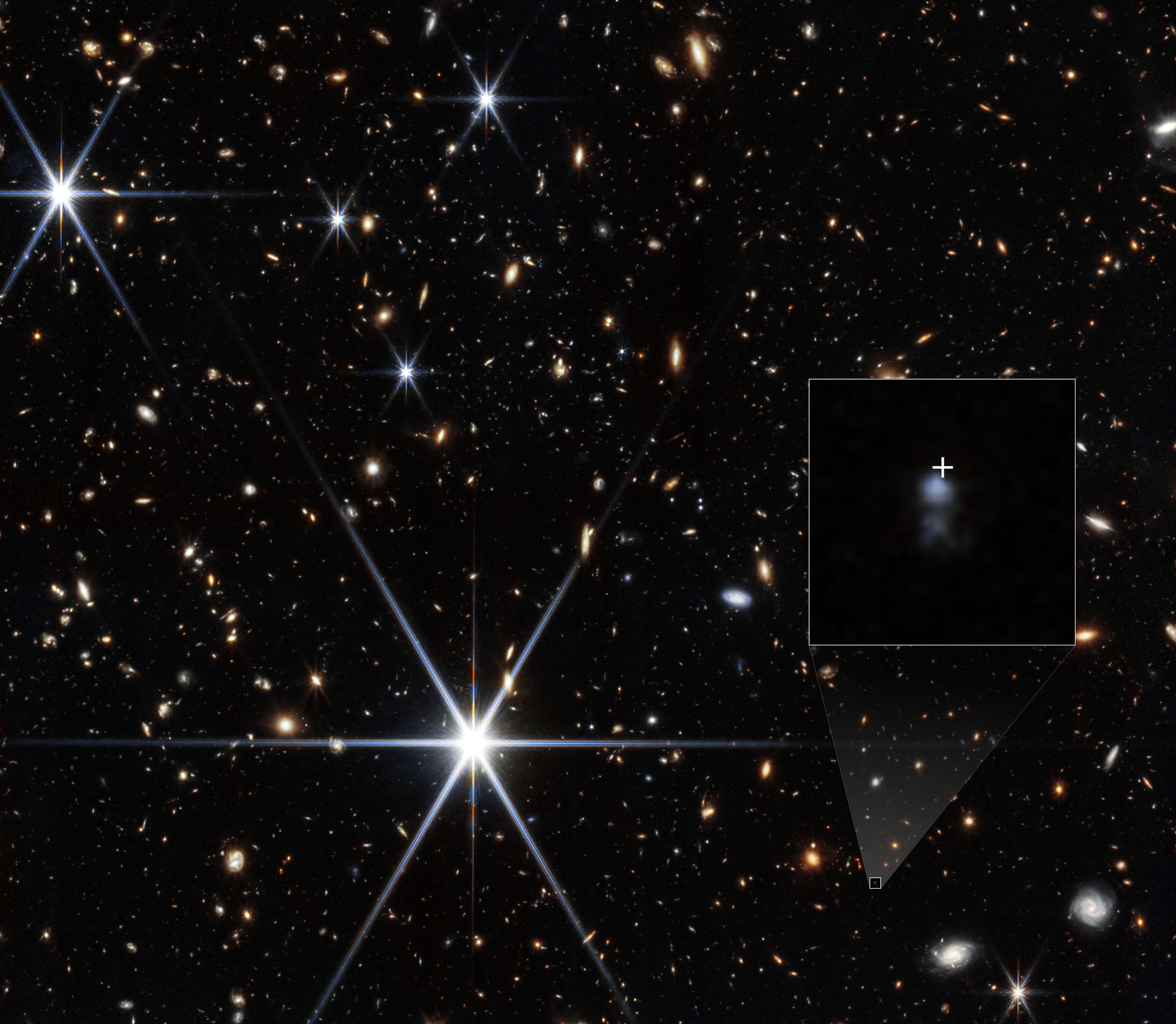
Webb’s NIRCam view marks the location of FRB 20240304B near its dwarf-galaxy host. The infrared exposures were taken on December 26, 2024; the radio burst was detected in March 2024. Image: NASA, ESA, CSA, STScI, Themiya Nanayakkara (USYD); Image Processing: Joseph DePasquale (STScI).
A radio flash lasting only milliseconds has given astronomers a view into a much younger universe. New research highlighted in an October 8, 2026 Webb release identifies the host of FRB 20240304B as a small, actively star-forming galaxy seen when the universe was about three billion years old.
The chronology matters. South Africa’s MeerKAT telescope detected the burst on March 4, 2024, through the MeerTRAP project. A preprint appeared in August 2025; the new development is its publication in Science and the accompanying October 2026 research announcements. The burst was not first observed this week.
A distance measured through its galaxy
The radio observations gave the team a precise sky position, but ground-based telescopes could not reveal the host. Webb’s NIRCam found it, and NIRSpec measured a redshift of 2.148. The researchers describe it as the most distant fast radio burst yet identified with a host.
Cosmological redshift records how much light has stretched while traveling through an expanding universe. Astronomers use that stretch, together with a cosmological model, to place an object in cosmic history. Comparing objects by redshift keeps the measured quantity separate from distance estimates, which also depend on the definition of distance being used.
The released NIRCam image shows the host and marks the burst’s location. Its underlying exposures were taken on December 26, 2024. Readers are seeing the galaxy in an infrared observation taken after the radio event, rather than a photograph of the millisecond flash itself.
A young environment narrows the possibilities
The University of Sydney’s research announcement describes the galaxy as small, poor in heavy elements and undergoing vigorous star formation. That environment provides a clue about the object that produced the burst.
One proposed source is a young magnetar, a neutron star with an exceptionally strong magnetic field, left behind after a massive star explodes. Another family of explanations involves older neutron stars merging. A youthful stellar population more naturally accommodates a source that becomes active soon after star formation than one requiring a long delay.
That comparison favors a young-magnetar explanation for this event. It does not identify the individual object directly or establish that every fast radio burst has the same origin. The strength of the result comes from connecting a transient signal with a measured environment.
The journey carries information too
The authors’ preprint also describes the burst as a probe of ionized ordinary matter across roughly 80 percent of cosmic history. Its path intersects the Virgo Cluster and a more distant foreground group, allowing the signal to carry information about material between the source and Earth.
Future bursts with securely identified hosts could extend that approach to other sightlines. Each adds two connected measurements: an energetic event in a particular galaxy, and a sample of the intervening universe. This result shows why finding the host can be as consequential as detecting the flash.
Leave a Reply