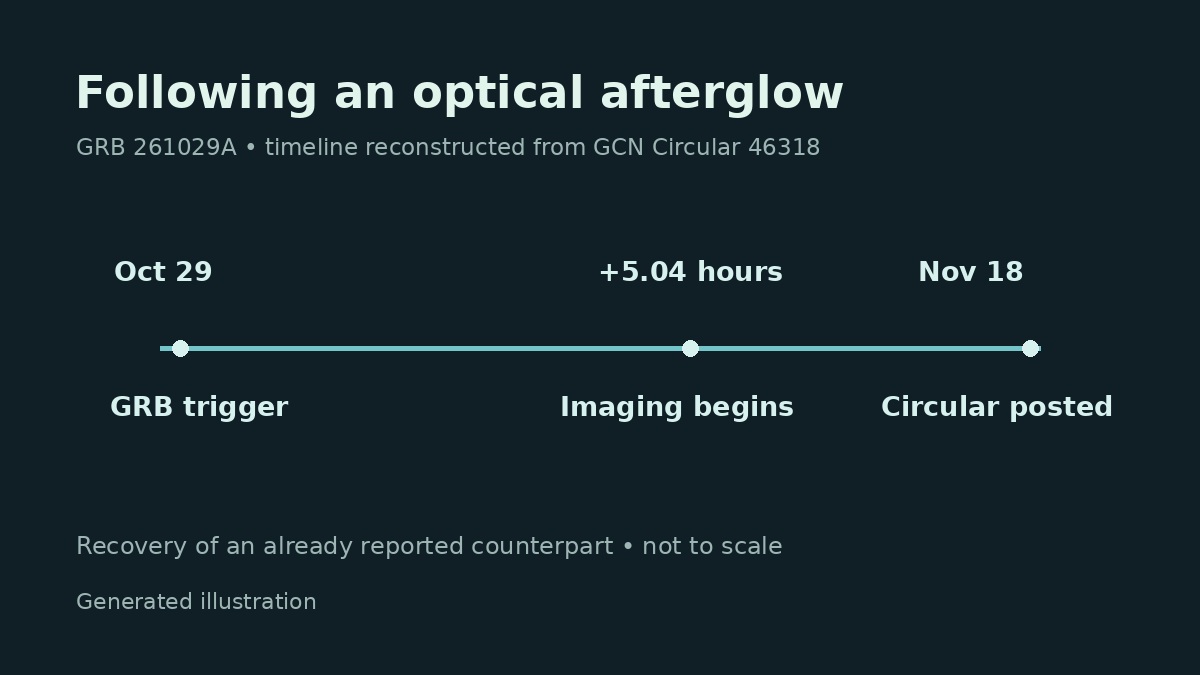
Two telescopes in the Kilonova Catcher network began observing the field of gamma-ray burst GRB 261029A just over five hours after the October 29 trigger. Their November 18 Gamma-ray Coordinates Network circular reports that they recovered the optical counterpart already reported by other observers. It is independent follow-up, not a first detection or a classification of the event as a kilonova.
The observers used image subtraction against a Pan-STARRS reference to pick out what had changed in the field. In practice, that compares follow-up images with a view of the same stars before the burst. It helps expose a newly appearing source that might be difficult to pick out from the surrounding field alone. The teams used different filters and calibrations, so simply comparing their reported magnitudes would not give a clean measurement of how fast the source faded.
Kilonova Catcher is an existing citizen-science program, not a new project launched with this circular. NASA’s participant listing explains what equipment and training are normally needed. This observation is a recent example of how a network can add its own measurements to an alert that professional and volunteer groups can follow together.
Sources: GCN Circular 46318, observing team report; NASA’s project listing.
Featured image: Generated illustration
Leave a Reply