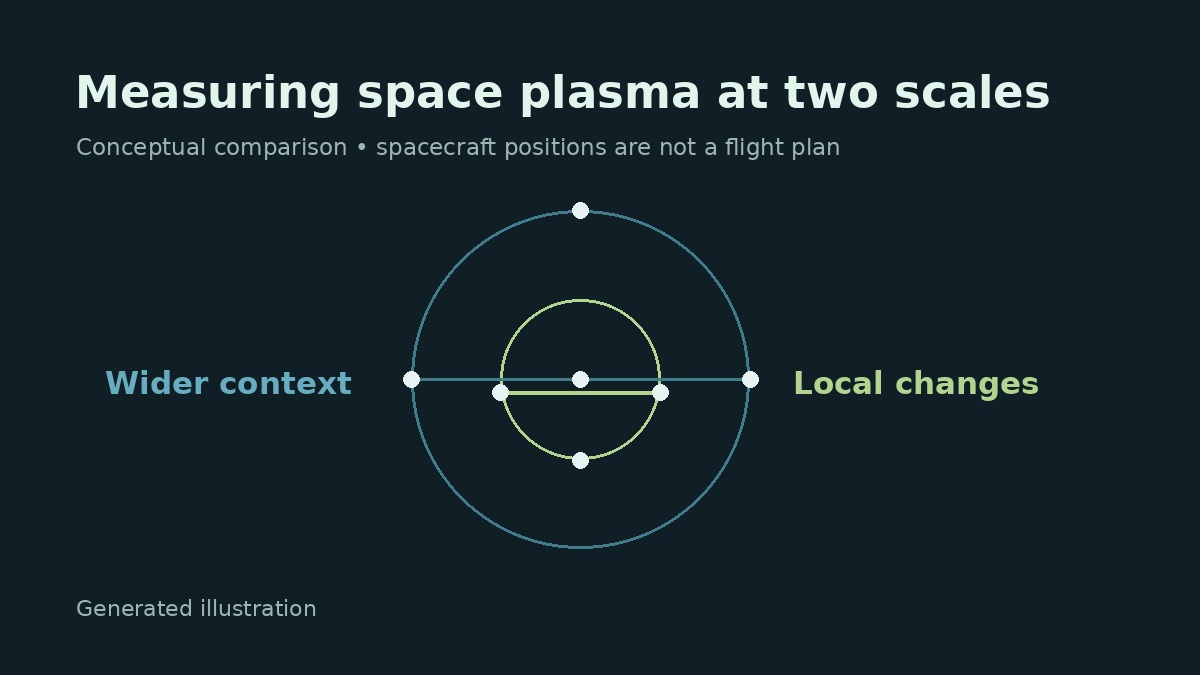
The European Space Agency selected Plasma Observatory on November 19 as its next medium-class science mission, known as M7. The plan calls for seven coordinated spacecraft to investigate how energy from the Sun moves through the plasma around Earth. Selection is not formal adoption or a fixed launch date; ESA describes launch in the late 2030s as the current expectation.
A spacecraft crossing a plasma boundary can record changes in fields and particle motion, but it cannot by itself tell whether the boundary changed in time or the spacecraft moved into a different part of it. Comparing multiple spacecraft helps address that ambiguity. ESA says its four-spacecraft Cluster mission studied one scale at a time. Plasma Observatory is designed to take measurements across more than one separation together.
That distinction drives the science: widely spaced readings can characterize what is happening across a larger plasma region while closer readings test what is happening locally. Neither alone tells the team how the two are linked. The measurements, not a claim that a specific mechanism has already been proved, are the point of the selection.
Sources: ESA’s November 19 selection; ESA’s earlier mission recommendation.
Featured image: Generated illustration
Leave a Reply