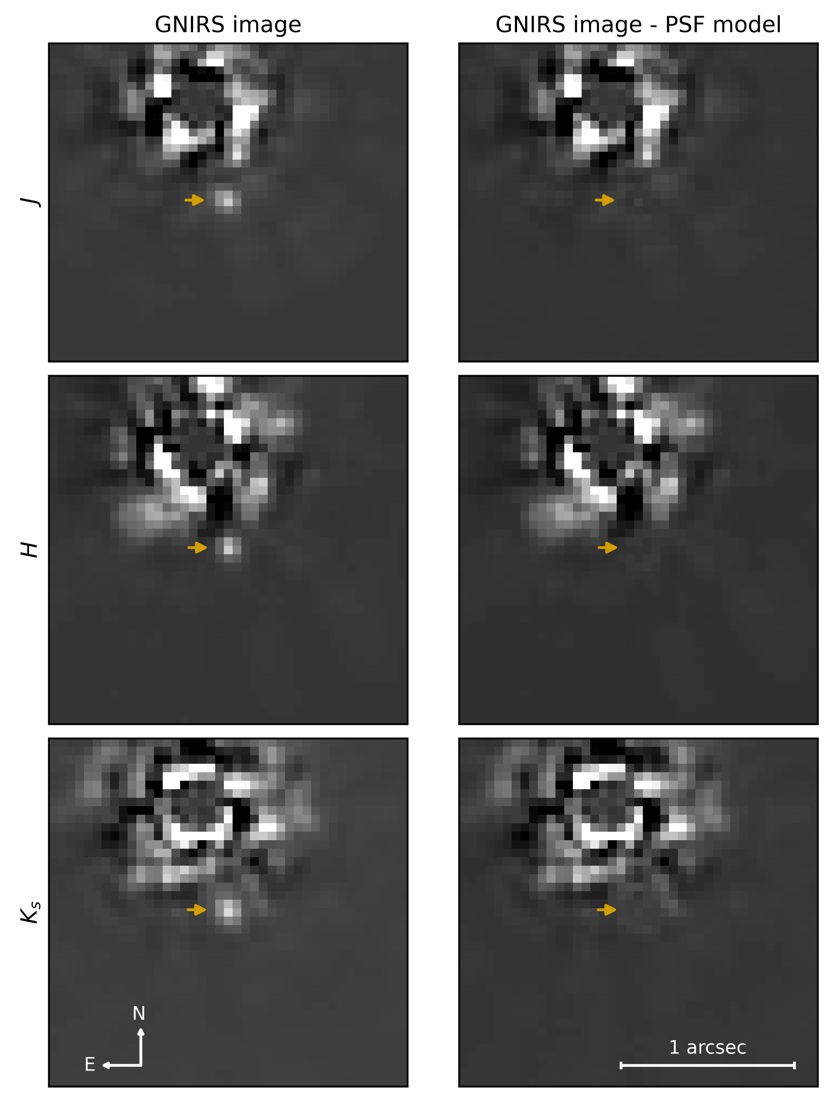
Welopōʻai, a system about 28 light-years away, was already known to contain a red dwarf and a widely separated white dwarf. A team reporting in Astronomy & Astrophysics identified a second white dwarf closer in. The authors describe it as the nearest known triple system containing more than one white dwarf.
Over 4.8 years, Canada-France-Hawaii Telescope’s SPIRou instrument recorded a roughly 16-kilometer-per-second peak-to-peak change in the red dwarf’s radial velocity. The amplitude was too large for the planetary interpretation the researchers considered. Gemini North observations then provided an independent test: speckle imaging separated the close source from the red dwarf’s glare, and near-infrared GNIRS imaging detected it in three bands.
The team combined the star’s changing line-of-sight speed with the measured positions to infer a roughly 9.8-year inner orbit and a mass of about 0.618 Suns for the newly identified white dwarf. The outer white dwarf’s separation, about 124 astronomical units, is measured in projection and is not a measurement of that orbit’s full size. The result rests on combining motion with imaging, not reading the mass from one picture.
Sources: Astronomy & Astrophysics paper; authors’ full manuscript and Figure 3; image license.
Featured image: Resized processed GNIRS observations, Figure 3 in Artigau et al. (2026), CC BY 4.0. Yellow arrows mark the close companion.
Leave a Reply