NASA’s Neil Gehrels Swift Observatory re-entered Earth’s atmosphere on November 4, closing the spacecraft’s nearly 22-year stay in orbit. The U.S. Space Force confirmed re-entry at 7:39 a.m. Eastern Standard Time, or 6:39 a.m. in Chicago, according to NASA’s updated mission notice.
The reported location was over Indonesia’s North Sumatra region, near 3.4 degrees north latitude and 98.6 degrees east longitude. NASA said it expected most of the spacecraft to burn up during atmospheric passage, although some components may have survived. The notice does not identify recovered debris or provide a confirmed ground-impact location.
A confirmed end to the orbit
The new development is the confirmation of re-entry itself. Swift’s science shutdown had already been announced in October. NASA originally published its latest notice on November 2, then revised it on November 4 after receiving the Space Force confirmation. Readers following the earlier forecast can therefore distinguish the predicted return from the now-confirmed event.
The coordinates describe the reported re-entry location. They should not be treated as a precise address for surviving hardware. Likewise, the possibility that components survived is not evidence that fragments have been found. NASA’s short update leaves those questions open.
Why Swift mattered to a changing sky
Swift launched on November 20, 2004, with a two-year primary mission. Its specialty was speed: it could catch a brief high-energy flash and turn toward it while the aftermath was still bright. That ability made the observatory particularly valuable for gamma-ray bursts, events associated with catastrophic stellar deaths and mergers involving compact objects.
NASA’s spacecraft description explains how its three instruments divided that work. The Burst Alert Telescope detected and located a burst, while the X-Ray Telescope and Ultraviolet/Optical Telescope examined its afterglow. After a detection, Swift could autonomously repoint in roughly 20 to 100 seconds. Observations across different wavelengths gave researchers a more complete view of an explosion than a single instrument could provide.
Its alerts also helped other observatories turn toward the same source. That coordination mattered because a transient can change substantially while astronomers are still organizing a follow-up. Swift made the initial discovery and the subsequent observations parts of a connected process.
The spacecraft is gone; its observations remain
Over time, Swift became a broader astronomical observatory. Its work extended to stellar flares, supernovae, active galaxies and stars disrupted by massive black holes, as well as comets and asteroids closer to home. NASA’s mission page preserves access to that scientific record and the observatory’s history.
November 4 marks a physical endpoint for the satellite, rather than a new explanation for its earlier shutdown. The immediate news is now settled: Swift has returned to the atmosphere. Its contribution to astronomy continues through the measurements and coordinated observations accumulated during more than two decades of operation.
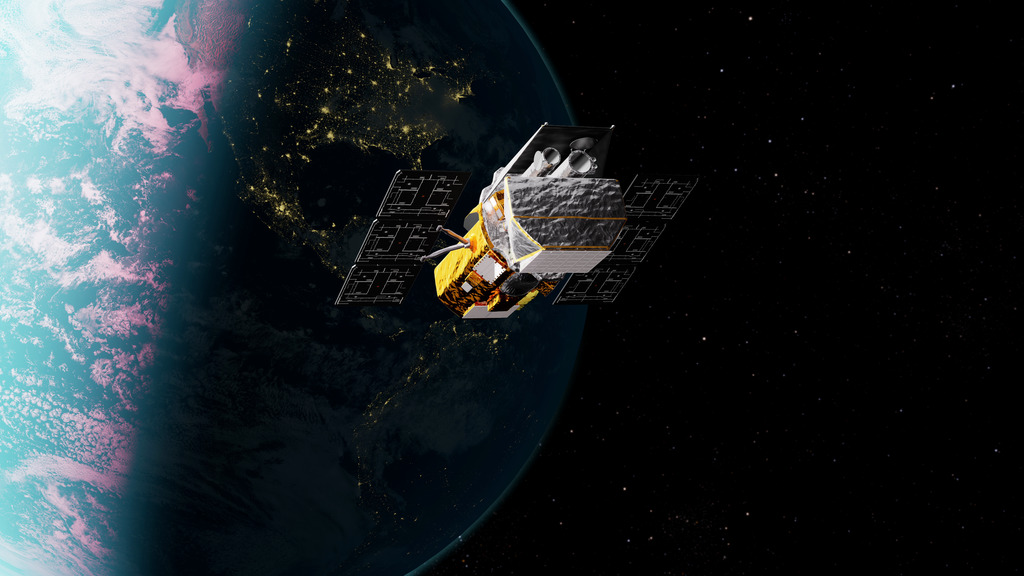
Featured image: Artist’s concept of Swift in orbit, not an image of its November 4 re-entry. Credit: NASA’s Goddard Space Flight Center Conceptual Image Lab. Image licence.
Leave a Reply