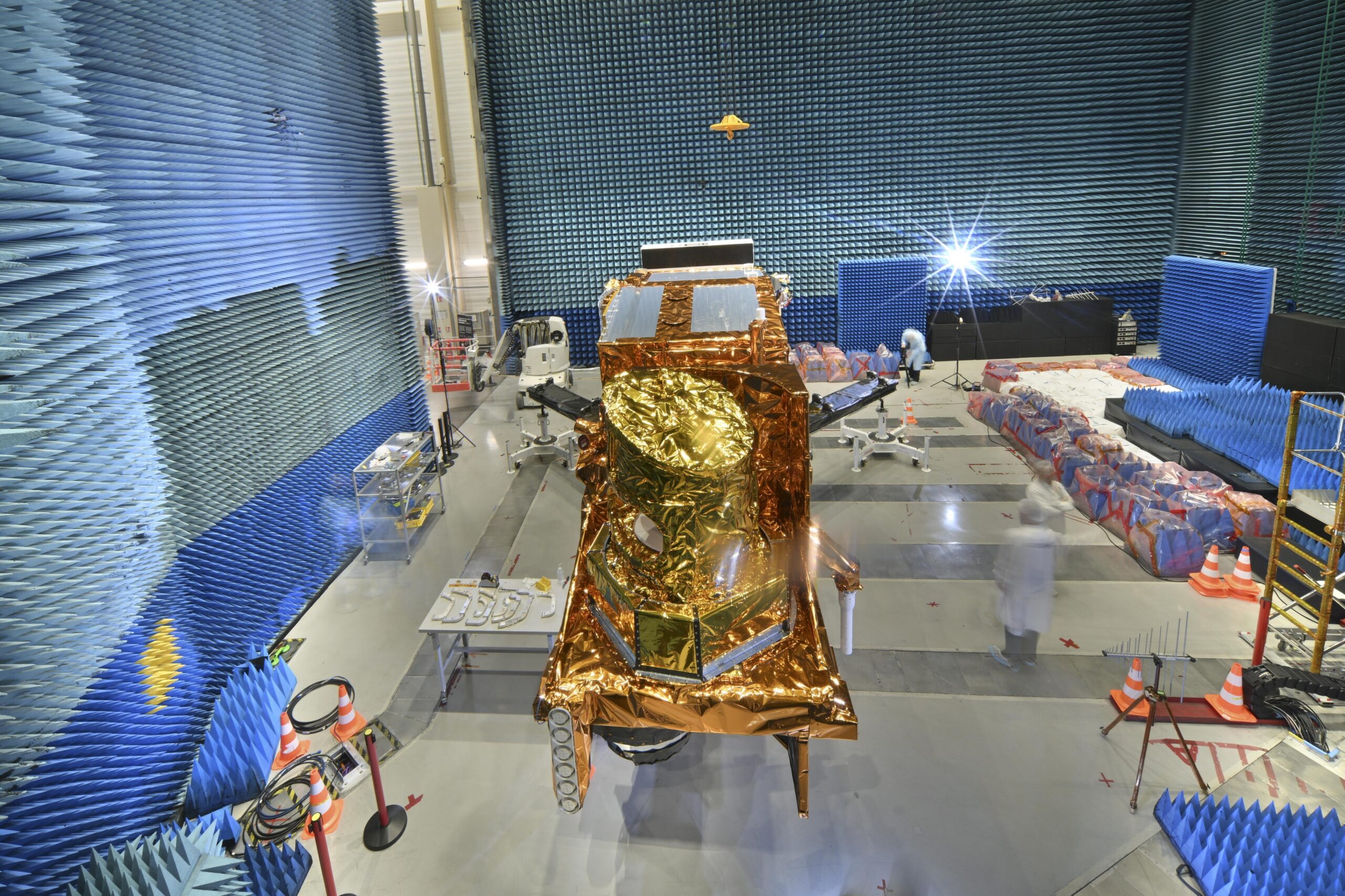
Europe’s next MetOp weather satellite has moved from protected storage into the cleanroom phase of its launch campaign. In a November 4 update, the European Space Agency said MetOp-SG-B1 had been removed from its transport container at Europe’s Spaceport in French Guiana. Engineers are preparing to reactivate it ahead of a launch planned toward the end of 2026.
The spacecraft reached Kourou on October 16 after leaving Bordeaux aboard the sail-assisted vessel Canopée on October 6. Its container maintained a dry, nitrogen-rich environment at a steady 22 degrees Celsius during storage.
Switching on the satellite, carrying out final checks and fuelling it are still ahead in the reported sequence. It will then be enclosed in its Ariane 6 rocket’s protective fairing and moved to the launch pad. ESA has not announced an exact launch date in this update.
One half of a complementary pair
MetOp-SG-B1 is part of a weather-observing system built around two different satellite types. The A and B spacecraft carry complementary instruments, allowing their measurements to be combined rather than simply duplicating the same observations. MetOp-SG-A1 launched on August 13, 2025.
According to ESA’s mission overview, the full programme consists of six spacecraft arranged as three successive pairs. They will operate in polar orbit at approximately 800 kilometres altitude, providing global observations for weather forecasting and climate work over more than two decades. Temperature, precipitation, clouds and winds are among the variables the system is designed to measure.
The successive-pair approach makes continuity part of the mission design. A forecasting system needs repeated measurements, while climate research also depends on observations sustained over long periods. The programme is intended to serve both timescales.
What the B satellite adds
ESA’s instrument description lists five payloads for the B-type spacecraft. A scatterometer measures ocean-surface winds and land-surface soil moisture. A radio-occultation sounder supplies atmospheric temperature and humidity profiles, along with information about the ionosphere.
The microwave imager will observe precipitation and sea-ice extent, while the ice-cloud imager measures ice within clouds. The Argos-4 data-collection system gathers and relays measurements from platforms such as buoys, ships, balloons and aircraft.
This mix connects observations made from orbit with information collected closer to the surface. It also illustrates why a weather satellite is more than a camera looking down at cloud tops: different instruments reveal different physical properties of the atmosphere, oceans and land.
Preparation, not yet liftoff
The current milestone moves the spacecraft closer to flight, but important work remains between removal from storage and launch. The distinction matters when reading an announcement about waking a satellite: preparation for switch-on is not confirmation that activation or final testing has finished.
For MetOp-SG-B1, the next checkpoints are those campaign operations. Once they are completed, the spacecraft can proceed toward joining the A1 satellite and expanding the measurements available to forecasters.
Featured image: MetOp-SG-B1 during earlier testing in Toulouse, in an image published November 24, 2025. Credit: ESA–M. Pédoussaut, CC BY-SA 3.0 IGO. Displayed crop. Image licence.
Leave a Reply