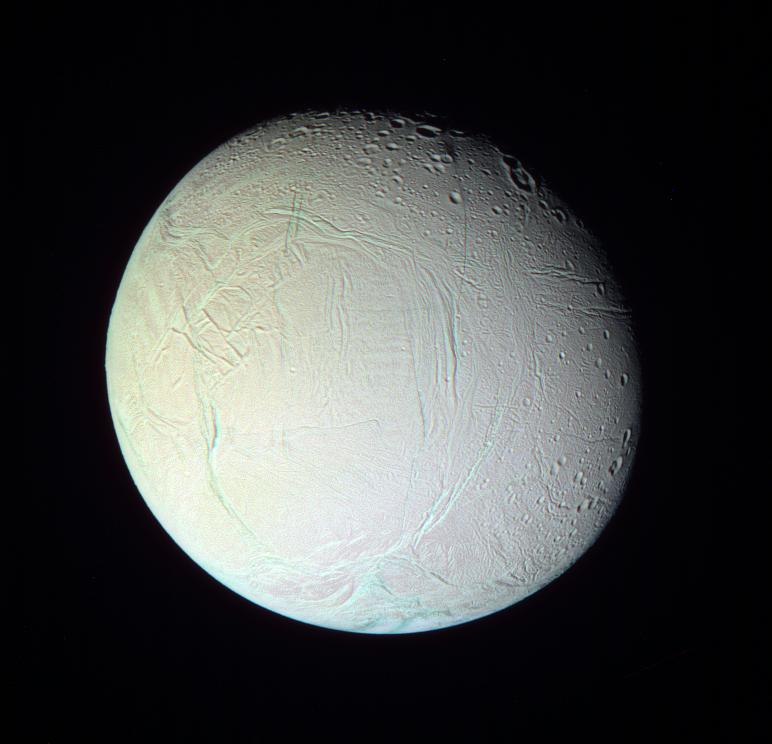
Enceladus’s fractured surface may preserve clues to how long its hidden ocean has endured. A study by Chelsea Eakins, Francis Nimmo and Paul Schenk uses the bending of icy terrain to reconstruct earlier heating—not to claim a detection of life.
The paper, posted on October 13, 2026, carries a journal reference to Icarus. Researchers modeled the ice shell’s response around ridges and troughs. Most inferred ancient heat fluxes fall near 125–200 milliwatts per square metre.
A warmer past beyond the south pole
The estimates suggest that regions outside today’s active south-polar terrain once experienced stronger heating, then cooled as their ice thickened. Similar peak heating across terrains of different ages is compatible with sustained tidal energy and a long-lived ocean.
What the ice cannot settle
The full study cautions that bending can preserve peak heat while obscuring colder intervals. Cyclic heating remains possible; local estimates are not global heat budgets, and crater-based ages carry uncertainty.
The result strengthens a geological argument about ocean persistence, but does not establish uninterrupted habitability or the presence of organisms.
Featured image: archival false-color Cassini observations from January 17, 2006, not a new 2026 photograph. Credit: NASA/JPL/Space Science Institute; used under JPL’s image-use policy.
Leave a Reply