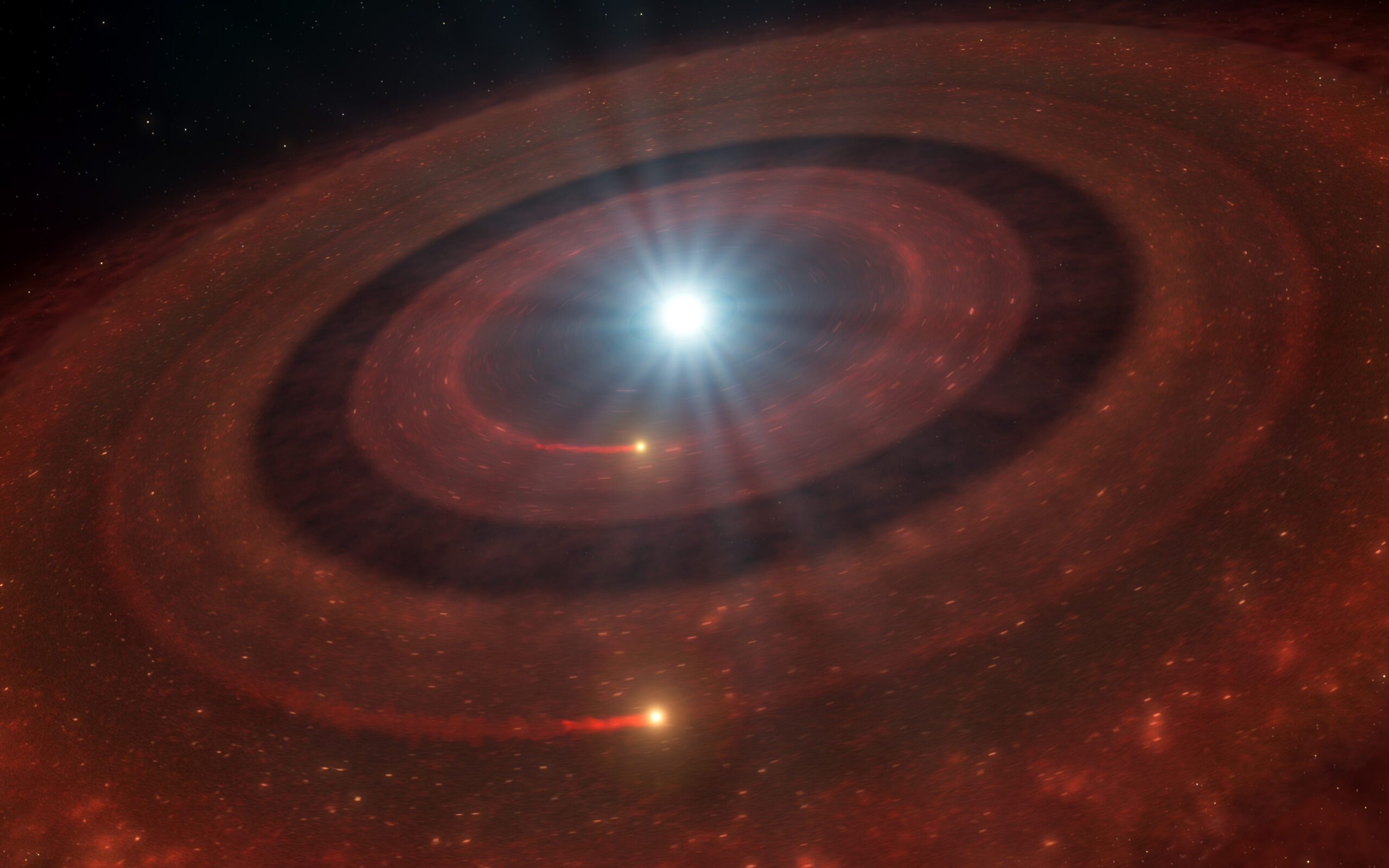
A white dwarf’s debris is arranged in two distinct rings rather than the single gas disc astronomers usually find around such stars. The structure offers a new way to investigate what remains after a planetary system’s host star dies—but the bodies thought to maintain it have not been directly seen.
The European Southern Observatory announced the result on October 27, 2026. The study of WD J1328−1450 appears in Nature Astronomy.
Four peaks reveal a divided disc
Researchers used the X-shooter instrument on ESO’s Very Large Telescope to examine the system’s light. According to the University of Warwick’s account, comparable systems normally produce two spectral peaks; this one produces four, indicating two concentric gas rings separated by a gap.
Repeated observations between 2021 and 2023 showed that the arrangement persisted for more than two years. The discovery announcement is new; the observations are not images taken this week.
The chemistry complicates the story
The gas contains calcium, oxygen, magnesium and iron—elements familiar from rocky planetary material. But the inner ring is richer in magnesium than the outer ring.
That contrast could reflect debris from separate parent bodies with different compositions. Another possibility is material from different layers of one body. The chemical difference alone does not settle which history occurred.
An interpretation, not two photographed planets
The team proposes that two surviving planetesimals interact with surrounding dust and replenish the gas. Their presence and sizes are inferred through models, not measured in direct pictures.
The important result is the unexpectedly complex debris structure. It broadens the evidence for how planetary material can persist around a stellar remnant, without establishing a detailed prediction for Earth’s eventual fate.
Featured image: artist’s impression of the proposed debris system, not a telescope photograph. Credit: ESO/L. Calçada; CC BY 4.0. Original artwork, resized for display.
Leave a Reply