A future gravitational-wave observatory could uncover planets around pairs of dead stars by measuring how those planets disturb the stars’ motion. Two studies highlighted by NASA on November 10 describe how LISA might detect these worlds and how the James Webb Space Telescope could help check some of the resulting candidates.
The research is a forecast of what instruments could measure. LISA has not discovered a planet: the observatory is still being developed, with launch planned for the mid-2030s.
A planet changes the signal
The proposed targets are closely orbiting pairs of white dwarfs, the compact remnants of stars such as the Sun. Their orbital motion produces gravitational waves. An additional planet can tug on the pair, introducing a small motion that modifies the signal reaching a distant observer.
In NASA’s account of the studies, that modification appears as signals on either side of the main gravitational-wave frequency. Researchers could search those patterns for evidence of an orbiting companion. The principle resembles the way astronomers detect stellar wobbles with light, although the measured messenger would be gravitational waves.
The second study considers independent checks using Webb. A sufficiently warm planet could supply additional infrared light beyond what the white dwarfs produce. Matching that excess with a gravitational-wave candidate would strengthen the case that the inferred companion is real.
Measuring distances across space
LISA’s mission design uses three spacecraft arranged in a huge triangle, each side about 2.5 million kilometers long. Laser links between the spacecraft will track tiny changes in their relative distances as gravitational waves pass through the formation.
The observatory is led by the European Space Agency with NASA participation. Its broader purpose includes studying compact stellar binaries and merging massive black holes. Exoplanets would be an additional scientific opportunity, extracted from details in signals produced by the stars they accompany.
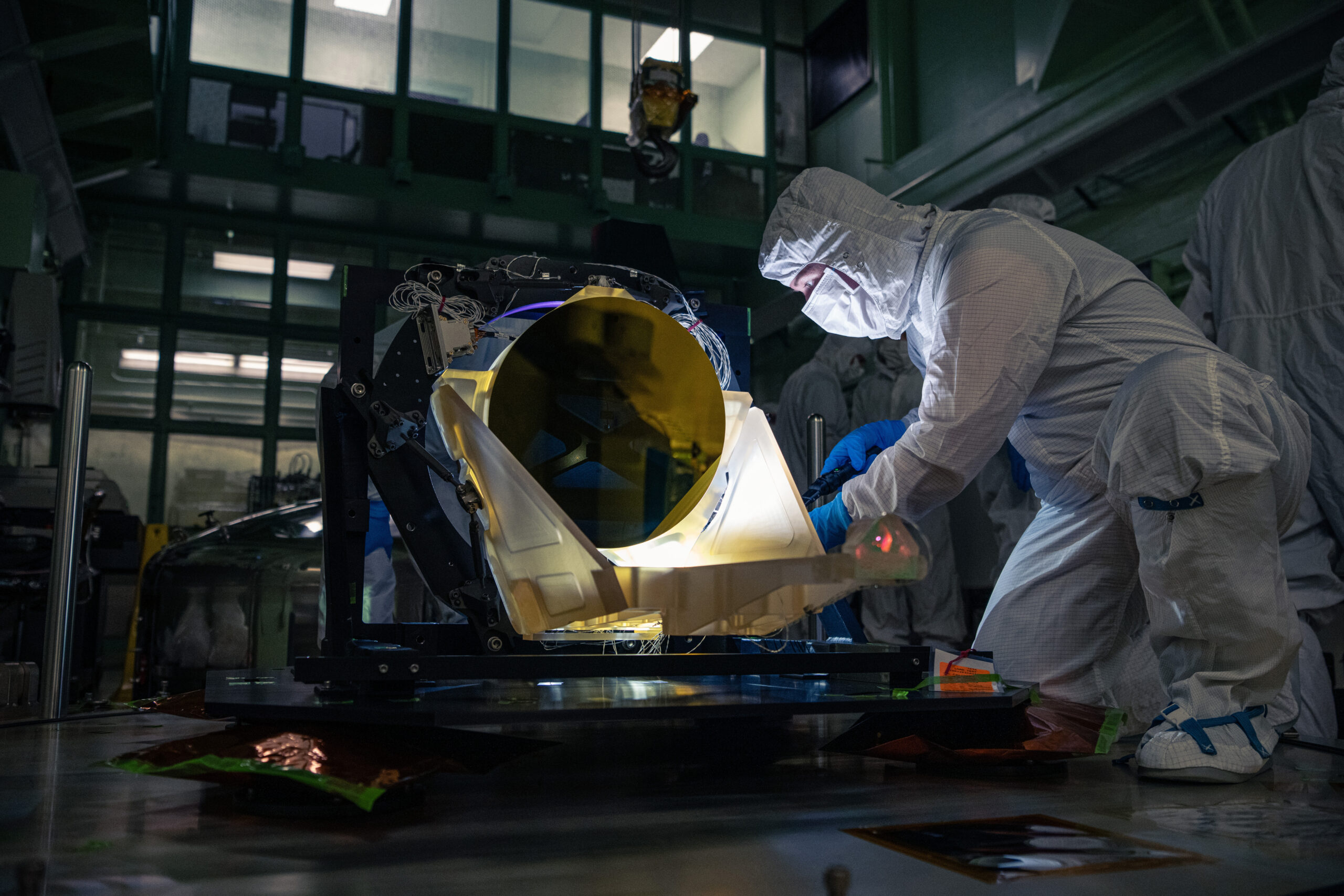
The optical hardware has a demanding job. NASA is providing six telescopes, two for each spacecraft, to send and receive the laser beams. A full-scale engineering prototype was publicly described in 2024, well before the new planet studies. NASA’s prototype documentation explains that its gold-coated mirror is designed for infrared light and that its glass-ceramic structure resists temperature-related changes in shape.
Why confirmation matters
A possible planet signature must survive tests against alternative explanations and instrumental effects. The strongest result would combine independent measurements that point to the same physical system.
That is why the proposed Webb checks matter alongside LISA’s theoretical sensitivity. Finding a pattern and establishing its cause are separate scientific steps. The new work offers a route connecting them, while the actual number and properties of detectable planets will depend on what nature provides and how the completed observatory performs.
If successful, the method would extend planet searches into an unusual setting: worlds associated with two compact stellar remnants, investigated through the motion of spacetime as well as through light.
Featured photograph: A prototype LISA telescope undergoes inspection at NASA’s Goddard Space Flight Center on May 20, 2024. Credit: NASA/Dennis Henry. This shows development hardware, not the observatory in space.
Leave a Reply