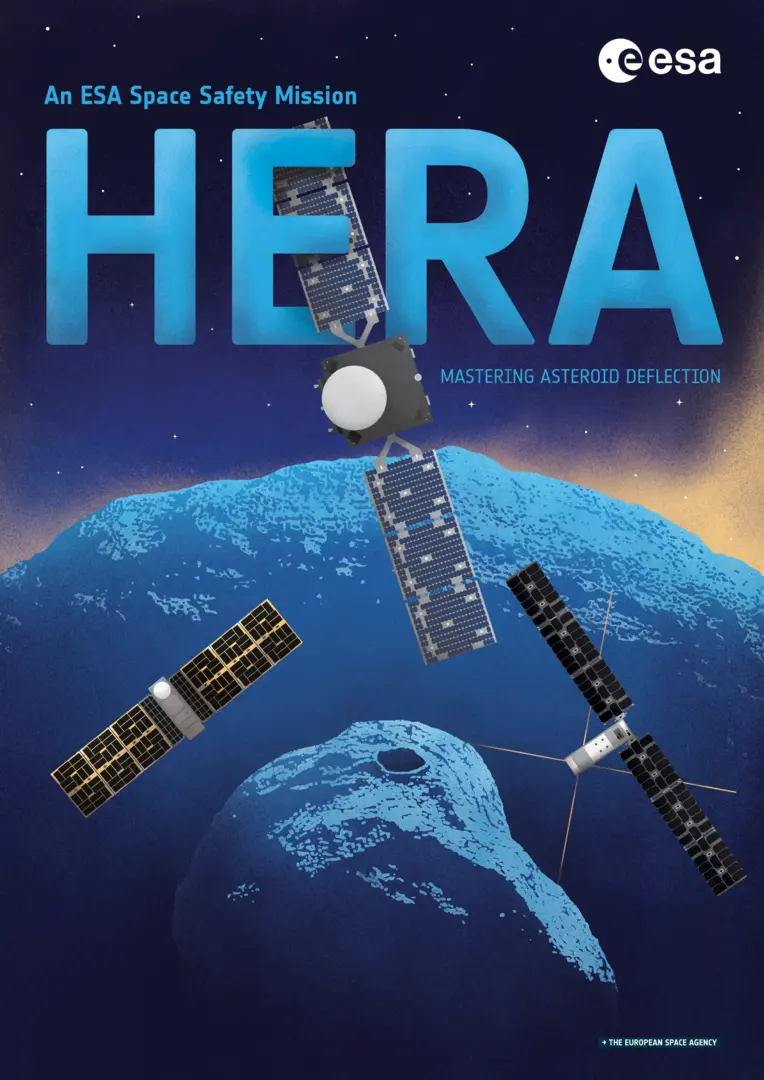
Hera mission artwork, released in March 2026. This illustration is not the newly released asteroid photograph. Credit: ©ESA; acknowledgement: Science Office. Image source.
Hera’s latest asteroid portrait moves the mission beyond identifying two separate points of light. Released by ESA on 5 November 2026, the close-up reveals a different face of Didymos from the one seen by NASA’s DART spacecraft before its 2022 impact on the smaller asteroid, Dimorphos.
Didymos shows an equatorial ridge along with boulders, craters and possible grooves or ridges. Dimorphos is mostly in shadow. The view therefore offers more immediate detail about the larger body than about DART’s impact site.
Scientists are considering whether some visible features might involve material thrown from Dimorphos onto its neighbour. That remains a hypothesis to investigate, not a result established by the photograph. ESA’s close-up announcement says more detailed images of both bodies will be unveiled on 25 November.
A survey, not a single snapshot
The Hera-JAPAN team’s 2 November operations plan explains how the spacecraft is intended to build a fuller picture. Its early survey uses three imagers: the Asteroid Framing Camera, a hyperspectral instrument and a thermal infrared camera. Together, their planned observations address the bodies’ shapes, motions and physical characteristics.
The plan describes an initial rectangular observing trajectory, followed by a closer, bowtie-shaped phase. Rather than relying on one favourable viewing angle, the mission is designed to accumulate observations under different conditions. Later stages include deploying the Juventas and Milani CubeSats to investigate internal structure and surface composition.
These remain planned operations with a schedule that can evolve. The Japanese team explicitly identifies its detailed programme as a plan and notes that the most ambitious close-flyby phase is still being refined. Treating those dates as completed milestones would overstate what has been reported.
Why the larger asteroid matters
The new view is useful precisely because the system contains two interacting bodies. Looking only at the object that was struck would risk missing changes elsewhere. If material travelled between them, the surrounding terrain could provide another record of the impact and its aftermath.
Interpreting that record requires care. A surface feature can be real without its origin being obvious. Shadows can emphasise relief, and a previously unseen side of an asteroid need not represent newly created terrain. Repeated mapping is the route from an intriguing shape to a defensible explanation.
For readers following the earlier images that first separated Didymos and Dimorphos, this is a distinct step forward: visible landscape rather than simple identification. The strongest takeaway is the arrival of questions that can now be tested against local observations. The mission’s scientific value will emerge from those comparisons, not from assigning a cause to every feature in its first close-up.
Leave a Reply