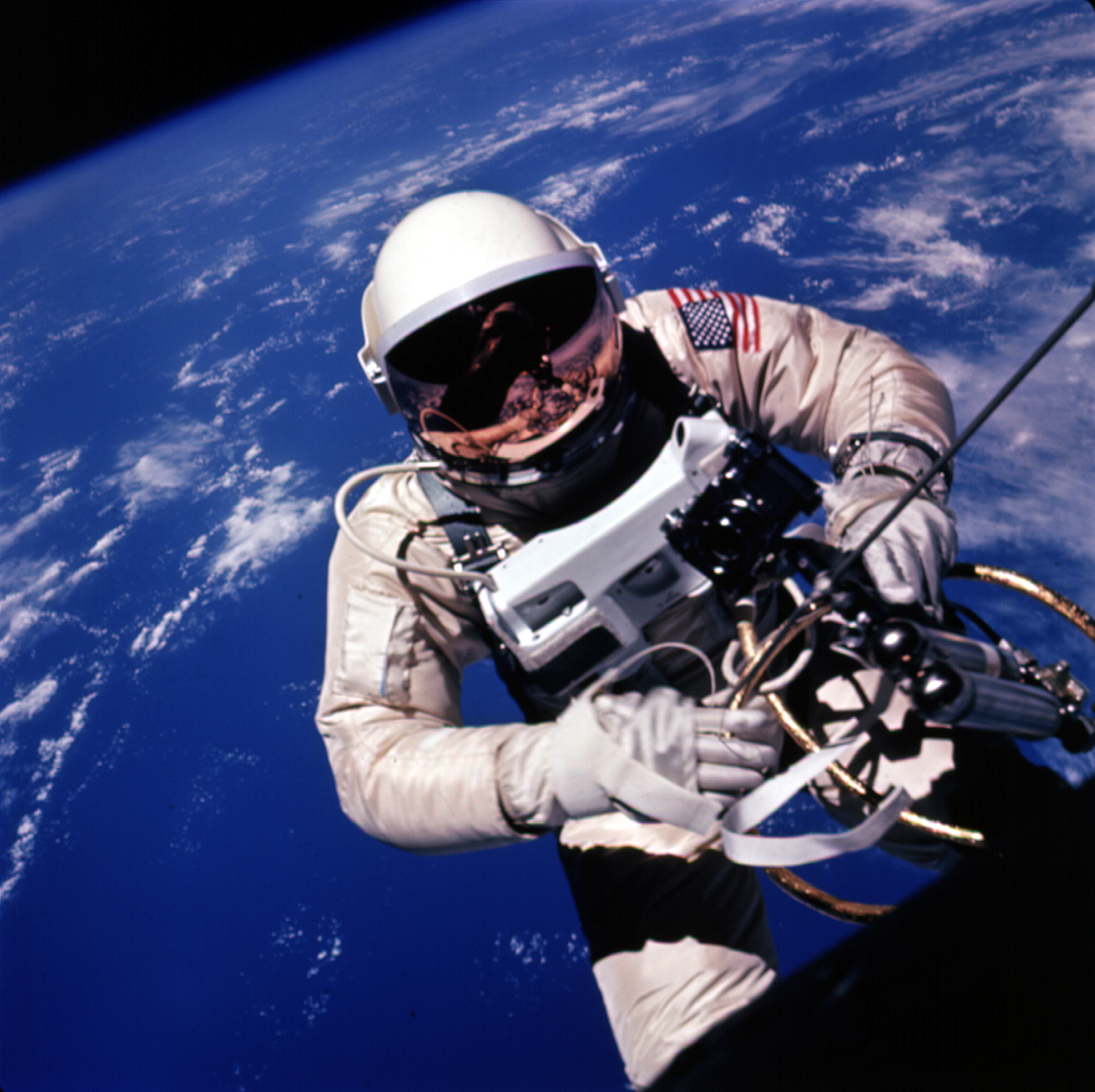
Image: Ed White during his 3 June 1965 spacewalk, photographed by James McDivitt. Mission context only; this is not the reported unidentified object. Credit: NASA / James McDivitt, photograph S65-30431. Public domain, NASA U.S. government photograph Image source.
James McDivitt’s observation of an unfamiliar object during Gemini IV has often been retold as an astronaut’s encounter with an alien craft. His own later account is considerably more cautious. It also raises a separate question: did the photographs associated with the story actually show what he had seen?
The mission and the recollection
Gemini IV launched on 3 June 1965 and returned on 7 June. McDivitt commanded the flight with Edward White, whose spacewalk became the mission’s best-known event. The contemporary NASA mission report establishes the flight’s operational context. The sighting should be examined within that setting, rather than detached from the spacecraft and its activities.
In a NASA oral-history interview recorded on 29 June 1999, McDivitt recalled a white, can-like object with a projecting feature. He said he could not determine its size or distance. He tried to photograph it, but later found nothing in his pictures that recorded the object. He considered material from the spacecraft, such as ice or Mylar, a likely explanation. He also said images later associated with the story appeared to show reflections from window hardware. These are McDivitt’s retrospective statements, not independent measurements of the object. Read the interview, transcript pages 12-45 through 12-47.
Two claims that need separate checks
The first claim is that an astronaut saw something he did not immediately identify. The second is that a particular photograph depicts that same thing. Even if the first claim is accepted, the second does not follow automatically. It needs its own chain of evidence: frame identification, timing, camera orientation and confirmation from the photographer.
This distinction matters whenever a compelling image becomes attached to an eyewitness narrative. The picture may be authentic as a photograph while being incorrectly described. Authenticity answers whether an image is genuine; attribution answers what it shows. Confusing the two can turn an ordinary photographic artifact into apparent corroboration.
Why size and distance matter
A familiar shape can be recognized without a reliable estimate of scale. A small object close to a window and a much larger one farther away may occupy similar angles in the observer’s view. If distance is unknown, claims about physical dimensions and extraordinary motion remain uncertain too.
McDivitt’s explicit acknowledgment of this limitation is valuable testimony. It should not be edited out merely because he was an experienced pilot and astronaut. Expertise can improve an observation without supplying information the viewing conditions did not provide.
The date of the interview matters as well. A 1999 recollection cannot silently replace every contemporary record of a 1965 flight. It can, however, establish how the witness later described his experience and what he thought about imagery attributed to it.
The most defensible conclusion is narrower than the legend: McDivitt reported an unfamiliar object, later favored an ordinary spacecraft-related origin, and did not endorse a successful photograph of that object. Preserving those distinctions makes the historical account more informative, not less interesting.
Leave a Reply