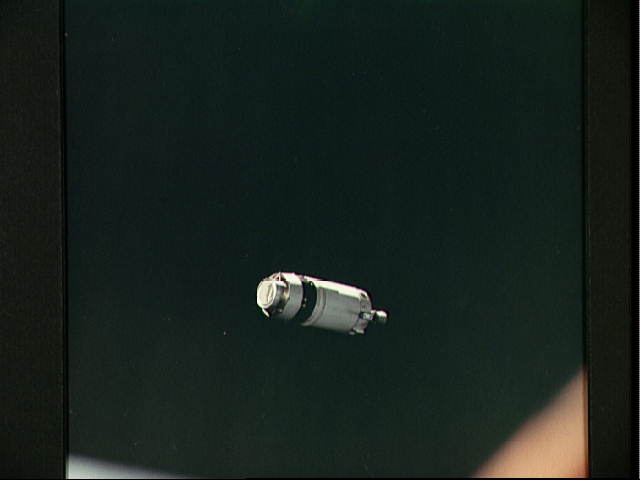
An S-IVB stage photographed from Apollo 8, NASA image AS08-16-2584. Illustrates the hardware type; it is not a photograph of J002E3. Credit: NASA, photograph AS08-16-2584. Image source.
On 3 September 2002, amateur astronomer Bill Yeung discovered a faint moving object designated J002E3. It was not a classic close-encounter report. It was an astronomical detection whose identity was initially uncertain. That makes it a useful comparison for UAP research: the investigation produced increasingly specific evidence rather than relying on a striking appearance.
An unexpected orbit
In an 11 September 2002 notice, NASA’s Center for Near-Earth Object Studies described an object apparently orbiting Earth that could not be matched to a recent launch. Its motion and brightness suggested artificial hardware. The leading candidate was a Saturn V third stage, particularly the one associated with Apollo 12, launched on 14 November 1969. Backward orbital analysis suggested the object had returned from a Sun-centered orbit. This was an initial identification based on several clues, not recovery of a serial number. Read the initial CNEOS analysis.
By 20 September, JPL reported more than one hundred positional measurements from over a dozen amateur astronomers. Refined calculations supported capture into Earth orbit in April 2002. Researchers also reported a surface signature consistent with white paint rather than typical asteroid material. JPL still described Apollo 12 hardware as the most likely identification and discussed less likely alternatives. Read JPL’s follow-up announcement.
Why several kinds of evidence matter
An orbit constrains where an object could have been. Brightness, combined with assumptions about reflectivity, helps constrain its size. Surface measurements add another comparison. No single clue has to carry the entire explanation when independent observations can be tested against the same candidate.
That is stronger reasoning than identifying an object solely because it resembles a familiar shape. It also makes the explanation vulnerable to useful criticism. If a proposed rocket stage could not occupy the measured orbit, or its surface properties were incompatible, the identification would need revision. A hypothesis gains value when it can fail a test.
Do not freeze the first announcement
The two September notices also show why dates belong beside scientific estimates. Early trajectory calculations carried larger uncertainties. The later JPL account substantially reduced the estimated short-term impact chances as additional observations arrived. Quoting an early probability as though it remained the final assessment would misrepresent the investigation.
The same discipline applies to identification language. “Most likely” should not quietly become “proved beyond any doubt” in a retelling. Conversely, the existence of a residual uncertainty does not make every alternative equally plausible. Competing explanations must account for the measurements that favor the leading candidate.
J002E3 is not evidence that all unfamiliar aerial observations are space debris. Its relevance is methodological. A genuine unknown can become understandable through repeated observation, transparent calculations and comparison with historical launch records.
In this case, the intriguing possibility was not a visitor from another civilization but a piece of humanity’s own lunar exploration returning to notice decades later. The investigation became more interesting as the evidence narrowed the possibilities, rather than less.
Leave a Reply