BepiColombo’s next major milestone is approaching: Mercury orbit insertion is scheduled for November 21, 2026. That is an upcoming maneuver, not an accomplished arrival. It also should not be confused with the start of the mission’s full scientific campaign.
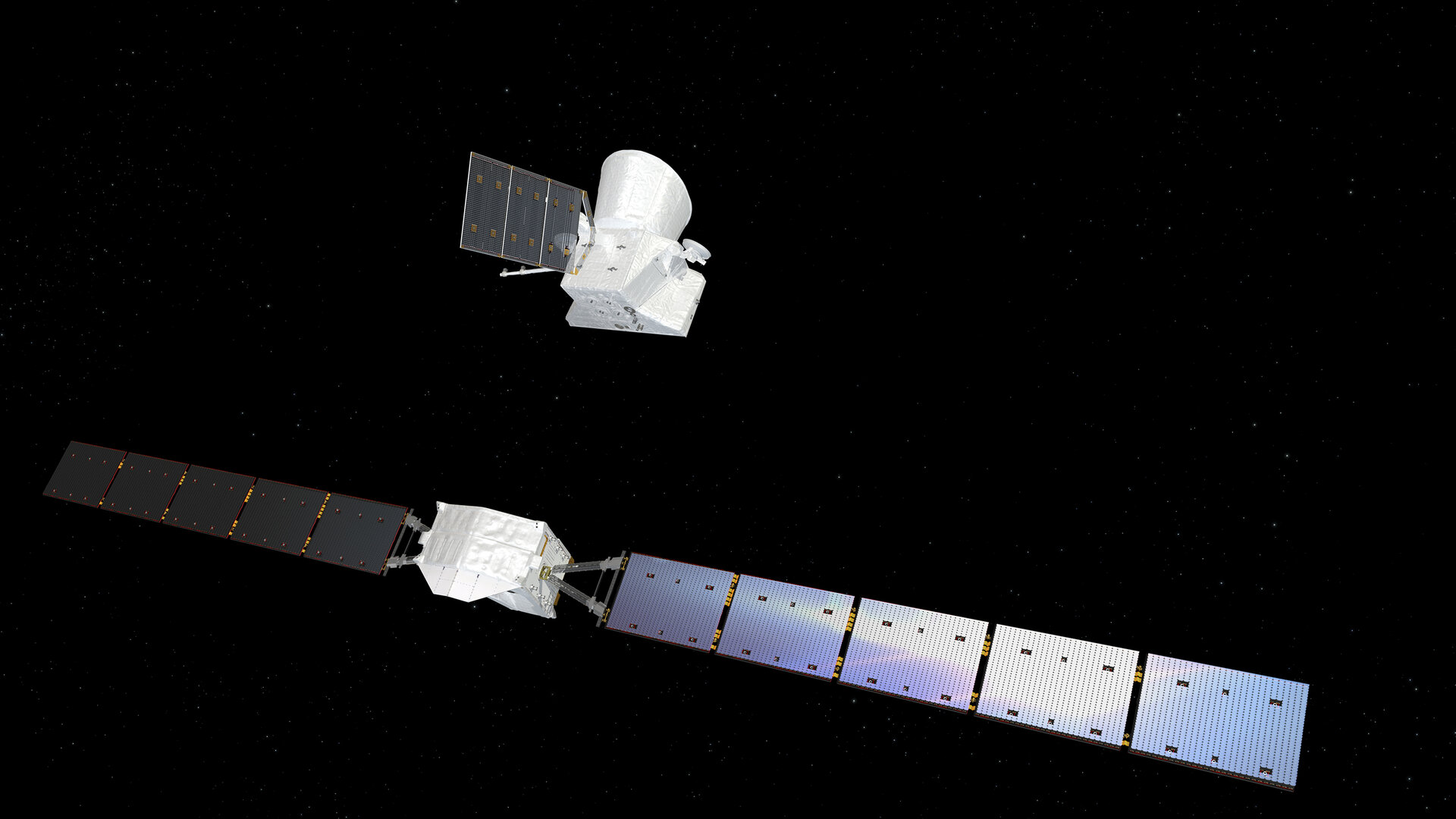
ESA’s arrival updates set out a staged sequence. The Mercury Transfer Module separated on September 3. The still-connected European and Japanese orbiters are to be captured together, separate on December 9–10, and begin the science phase in April 2027. Those dates describe the current plan; each operational step still needs confirmation.
Readiness is more than reaching the planet
ESA’s October 6 update describes September 15 instrument tests after the transfer module’s departure. BELA, the laser altimeter, fired more than 700,000 pulses during a 21.5-hour test. MERTIS tested its now-unobstructed planet-viewing port alongside its calibration port. The SIMBIO-SYS camera system activated all three optical channels. The initial assessments were encouraging, but these were readiness tests, not the completed Mercury survey.
Two orbiters, different jobs
NASA’s mission overview explains the complementary design: ESA’s Mercury Planetary Orbiter will study the surface and interior, while JAXA’s Mio focuses on Mercury’s magnetic environment. Two vantage points let the mission investigate the planet and its surroundings together rather than asking one orbit to serve every measurement.
The spacecraft launched on October 20, 2018. Their long approach is not evidence of inactivity: the journey has included planetary gravity-assist encounters and observations during Mercury flybys. But brief passes and sustained orbital measurements answer different questions. Orbiting permits repeated coverage and the systematic measurement program for which the spacecraft were built.
Mercury is not wholly unexplored. Mariner 10 made three flybys in 1974–1975, and MESSENGER orbited from 2011 to 2015, revealing surface composition, geology, magnetic-field properties and polar water-ice deposits. BepiColombo extends that record with a coordinated European-Japanese observatory.
What to watch next
The immediate question is operational: has the planned capture succeeded? After that come separation, orbital adjustments and commissioning. Healthy instrument tests are reason for confidence, but they do not make later milestones automatic. Keeping those stages separate will make the arrival coverage easier to follow, and keep a scheduled achievement from becoming a premature headline.
Featured image: artist’s impression of transfer-module separation, created in 2018; not a photograph of the 2026 event. ESA/ATG medialab, ESA Standard Licence.
Leave a Reply