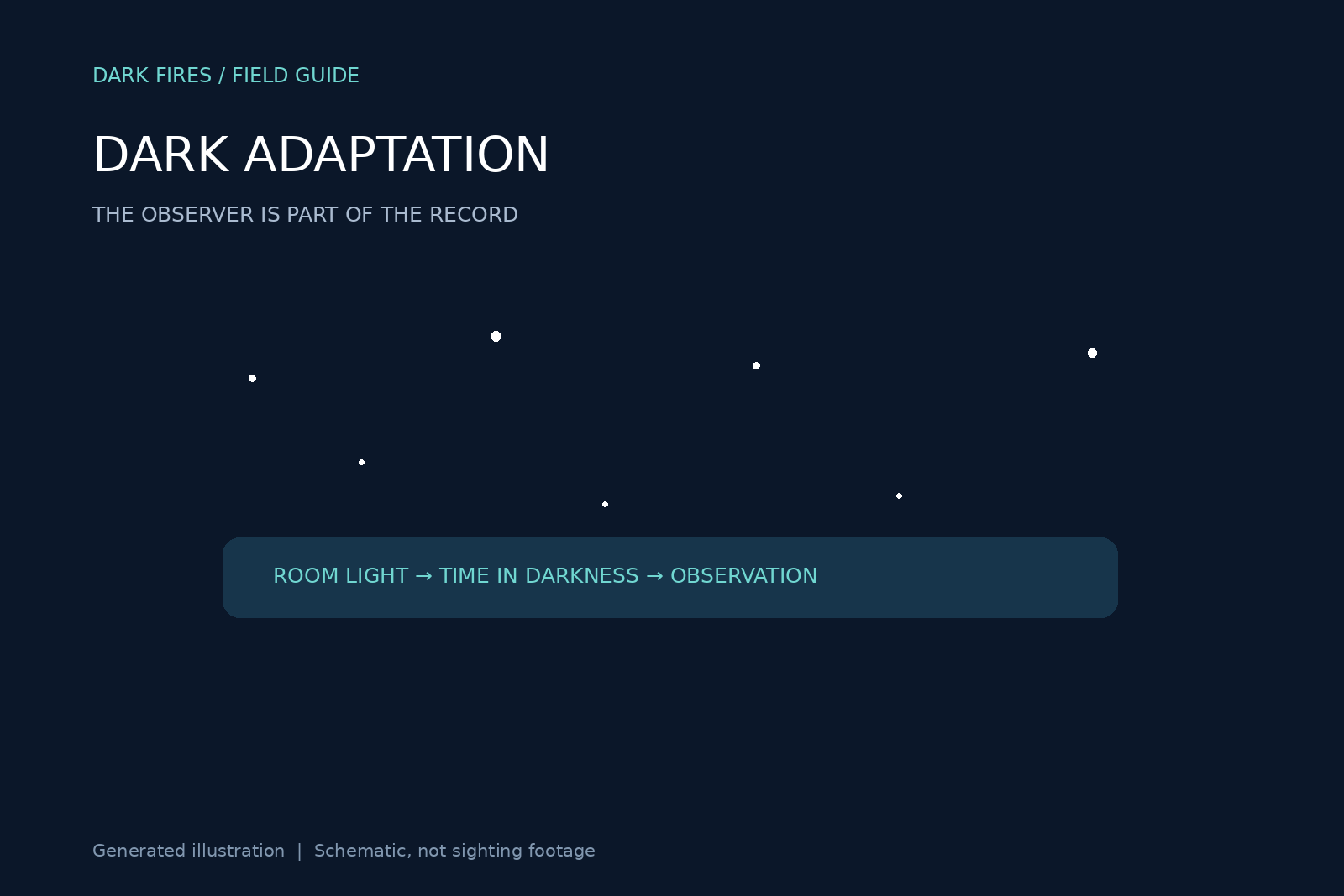
A night-sky report often begins when a light is first noticed. For evidence review, the preceding minutes can be just as important. Someone who has been outdoors in darkness and someone who has just left a brightly lit room are not necessarily observing with the same sensitivity to faint light.
Visibility changes without the sky changing
The FAA’s Aeronautical Information Manual, section 8-1-6, describes dark adaptation as increasing sensitivity in darkness. Its guidance allows at least 30 minutes in total darkness for complete adaptation and notes that bright light can rapidly impair it. The same section explains that illumination and scanning technique affect what an observer can see.
That does not make a witness unreliable. It means the observer’s recent lighting conditions are part of the observation. A newly visible faint point could reflect a change in the object, the atmosphere, attention or visual sensitivity. The first appearance in testimony alone does not choose among those explanations.
Ask about the minutes before, not just the object
For UAP documentation, we suggest a short, neutral sequence of questions: Had the observer recently come outdoors? Were porch lights, headlights or interior lights nearby? Was a phone screen or flashlight used immediately before the light disappeared or returned? Did the observer look continuously or alternate between the sky and a display?
Record the answers without coaching. “Looked down at phone, then could not relocate the point” is useful detail. Rewriting it as either “the object vanished instantly” or “the phone caused the disappearance” goes beyond what was established. Preserve the observed sequence and keep proposed explanations separate.
Two people are not two identical detectors
If one person saw a faint light and another did not, compare their positions, obstructions and recent lighting exposure before treating the disagreement as a contradiction. A witness who joined later may also have looked at a different patch of sky. These possibilities are worth checking, not reasons to disregard testimony.
Camera footage supplies another record but does not reproduce the eye’s adaptation state. A phone may change exposure while its user looks away; the resulting clip and the person’s account should be analyzed on their own terms before being combined.
The practical takeaway is modest: add a lighting-history field to a nighttime report. This does not diagnose a witness or resolve a sighting by itself. It gives later reviewers a way to test whether an apparent onset, disappearance or disagreement might involve the observer’s conditions as well as the external scene. A case with that context is more useful than one with confident conclusions and missing circumstances.
Featured image: original Dark Fires schematic. Generated illustration; not an observation or sighting photograph.
Leave a Reply