Euclid’s November 12, 2026 data release is a change in scale, not a declaration that dark matter or dark energy has been solved. DR1-Foundation makes a vast new observing record available for scientists to test: images, catalogues and spectra that can support many investigations beyond the striking pictures.
ESA’s release announcement describes roughly 13 months of observations, including more than 900 million galaxies and spectra for over 160 million sources. The Wide Survey coverage is about 1,900 square degrees. Among the catalogues are around 15,000 strong-gravitational-lens candidates and more than 60 million quasar candidates.
Why the word candidate matters
Candidate lists are starting points for analysis, not a promise that every entry will survive follow-up scrutiny. Strong lenses are systems in which foreground mass distorts the light of a background galaxy. A much larger, consistently collected sample can let astronomers study populations rather than isolated curiosities. It is still necessary to separate genuine systems from lookalikes and understand how the search selected them.
Foundation first, complete release later
The IPAC archive record for the Wide Survey galaxy-candidate redshift catalogue confirms that DR1 is being released in two stages. Foundation was released November 12; the complete release is expected in mid-2027 and will add higher-level products for galaxy clustering and weak-lensing studies. IPAC also notes that DR1 supersedes the earlier Q1 release and includes observations of deep and calibration fields alongside the wide survey.
That distinction is useful when judging announcements. Access to measurements is one milestone. Deriving robust distances, testing calibration, checking selection effects and comparing the resulting maps with cosmological models are further steps. A large catalogue gives those analyses statistical power; size alone does not settle the interpretation.
A picture inside the larger survey
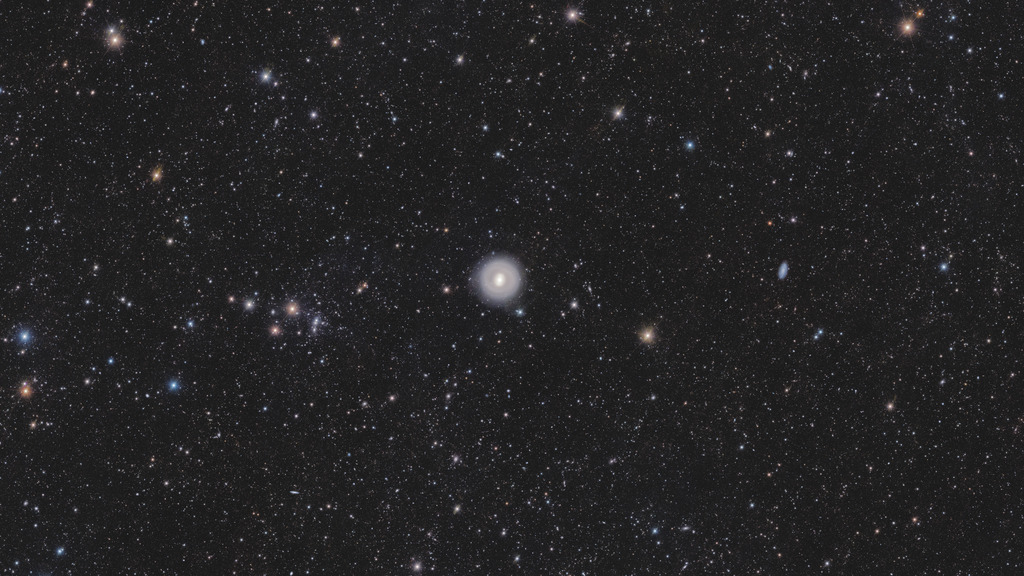
The featured Euclid view of NGC 1291 illustrates the survey’s breadth. Released with this batch, it covers about 14 square degrees and took roughly a day and a half to acquire. The conspicuous nearby ring galaxy sits amid numerous smaller background objects: the visually dominant target is only part of the scientific content.
The immediate opportunity is therefore concrete: researchers can work with the new archive now. Claims that this release has already delivered the final three-dimensional cosmic map, or identified the nature of dark energy, would go beyond what was announced.
Featured image: NGC 1291 field from Euclid DR1-Foundation. ESA/Euclid/Euclid Consortium/NASA; image processing J.-C. Cuillandre and E. Bertin. CC BY-SA 3.0 IGO. Observational image, not generated artwork.
Leave a Reply