An automated sky survey cannot be judged only by the objects it flags. It must also measure how often ordinary, independently known objects pass through without becoming usable detections.
A Galileo Project commissioning study published January 28, 2025, offers a concrete example. Its eight-camera infrared array used aircraft position broadcasts to help benchmark performance during five months of operation.
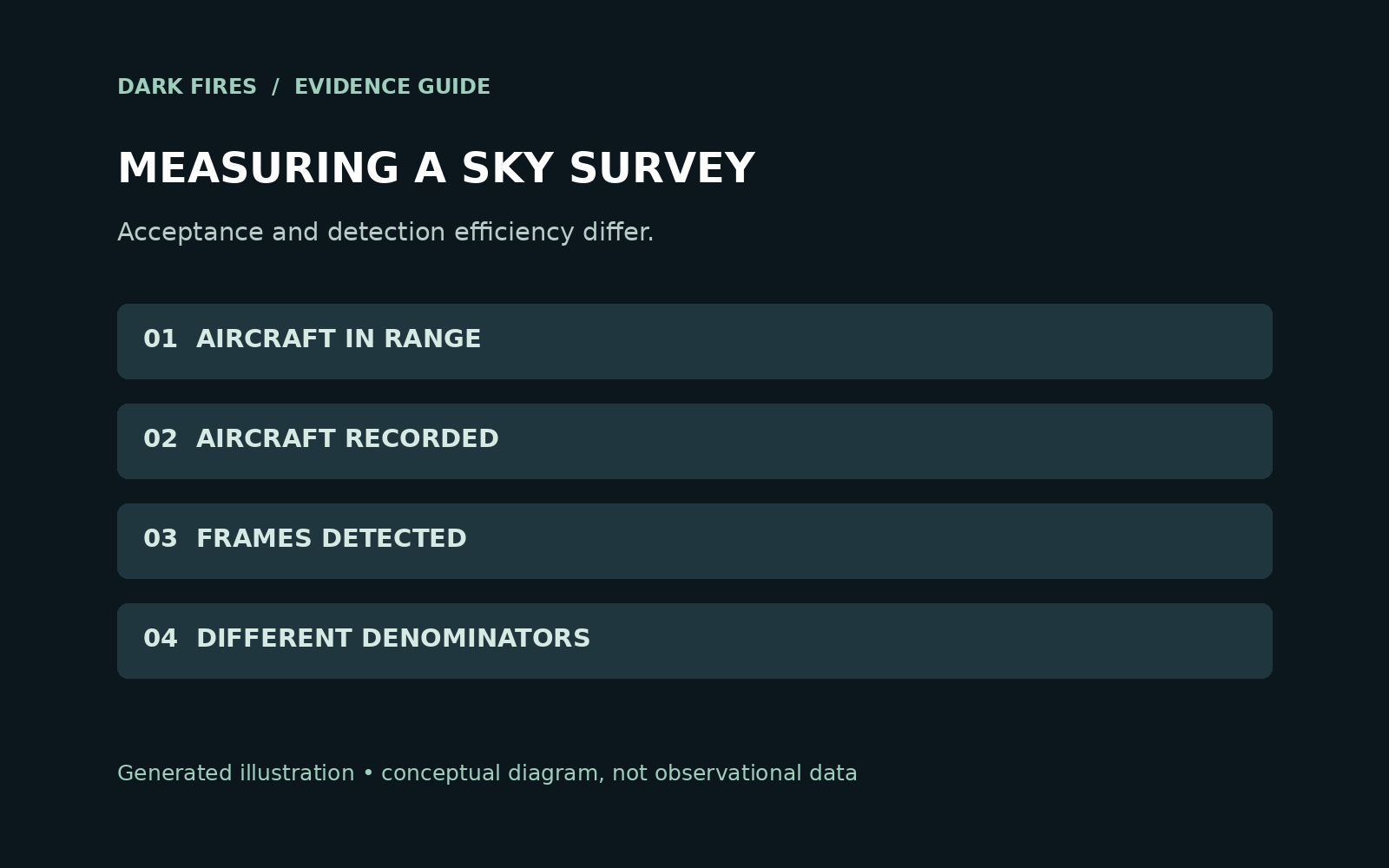
The researchers reported 41 percent acceptance for ADS-B-equipped aircraft: the fraction of in-range aircraft within an effective camera field of view that were recorded. Separately, mean frame-by-frame aircraft detection efficiency was 36 percent: the fraction of recorded aircraft in individual frames successfully detected by the processing system. These percentages describe different stages and different denominators. They are not interchangeable measures of accuracy.
Weather, distance and aircraft size affected detection efficiency. Consequently, an apparent absence in a survey can reflect observing conditions or processing limitations rather than an empty sky.
The lesson for UAP research is to publish the detection pipeline’s limitations alongside its unusual results. Ask what was observable, what was recorded and what the software recognized. An anomaly count without those distinctions is difficult to interpret.
This commissioning result characterizes a particular instrument and period. It does not establish the performance of every sky survey or identify an extraterrestrial object.
Primary source: Commissioning an All-Sky Infrared Camera Array for Detection of Airborne Objects.
Generated illustration
Original Dark Fires conceptual diagram, not observational data or a reconstruction of a sighting.
Leave a Reply