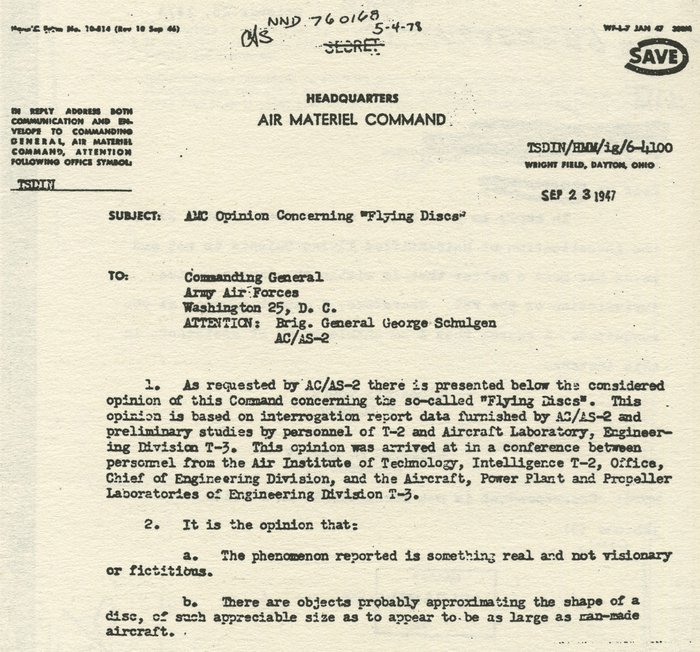
Image: Cropped detail of the first page of the 23 September 1947 Twining memorandum. The full letter includes qualifications and a recommendation for further study. Credit: U.S. Air Force, via Wikimedia Commons. Public domain, U.S. federal government work Full first-page scan and image source.

On 23 September 1947, Lieutenant General Nathan F. Twining signed an Air Materiel Command assessment of reported flying discs. Its best-known sentence described the reported phenomenon as “something real and not visionary or fictitious.” Reading that sentence alone, however, removes the document’s uncertainty and its practical purpose.
What kind of record is this?
The memorandum was addressed to Army Air Forces headquarters, for the attention of Brigadier General George Schulgen. It presented a command opinion based on interrogation reports and preliminary technical work. It summarized reported appearances and performance, considered natural phenomena, and raised both domestic and foreign technological possibilities. Crucially, it acknowledged a lack of recovered physical exhibits that would conclusively establish the objects’ existence. Its recommendation was a dedicated study with information shared among relevant scientific and military bodies. Read the memorandum reproduced as Appendix R of the government-sponsored Colorado study.
This is therefore an assessment of a reporting problem. It is not a laboratory report on recovered material, a description of an inspected vehicle, or a statement that its origin had been established. Those are different documentary categories, and substituting one for another changes what the evidence says.
The importance of conditional language
The letter repeatedly works with possibilities and estimates. That does not make it meaningless. An intelligence organization may reasonably recommend investigation before it has a complete explanation. Indeed, the threshold for deciding that reports deserve attention should be lower than the threshold for declaring a revolutionary discovery.
The reverse mistake is also possible: treating every expression of uncertainty as proof that the authors had dismissed the reports. The recommendation to establish a more organized inquiry is plainly incompatible with simple indifference. The document shows that officers regarded the subject as worth technical attention, while remaining short of a demonstrated explanation.
How to test a claim about the memo
A useful reading method is to ask three questions. Is a passage reporting what witnesses described, offering an institutional judgment, or recommending future work? Does a later retelling retain the qualifying words? Finally, does the conclusion being advertised actually appear in the document?
For example, unusual reported maneuvering and a proven propulsion system are not equivalent propositions. Likewise, considering a secret domestic project does not demonstrate that such a project existed. Listing a foreign technological possibility does not identify a foreign manufacturer. Each stronger claim would require evidence beyond this letter.
The first-page scan is useful for checking the opening language against later quotations, but the remaining pages are essential to understanding the argument. A cropped sentence should never stand in for the complete recommendation.
Twining’s memorandum remains important because it captures an early official attempt to turn uncertain aerial reports into a researchable problem. Its historical value does not depend on converting that uncertainty into a conclusion the authors had not reached. The strongest reading is also the most restrained: investigate systematically, compare possibilities, and recognize the missing physical evidence.
Leave a Reply